

136
4 How to Determine Wave Parameters
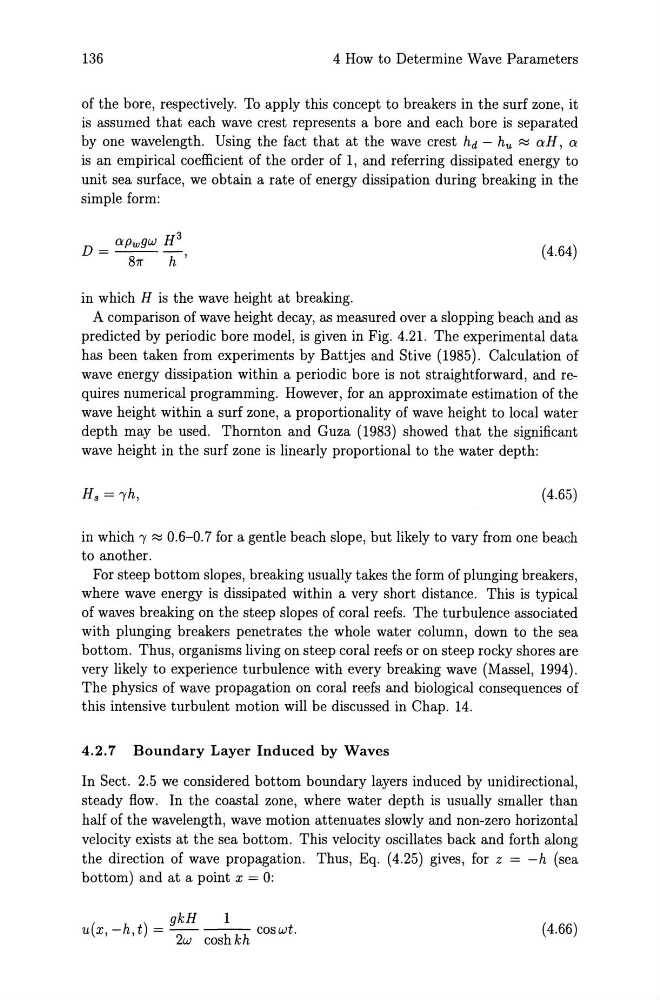
of the bore, respectively. To apply this concept to breakers in the surf zone, it
is assumed that each wave crest represents a bore and each bore is separated
by one wavelength. Using the fact that at the wave crest hd - hu ;:::: aH, a
is an empirical coefficient of the order of 1, and referring dissipated energy to
unit sea surface, we obtain a rate of energy dissipation during breaking in the
simple form:
(4.64)
in which H is the wave height at breaking.
A comparison of wave height decay, as measured over a slopping beach and as
predicted by periodic bore model, is given in Fig. 4.21. The experimental data
has been taken from experiments by Battjes and Stive (1985). Calculation of
wave energy dissipation within a periodic bore is not straightforward, and requires numerical programming. However, for an approximate estimation of the
wave height within a surf zone, a proportionality of wave height to local water
depth may be used. Thornton and Guza (1983) showed that the significant
wave height in the surf zone is linearly proportional to the water depth:
Hs = ')'h,
(4.65)
in which,), ;:::: 0.6-0.7 for a gentle beach slope, but likely to vary from one beach
to another.
For steep bottom slopes, breaking usually takes the form of plunging breakers,
where wave energy is dissipated within a very short distance. This is typical
of waves breaking on the steep slopes of coral reefs. The turbulence associated
with plunging breakers penetrates the whole water column, down to the sea
bottom. Thus, organisms living on steep coral reefs or on steep rocky shores are
very likely to experience turbulence with every breaking wave (Massel, 1994).
The physics of wave propagation on coral reefs and biological consequences of
this intensive turbulent motion will be discussed in Chap. 14.
4.2.7 Boundary Layer Induced by Waves
In Sect. 2.5 we considered bottom boundary layers induced by unidirectional,
steady flow. In the coastal zone, where water depth is usually smaller than
half of the wavelength, wave motion attenuates slowly and non-zero horizontal
velocity exists at the sea bottom. This velocity oscillates back and forth along
the direction of wave propagation. Thus, Eq. (4.25) gives, for z = -h (sea
bottom) and at a point x = 0:
gkH
1
u(x,-h,t)= 2w coshkhcoswt.
( 4.66)
4 How to Determine Wave Parameters
of the bore, respectively. To apply this concept to breakers in the surf zone, it
is assumed that each wave crest represents a bore and each bore is separated
by one wavelength. Using the fact that at the wave crest hd - hu ;:::: aH, a
is an empirical coefficient of the order of 1, and referring dissipated energy to
unit sea surface, we obtain a rate of energy dissipation during breaking in the
simple form:
(4.64)
in which H is the wave height at breaking.
A comparison of wave height decay, as measured over a slopping beach and as
predicted by periodic bore model, is given in Fig. 4.21. The experimental data
has been taken from experiments by Battjes and Stive (1985). Calculation of
wave energy dissipation within a periodic bore is not straightforward, and requires numerical programming. However, for an approximate estimation of the
wave height within a surf zone, a proportionality of wave height to local water
depth may be used. Thornton and Guza (1983) showed that the significant
wave height in the surf zone is linearly proportional to the water depth:
Hs = ')'h,
(4.65)
in which,), ;:::: 0.6-0.7 for a gentle beach slope, but likely to vary from one beach
to another.
For steep bottom slopes, breaking usually takes the form of plunging breakers,
where wave energy is dissipated within a very short distance. This is typical
of waves breaking on the steep slopes of coral reefs. The turbulence associated
with plunging breakers penetrates the whole water column, down to the sea
bottom. Thus, organisms living on steep coral reefs or on steep rocky shores are
very likely to experience turbulence with every breaking wave (Massel, 1994).
The physics of wave propagation on coral reefs and biological consequences of
this intensive turbulent motion will be discussed in Chap. 14.
4.2.7 Boundary Layer Induced by Waves
In Sect. 2.5 we considered bottom boundary layers induced by unidirectional,
steady flow. In the coastal zone, where water depth is usually smaller than
half of the wavelength, wave motion attenuates slowly and non-zero horizontal
velocity exists at the sea bottom. This velocity oscillates back and forth along
the direction of wave propagation. Thus, Eq. (4.25) gives, for z = -h (sea
bottom) and at a point x = 0:
gkH
1
u(x,-h,t)= 2w coshkhcoswt.
( 4.66)