

134
4 How to Determine Wave Parameters
a
b
SWL
h
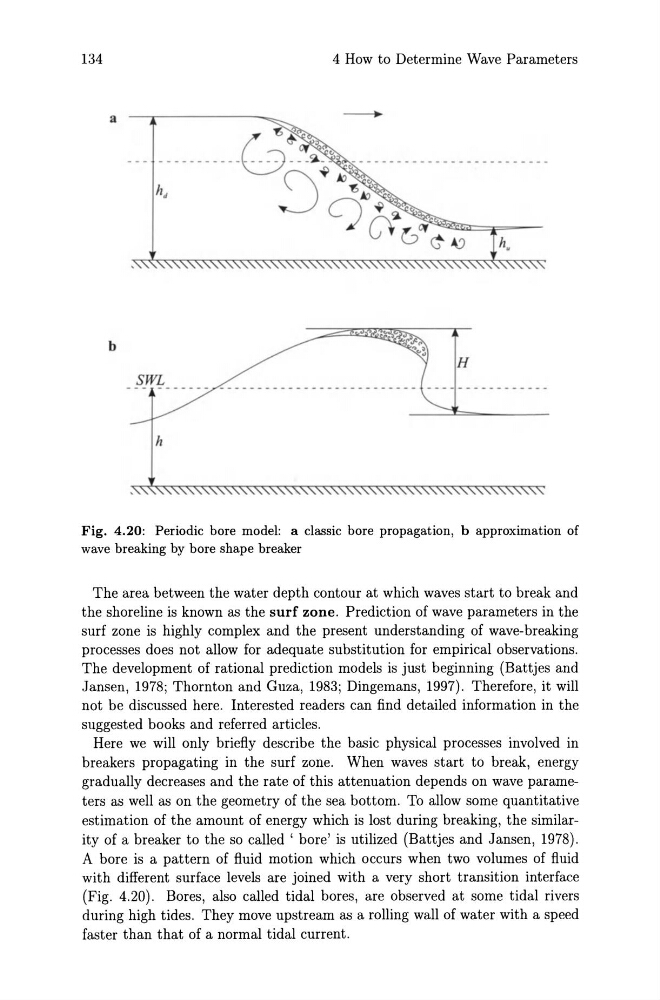
Fig. 4.20: Periodic bore model: a classic bore propagation, b approximation of
wave breaking by bore shape breaker
The area between the water depth contour at which waves start to break and
the shoreline is known as the surf zone. Prediction of wave parameters in the
surf zone is highly complex and the present understanding of wave-breaking
processes does not allow for adequate substitution for empirical observations.
The development of rational prediction models is just beginning (Battjes and
Jansen, 1978; Thornton and Guza, 1983; Dingemans, 1997) . Therefore, it will
not be discussed here. Interested readers can find detailed information in the
suggested books and referred articles.
Here we will only briefly describe the basic physical processes involved in
breakers propagating in the surf zone. When waves start to break, energy
gradually decreases and the rate of this attenuation depends on wave parameters as well as on the geometry of the sea bottom. To allow some quantitative
estimation of the amount of energy which is lost during breaking, the similarity of a breaker to the so called ' bore' is utilized (Battjes and Jansen, 1978).
A bore is a pattern of fluid motion which occurs when two volumes of fluid
with different surface levels are joined with a very short transition interface
(Fig. 4.20). Bores, also called tidal bores, are observed at some tidal rivers
during high tides. They move upstream as a rolling wall of water with a speed
faster than that of a normal tidal current.
4 How to Determine Wave Parameters
a
b
SWL
h
Fig. 4.20: Periodic bore model: a classic bore propagation, b approximation of
wave breaking by bore shape breaker
The area between the water depth contour at which waves start to break and
the shoreline is known as the surf zone. Prediction of wave parameters in the
surf zone is highly complex and the present understanding of wave-breaking
processes does not allow for adequate substitution for empirical observations.
The development of rational prediction models is just beginning (Battjes and
Jansen, 1978; Thornton and Guza, 1983; Dingemans, 1997) . Therefore, it will
not be discussed here. Interested readers can find detailed information in the
suggested books and referred articles.
Here we will only briefly describe the basic physical processes involved in
breakers propagating in the surf zone. When waves start to break, energy
gradually decreases and the rate of this attenuation depends on wave parameters as well as on the geometry of the sea bottom. To allow some quantitative
estimation of the amount of energy which is lost during breaking, the similarity of a breaker to the so called ' bore' is utilized (Battjes and Jansen, 1978).
A bore is a pattern of fluid motion which occurs when two volumes of fluid
with different surface levels are joined with a very short transition interface
(Fig. 4.20). Bores, also called tidal bores, are observed at some tidal rivers
during high tides. They move upstream as a rolling wall of water with a speed
faster than that of a normal tidal current.