

4.2 Wave Parameters Based on Small Amplitude Wave Theory
133
-s 0.9
c..
.g
~ 0.8
~
'v ::r: 0.7
0.6
0.5
0.4
0.3
0.2
0.1
0.0
limiting wave
height
highest solitary wave Hih = 0.833
demarcation line (see Eq. 4.40)
cnoidal waves
Stokes' waves
10
100
Log]O (wavelength/depth)
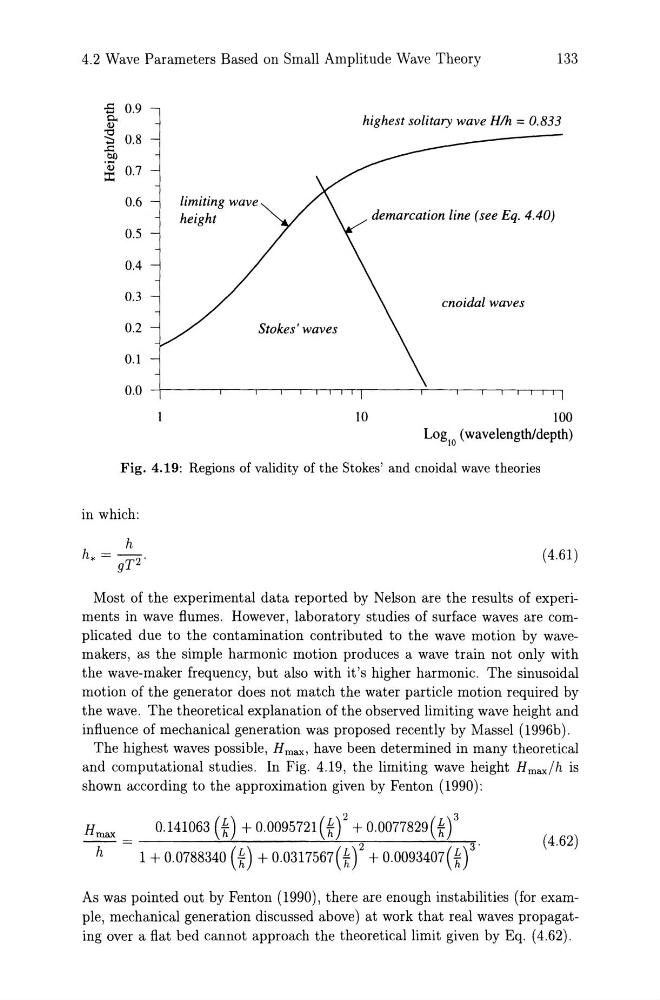
Fig. 4.19: Regions of validity of the Stokes' and cnoidal wave theories
in which:
h
h. = - 2 '
gT
(4.61)
Most of the experimental data reported by Nelson are the results of experiments in wave flumes. However, laboratory studies of surface waves are complicated due to the contamination contributed to the wave motion by wavemakers, as the simple harmonic motion produces a wave train not only with
the wave-maker frequency, but also with it's higher harmonic. The sinusoidal
motion of the generator does not match the water particle motion required by
the wave. The theoretical explanation of the observed limiting wave height and
influence of mechanical generation was proposed recently by Massel (1996b).
The highest waves possible, H max , have been determined in many theoretical
and computational studies. In Fig. 4.19, the limiting wave height Hmax/h is
shown according to the approximation given by Fenton (1990):
Hmax
h
( 4.62)
1 + 0.0788340 UO + 0.0317567(f)2 + 0.0093407(ff·
As was pointed out by Fenton (1990), there are enough instabilities (for example, mechanical generation discussed above) at work that real waves propagating over a flat bed cannot approach the theoretical limit given by Eq. (4.62).
133
-s 0.9
c..
.g
~ 0.8
~
'v ::r: 0.7
0.6
0.5
0.4
0.3
0.2
0.1
0.0
limiting wave
height
highest solitary wave Hih = 0.833
demarcation line (see Eq. 4.40)
cnoidal waves
Stokes' waves
10
100
Log]O (wavelength/depth)
Fig. 4.19: Regions of validity of the Stokes' and cnoidal wave theories
in which:
h
h. = - 2 '
gT
(4.61)
Most of the experimental data reported by Nelson are the results of experiments in wave flumes. However, laboratory studies of surface waves are complicated due to the contamination contributed to the wave motion by wavemakers, as the simple harmonic motion produces a wave train not only with
the wave-maker frequency, but also with it's higher harmonic. The sinusoidal
motion of the generator does not match the water particle motion required by
the wave. The theoretical explanation of the observed limiting wave height and
influence of mechanical generation was proposed recently by Massel (1996b).
The highest waves possible, H max , have been determined in many theoretical
and computational studies. In Fig. 4.19, the limiting wave height Hmax/h is
shown according to the approximation given by Fenton (1990):
Hmax
h
( 4.62)
1 + 0.0788340 UO + 0.0317567(f)2 + 0.0093407(ff·
As was pointed out by Fenton (1990), there are enough instabilities (for example, mechanical generation discussed above) at work that real waves propagating over a flat bed cannot approach the theoretical limit given by Eq. (4.62).