

4.2 Wave Parameters Based on Small Amplitude Wave Theory
127
shoreline
h2
~--~ __ ------------------------------~~----C&
h I
wave crest
-L---4~--------~~~~~----------~~-----Cgl
wave
ray
t
wave
ray
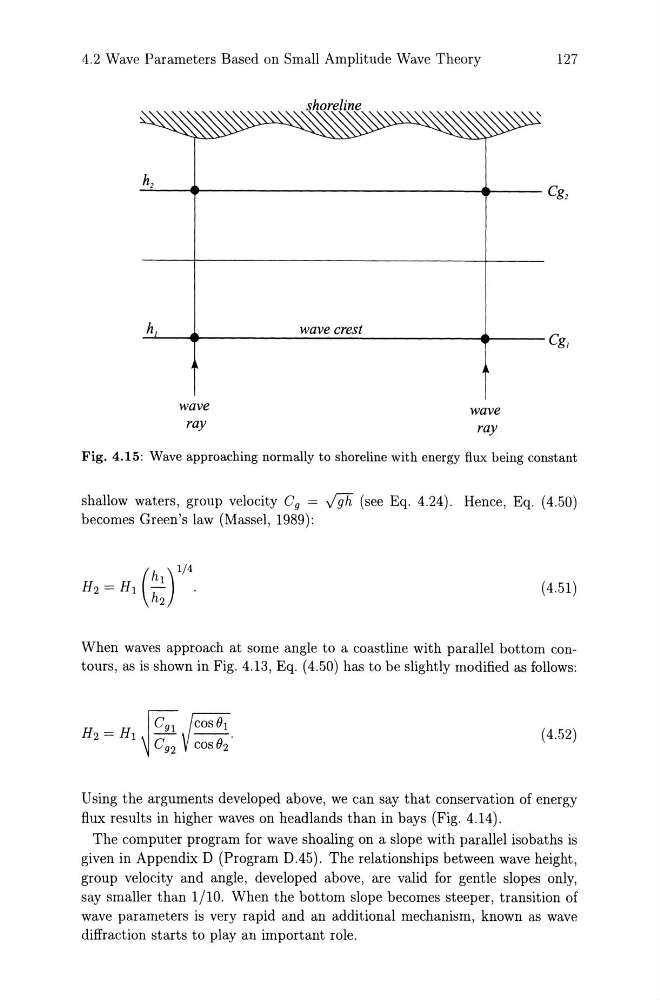
Fig. 4.15: Wave approaching normally to shoreline with energy flux being constant
shallow waters, group velocity Cg = y'gFi (see Eq. 4.24). Hence, Eq. (4.50)
becomes Green's law (Massel, 1989):
(4.51)
When waves approach at some angle to a coastline with parallel bottom contours, as is shown in Fig. 4.13, Eq. (4.50) has to be slightly modified as follows:
( 4.52)
Using the arguments developed above, we can say that conservation of energy
flux results in higher waves on headlands than in bays (Fig. 4.14).
The computer program for wave shoaling on a slope with parallel isobaths is
given in Appendix D (Program D.45). The relationships between wave height,
group velocity and angle, developed above, are valid for gentle slopes only,
say smaller than 1/10. When the bottom slope becomes steeper, transition of
wave parameters is very rapid and an additional mechanism, known as wave
diffraction starts to play an important role.
127
shoreline
h2
~--~ __ ------------------------------~~----C&
h I
wave crest
-L---4~--------~~~~~----------~~-----Cgl
wave
ray
t
wave
ray
Fig. 4.15: Wave approaching normally to shoreline with energy flux being constant
shallow waters, group velocity Cg = y'gFi (see Eq. 4.24). Hence, Eq. (4.50)
becomes Green's law (Massel, 1989):
(4.51)
When waves approach at some angle to a coastline with parallel bottom contours, as is shown in Fig. 4.13, Eq. (4.50) has to be slightly modified as follows:
( 4.52)
Using the arguments developed above, we can say that conservation of energy
flux results in higher waves on headlands than in bays (Fig. 4.14).
The computer program for wave shoaling on a slope with parallel isobaths is
given in Appendix D (Program D.45). The relationships between wave height,
group velocity and angle, developed above, are valid for gentle slopes only,
say smaller than 1/10. When the bottom slope becomes steeper, transition of
wave parameters is very rapid and an additional mechanism, known as wave
diffraction starts to play an important role.