

126
4 How to Determine Wave Parameters
a
b
contours
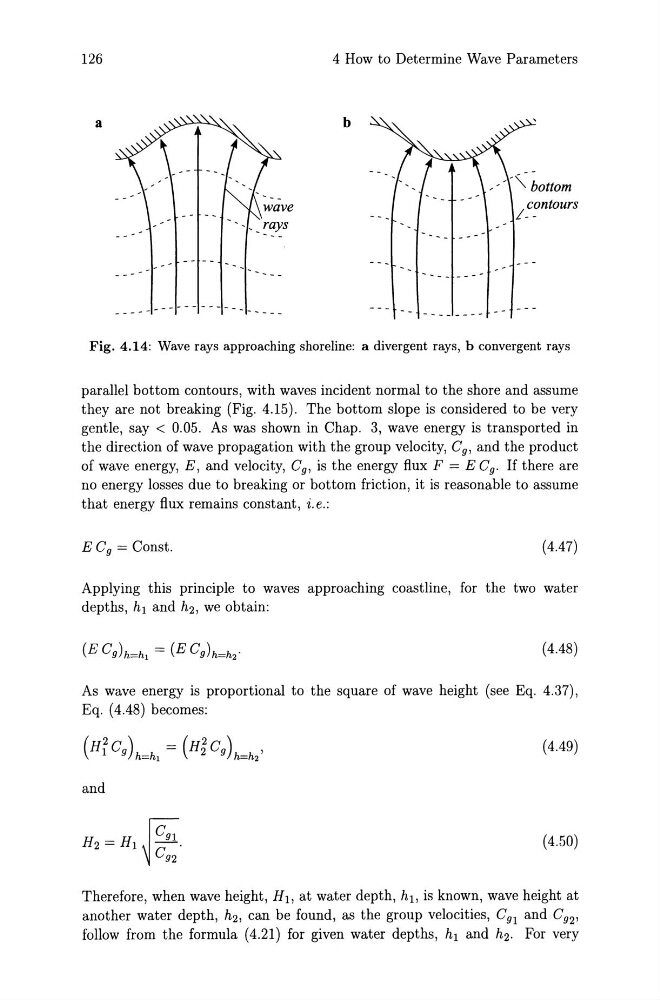
1-Fig. 4.14: Wave rays approaching shoreline: a divergent rays, b convergent rays
parallel bottom contours, with waves incident normal to the shore and assume
they are not breaking (Fig. 4.15). The bottom slope is considered to be very
gentle, say < 0.05. As was shown in Chap. 3, wave energy is transported in
the direction of wave propagation with the group velocity, C 9 , and the product
of wave energy, E, and velocity, C 9 , is the energy flux F = E Cg• If there are
no energy losses due to breaking or bottom friction, it is reasonable to assume
that energy flux remains constant, i.e.:
E Cg = Const.
( 4.47)
Applying this principle to waves approaching coastline, for the two water
depths, hI and h2' we obtain:
( 4.48)
As wave energy is proportional to the square of wave height (see Eq. 4.37),
Eq. (4.48) becomes:
( 4.49)
and
(4.50)
Therefore, when wave height, HI, at water depth, hI, is known, wave height at
another water depth, h2' can be found, as the group velocities, C 91 and C 92 ,
follow from the formula (4.21) for given water depths, hI and h 2. For very
4 How to Determine Wave Parameters
a
b
contours
1-Fig. 4.14: Wave rays approaching shoreline: a divergent rays, b convergent rays
parallel bottom contours, with waves incident normal to the shore and assume
they are not breaking (Fig. 4.15). The bottom slope is considered to be very
gentle, say < 0.05. As was shown in Chap. 3, wave energy is transported in
the direction of wave propagation with the group velocity, C 9 , and the product
of wave energy, E, and velocity, C 9 , is the energy flux F = E Cg• If there are
no energy losses due to breaking or bottom friction, it is reasonable to assume
that energy flux remains constant, i.e.:
E Cg = Const.
( 4.47)
Applying this principle to waves approaching coastline, for the two water
depths, hI and h2' we obtain:
( 4.48)
As wave energy is proportional to the square of wave height (see Eq. 4.37),
Eq. (4.48) becomes:
( 4.49)
and
(4.50)
Therefore, when wave height, HI, at water depth, hI, is known, wave height at
another water depth, h2' can be found, as the group velocities, C 91 and C 92 ,
follow from the formula (4.21) for given water depths, hI and h 2. For very