

4.2 Wave Parameters Based on Small Amplitude Wave Theory
125
B'
h
wave crest
h
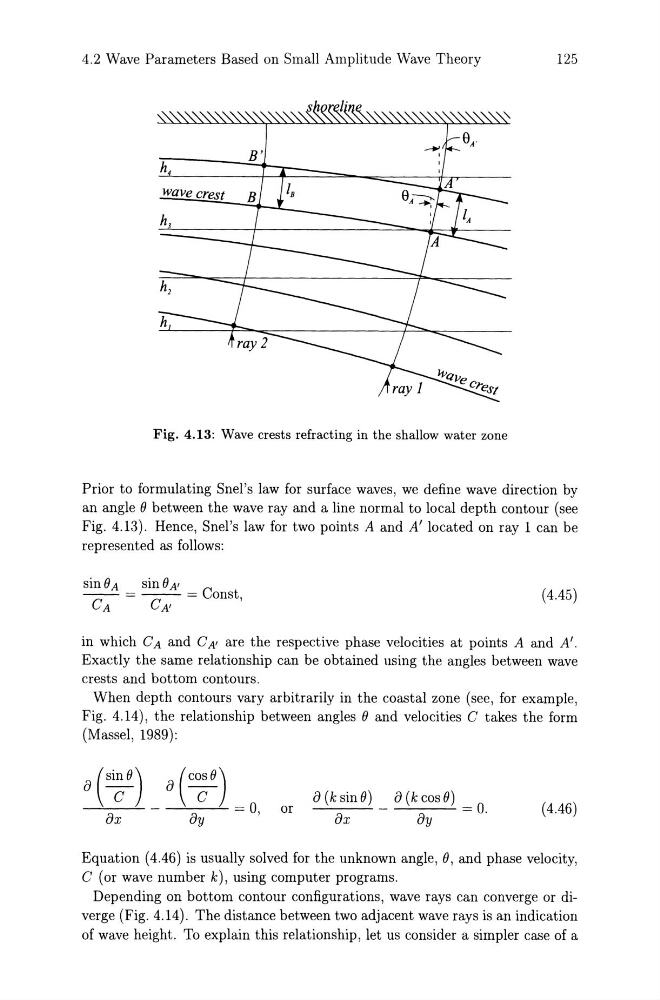
Fig. 4.13: Wave crests refracting in the shallow water zone
Prior to formulating Snel's law for surface waves, we define wave direction by
an angle () between the wave ray and a line normal to local depth contour (see
Fig. 4.13). Hence, Snel's law for two points A and A'located on ray 1 can be
represented as follows:
( 4.45)
in which CA and CA' are the respective phase velocities at points A and A'.
Exactly the same relationship can be obtained using the angles between wave
crests and bottom contours.
When depth contours vary arbitrarily in the coastal zone (see, for example,
Fig. 4.14), the relationship between angles () and velocities C takes the form
(Massel, 1989):
ox
oy
= 0, or
_0 -'-( k_si_n ()--' -) _ 0 (k cos ()) = O.
ox
oy
( 4.46)
Equation (4.46) is usually solved for the unknown angle, (), and phase velocity,
C (or wave number k), using computer programs.
Depending on bottom contour configurations, wave rays can converge or diverge (Fig. 4.14). The distance between two adjacent wave rays is an indication
of wave height. To explain this relationship, let us consider a simpler case of a
125
B'
h
wave crest
h
Fig. 4.13: Wave crests refracting in the shallow water zone
Prior to formulating Snel's law for surface waves, we define wave direction by
an angle () between the wave ray and a line normal to local depth contour (see
Fig. 4.13). Hence, Snel's law for two points A and A'located on ray 1 can be
represented as follows:
( 4.45)
in which CA and CA' are the respective phase velocities at points A and A'.
Exactly the same relationship can be obtained using the angles between wave
crests and bottom contours.
When depth contours vary arbitrarily in the coastal zone (see, for example,
Fig. 4.14), the relationship between angles () and velocities C takes the form
(Massel, 1989):
ox
oy
= 0, or
_0 -'-( k_si_n ()--' -) _ 0 (k cos ()) = O.
ox
oy
( 4.46)
Equation (4.46) is usually solved for the unknown angle, (), and phase velocity,
C (or wave number k), using computer programs.
Depending on bottom contour configurations, wave rays can converge or diverge (Fig. 4.14). The distance between two adjacent wave rays is an indication
of wave height. To explain this relationship, let us consider a simpler case of a