

128
4 How to Determine Wave Parameters
4.2.5 Wave Diffraction
In Chap. 2, it was illustrated that an object located in a flow generates some
disturbances to the flow in the vicinity of the object. Therefore, it is quite obvious that some disturbances will also be generated in the wave field. To explore
the nature of disturbances which have dimensions larger than the wavelength,
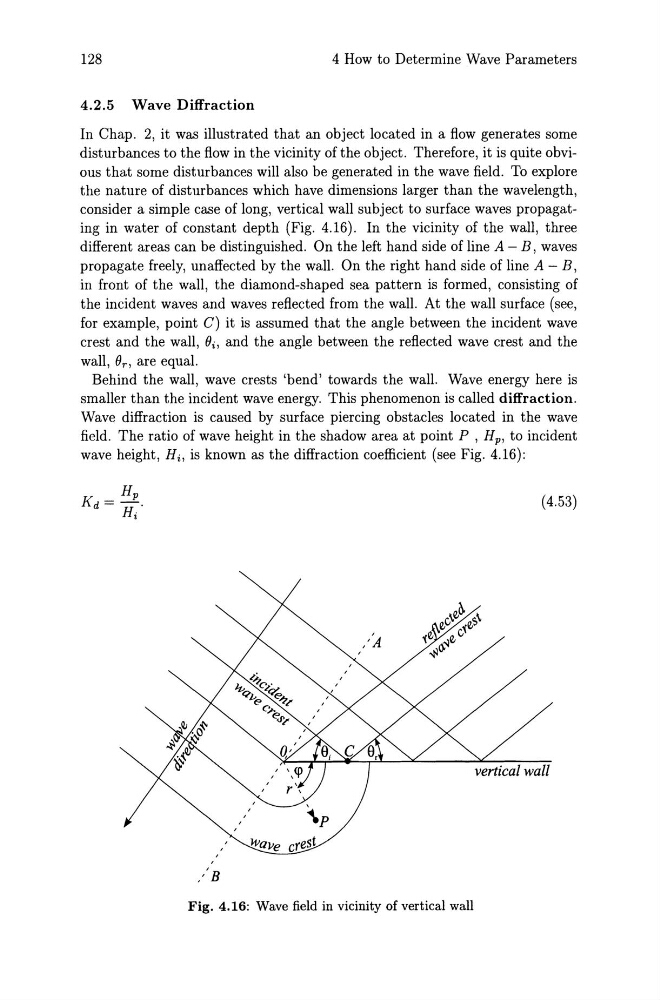
consider a simple case of long, vertical wall subject to surface waves propagating in water of constant depth (Fig. 4.16). In the vicinity of the wall, three
different areas can be distinguished. On the left hand side of line A - B, waves
propagate freely, unaffected by the wall. On the right hand side of line A - B,
in front of the wall, the diamond-shaped sea pattern is formed, consisting of
the incident waves and waves reflected from the wall. At the wall surface (see,
for example, point C) it is assumed that the angle between the incident wave
crest and the wall, Oi, and the angle between the reflected wave crest and the
wall, Or, are equal.
Behind the wall, wave crests 'bend' towards the wall. Wave energy here is
smaller than the incident wave energy. This phenomenon is called diffraction.
Wave diffraction is caused by surface piercing obstacles located in the wave
field. The ratio of wave height in the shadow area at point P , Hp , to incident
wave height, Hi, is known as the diffraction coefficient (see Fig. 4.16):
( 4.53)
Fig. 4.16: Wave field in vicinity of vertical wall
4 How to Determine Wave Parameters
4.2.5 Wave Diffraction
In Chap. 2, it was illustrated that an object located in a flow generates some
disturbances to the flow in the vicinity of the object. Therefore, it is quite obvious that some disturbances will also be generated in the wave field. To explore
the nature of disturbances which have dimensions larger than the wavelength,
consider a simple case of long, vertical wall subject to surface waves propagating in water of constant depth (Fig. 4.16). In the vicinity of the wall, three
different areas can be distinguished. On the left hand side of line A - B, waves
propagate freely, unaffected by the wall. On the right hand side of line A - B,
in front of the wall, the diamond-shaped sea pattern is formed, consisting of
the incident waves and waves reflected from the wall. At the wall surface (see,
for example, point C) it is assumed that the angle between the incident wave
crest and the wall, Oi, and the angle between the reflected wave crest and the
wall, Or, are equal.
Behind the wall, wave crests 'bend' towards the wall. Wave energy here is
smaller than the incident wave energy. This phenomenon is called diffraction.
Wave diffraction is caused by surface piercing obstacles located in the wave
field. The ratio of wave height in the shadow area at point P , Hp , to incident
wave height, Hi, is known as the diffraction coefficient (see Fig. 4.16):
( 4.53)
Fig. 4.16: Wave field in vicinity of vertical wall