

122
4 How to Determine Wave Parameters
---. 1.0
S
'-"
r::
0
0.8
Stokes' theory
.~
0.6
CIS
:>
Q)
Q) 0.4
small amplitude wave theory
Q)
()
0.2
~ ....
Li2
L
;:::I 0.0
(/)
-0.2
-0.4
-0.6
-0.8
0
5
10
15
20
25
30
35
40
x(m)
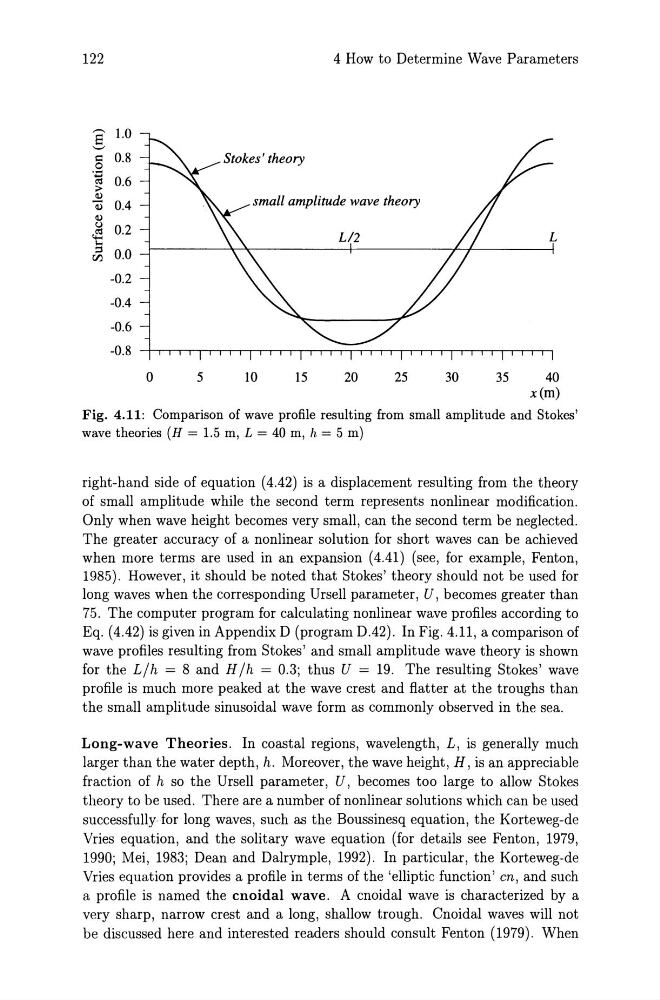
Fig. 4.11: Comparison of wave profile resulting from small amplitude and Stokes'
wave theories (H = 1.5 m, L = 40 m, h = 5 m)
right-hand side of equation (4.42) is a displacement resulting from the theory
of small amplitude while the second term represents nonlinear modification.
Only when wave height becomes very small, can the second term be neglected.
The greater accuracy of a nonlinear solution for short waves can be achieved
when more terms are used in an expansion (4.41) (see, for example, Fenton,
1985). However, it should be noted that Stokes' theory should not be used for
long waves when the corresponding U rsell parameter, U, becomes greater than
75. The computer program for calculating nonlinear wave profiles according to
Eq. (4.42) is given in Appendix D (program D.42). In Fig. 4.11, a comparison of
wave profiles resulting from Stokes' and small amplitude wave theory is shown
for the L/h = 8 and H /h = 0.3; thus U = 19. The resulting Stokes' wave
profile is much more peaked at the wave crest and flatter at the troughs than
the small amplitude sinusoidal wave form as commonly observed in the sea.
Long-wave Theories. In coastal regions, wavelength, L, is generally much
larger than the water depth, h. Moreover, the wave height, H, is an appreciable
fraction of h so the U rsell parameter, U, becomes too large to allow Stokes
theory to be used. There are a number of nonlinear solutions which can be used
successfully for long waves, such as the Boussinesq equation, the Korteweg-de
Vries equation, and the solitary wave equation (for details see Fenton, 1979,
1990; Mei, 1983; Dean and Dalrymple, 1992). In particular, the Korteweg-de
Vries equation provides a profile in terms of the 'elliptic function' en, and such
a profile is named the cnoidal wave. A cnoidal wave is characterized by a
very sharp, narrow crest and a long, shallow trough. Cnoidal waves will not
be discussed here and interested readers should consult Fenton (1979). When
4 How to Determine Wave Parameters
---. 1.0
S
'-"
r::
0
0.8
Stokes' theory
.~
0.6
CIS
:>
Q)
Q) 0.4
small amplitude wave theory
Q)
()
0.2
~ ....
Li2
L
;:::I 0.0
(/)
-0.2
-0.4
-0.6
-0.8
0
5
10
15
20
25
30
35
40
x(m)
Fig. 4.11: Comparison of wave profile resulting from small amplitude and Stokes'
wave theories (H = 1.5 m, L = 40 m, h = 5 m)
right-hand side of equation (4.42) is a displacement resulting from the theory
of small amplitude while the second term represents nonlinear modification.
Only when wave height becomes very small, can the second term be neglected.
The greater accuracy of a nonlinear solution for short waves can be achieved
when more terms are used in an expansion (4.41) (see, for example, Fenton,
1985). However, it should be noted that Stokes' theory should not be used for
long waves when the corresponding U rsell parameter, U, becomes greater than
75. The computer program for calculating nonlinear wave profiles according to
Eq. (4.42) is given in Appendix D (program D.42). In Fig. 4.11, a comparison of
wave profiles resulting from Stokes' and small amplitude wave theory is shown
for the L/h = 8 and H /h = 0.3; thus U = 19. The resulting Stokes' wave
profile is much more peaked at the wave crest and flatter at the troughs than
the small amplitude sinusoidal wave form as commonly observed in the sea.
Long-wave Theories. In coastal regions, wavelength, L, is generally much
larger than the water depth, h. Moreover, the wave height, H, is an appreciable
fraction of h so the U rsell parameter, U, becomes too large to allow Stokes
theory to be used. There are a number of nonlinear solutions which can be used
successfully for long waves, such as the Boussinesq equation, the Korteweg-de
Vries equation, and the solitary wave equation (for details see Fenton, 1979,
1990; Mei, 1983; Dean and Dalrymple, 1992). In particular, the Korteweg-de
Vries equation provides a profile in terms of the 'elliptic function' en, and such
a profile is named the cnoidal wave. A cnoidal wave is characterized by a
very sharp, narrow crest and a long, shallow trough. Cnoidal waves will not
be discussed here and interested readers should consult Fenton (1979). When