

4.2 Wave Parameters Based on Small Amplitude Wave Theory
121
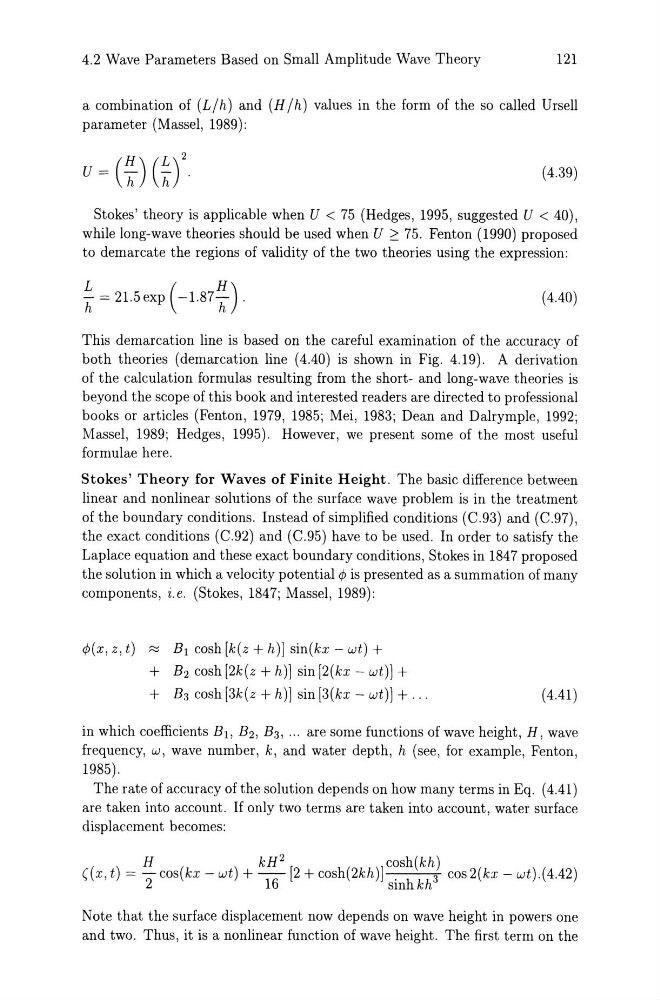
a combination of (L / h) and (H / h) values in the form of the so called U rsell
parameter (Massel, 1989):
(4.39)
Stokes' theory is applicable when U < 75 (Hedges, 1995, suggested U < 40),
while long-wave theories should be used when U :::: 75. Fenton (1990) proposed
to demarcate the regions of validity of the two theories using the expression:
(4.40)
This demarcation line is based on the careful examination of the accuracy of
both theories (demarcation line (4.40) is shown in Fig. 4.19). A derivation
of the calculation formulas resulting from the short- and long-wave theories is
beyond the scope of this book and interested readers are directed to professional
books or articles (Fenton, 1979, 1985; Mei, 1983; Dean and Dalrymple, 1992;
Massel, 1989; Hedges, 1995). However, we present some of the most useful
formulae here.
Stokes' Theory for Waves of Finite Height. The basic difference between
linear and nonlinear solutions of the surface wave problem is in the treatment
of the boundary conditions. Instead of simplified conditions (C.93) and (C.97),
the exact conditions (C.92) and (C.95) have to be used. In order to satisfy the
Laplace equation and these exact boundary conditions, Stokes in 1847 proposed
the solution in which a velocity potential ¢ is presented as a summation of many
components, i.e. (Stokes, 1847; Massel, 1989):
¢(x, z, t) ~ Bl cosh [k(z + h)] sin(kx - wt) +
+ B2 cosh [2k(z + h)] sin [2(kx - wt)] +
+ B3 cosh [3k(z + h)] sin [3(kx - wt)] + ...
(4.41 )
in which coefficients Bl, B 2, B3, ... are some functions of wave height, H, wave
frequency, w, wave number, k, and water depth, h (see, for example, Fenton,
1985).
The rate of accuracy of the solution depends on how many terms in Eq. (4.41)
are taken into account. If only two terms are taken into account, water surface
displacement becomes:
H
kH2
cosh(kh)
((x,t)=-cos(kx-wt)+-[2+cosh(2kh)].
3 cos2(kx-wt).(4.42)
2
16
smhkh
Note that the surface displacement now depends on wave height in powers one
and two. Thus, it is a nonlinear function of wave height. The first term on the
121
a combination of (L / h) and (H / h) values in the form of the so called U rsell
parameter (Massel, 1989):
(4.39)
Stokes' theory is applicable when U < 75 (Hedges, 1995, suggested U < 40),
while long-wave theories should be used when U :::: 75. Fenton (1990) proposed
to demarcate the regions of validity of the two theories using the expression:
(4.40)
This demarcation line is based on the careful examination of the accuracy of
both theories (demarcation line (4.40) is shown in Fig. 4.19). A derivation
of the calculation formulas resulting from the short- and long-wave theories is
beyond the scope of this book and interested readers are directed to professional
books or articles (Fenton, 1979, 1985; Mei, 1983; Dean and Dalrymple, 1992;
Massel, 1989; Hedges, 1995). However, we present some of the most useful
formulae here.
Stokes' Theory for Waves of Finite Height. The basic difference between
linear and nonlinear solutions of the surface wave problem is in the treatment
of the boundary conditions. Instead of simplified conditions (C.93) and (C.97),
the exact conditions (C.92) and (C.95) have to be used. In order to satisfy the
Laplace equation and these exact boundary conditions, Stokes in 1847 proposed
the solution in which a velocity potential ¢ is presented as a summation of many
components, i.e. (Stokes, 1847; Massel, 1989):
¢(x, z, t) ~ Bl cosh [k(z + h)] sin(kx - wt) +
+ B2 cosh [2k(z + h)] sin [2(kx - wt)] +
+ B3 cosh [3k(z + h)] sin [3(kx - wt)] + ...
(4.41 )
in which coefficients Bl, B 2, B3, ... are some functions of wave height, H, wave
frequency, w, wave number, k, and water depth, h (see, for example, Fenton,
1985).
The rate of accuracy of the solution depends on how many terms in Eq. (4.41)
are taken into account. If only two terms are taken into account, water surface
displacement becomes:
H
kH2
cosh(kh)
((x,t)=-cos(kx-wt)+-[2+cosh(2kh)].
3 cos2(kx-wt).(4.42)
2
16
smhkh
Note that the surface displacement now depends on wave height in powers one
and two. Thus, it is a nonlinear function of wave height. The first term on the