

120
4 How to Determine Wave Parameters
y
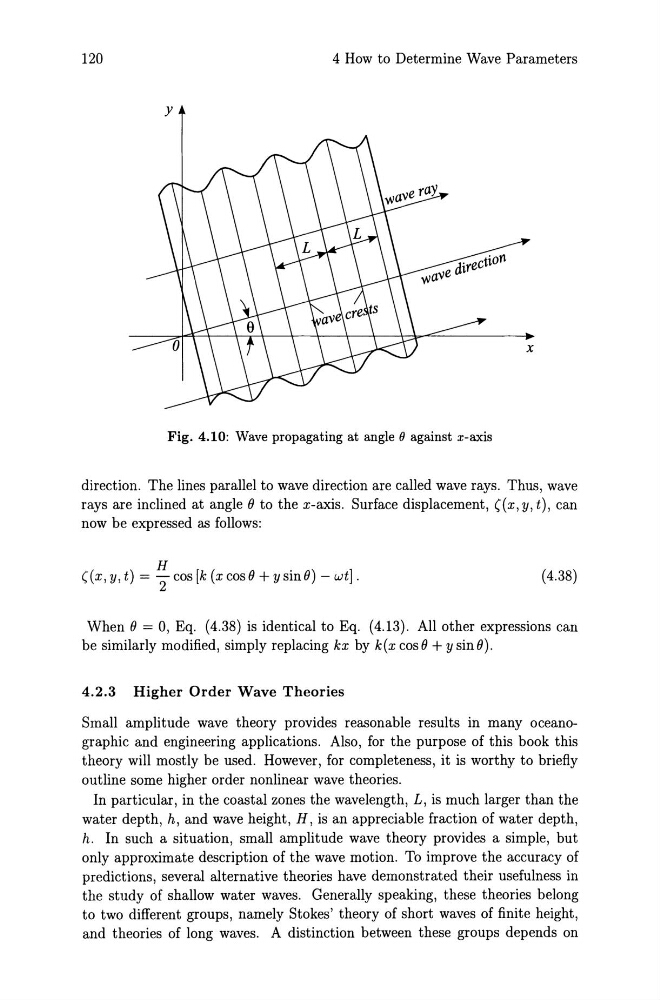
Fig. 4.10: Wave propagating at angle () against x-axis
direction. The lines parallel to wave direction are called wave rays. Thus, wave
rays are inclined at angle 0 to the x-axis. Surface displacement, ((x, y, t), can
now be expressed as follows:
H
((x, y, t) = "2 cos [k (x cosO + y sinO) - wt].
(4.38)
When 0 = 0, Eq. (4.38) is identical to Eq. (4.13). All other expressions can
be similarly modified, simply replacing kx by k(x cos 0 + y sin 0).
4.2.3 Higher Order Wave Theories
Small amplitude wave theory provides reasonable results in many oceanographic and engineering applications. Also, for the purpose of this book this
theory will mostly be used. However, for completeness, it is worthy to briefly
outline some higher order nonlinear wave theories.
In particular, in the coastal zones the wavelength, L, is much larger than the
water depth, h, and wave height, H, is an appreciable fraction of water depth,
h. In such a situation, small amplitude wave theory provides a simple, but
only approximate description of the wave motion. To improve the accuracy of
predictions, several alternative theories have demonstrated their usefulness in
the study of shallow water waves. Generally speaking, these theories belong
to two different groups, namely Stokes' theory of short waves of finite height,
and theories of long waves. A distinction between these groups depends on
4 How to Determine Wave Parameters
y
Fig. 4.10: Wave propagating at angle () against x-axis
direction. The lines parallel to wave direction are called wave rays. Thus, wave
rays are inclined at angle 0 to the x-axis. Surface displacement, ((x, y, t), can
now be expressed as follows:
H
((x, y, t) = "2 cos [k (x cosO + y sinO) - wt].
(4.38)
When 0 = 0, Eq. (4.38) is identical to Eq. (4.13). All other expressions can
be similarly modified, simply replacing kx by k(x cos 0 + y sin 0).
4.2.3 Higher Order Wave Theories
Small amplitude wave theory provides reasonable results in many oceanographic and engineering applications. Also, for the purpose of this book this
theory will mostly be used. However, for completeness, it is worthy to briefly
outline some higher order nonlinear wave theories.
In particular, in the coastal zones the wavelength, L, is much larger than the
water depth, h, and wave height, H, is an appreciable fraction of water depth,
h. In such a situation, small amplitude wave theory provides a simple, but
only approximate description of the wave motion. To improve the accuracy of
predictions, several alternative theories have demonstrated their usefulness in
the study of shallow water waves. Generally speaking, these theories belong
to two different groups, namely Stokes' theory of short waves of finite height,
and theories of long waves. A distinction between these groups depends on