

(a)
(b)
F requency (Hz)
0
400
800
Velocity (µm/s)
1200
1600
2000
10
20
30
40
50
80
100
(c)
246 mm
1
Flow speed (mm/s)
3
4
2
60
0
Time (s)
(d)
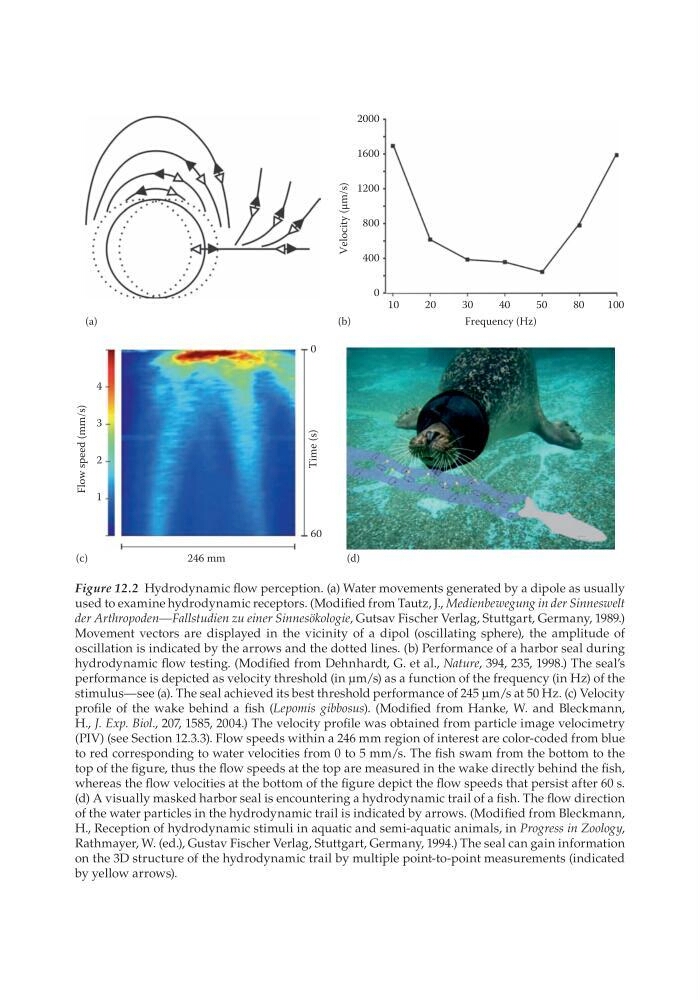
Figure 12.2 Hydrodynamic flow perception. (a) Water movements generated by a dipole as usually
used to examine hydrodynamic receptors. (Modified from Tautz, J., Medienbewegung in der Sinneswelt
der Arthropoden—Fallstudien zu einer Sinnesökologie, Gutsav Fischer Verlag, Stuttgart, Germany, 1989.)
Movement vectors are displayed in the vicinity of a dipol (os cillating sphere), the amplitude of
oscillation is indicated by the arrows and the dotted lines. (b) Performance of a harbor seal during
hydrodynamic flow testing. (Modified from Dehnhardt, G. et al., Nature, 394, 235, 1998.) The seal’s
performance is depicted as velocity threshold (in µm/s) as a function of the frequency (in Hz) of the
stimulus—see (a). The seal achieved its best threshold performance of 245 µm/s at 50 Hz. (c) Velocity
profile of the wake behind a fish (Lepomis gibbosus). (Modified from Hanke, W. and Bleckmann,
H., J. Exp. Biol., 207, 1585, 2004.) The velocity profile was obtained from particle image velocimetry
(PIV) (see Section 12.3.3). Flow speeds within a 246 mm region of interest are color-coded from blue
to red corresponding to water velocities from 0 to 5 mm/s. The fish swam from the bottom to the
top of the figure, thus the flow speeds at the top are measured in the wake directly behind the fish,
whereas the flow velocities at the bottom of the figure depict the flow speeds that persist after 60 s.
(d) A visually masked harbor seal is encountering a hydrodynamic trail of a fish. The flow direction
of the water particles in the hydrodynamic trail is indicated by arrows. (Modified from Bleckmann,
H., Reception of hydrodynamic stimuli in aquatic and semi-aquatic animals, in Progress in Zoology,
Rathmayer, W. (ed.), Gustav Fischer Verlag, Stuttgart, Germany, 1994.) The seal can gain information
on the 3D structure of the hydrodynamic trail by multiple point-to-point measurements (indicated
by yellow arrows).
(b)
F requency (Hz)
0
400
800
Velocity (µm/s)
1200
1600
2000
10
20
30
40
50
80
100
(c)
246 mm
1
Flow speed (mm/s)
3
4
2
60
0
Time (s)
(d)
Figure 12.2 Hydrodynamic flow perception. (a) Water movements generated by a dipole as usually
used to examine hydrodynamic receptors. (Modified from Tautz, J., Medienbewegung in der Sinneswelt
der Arthropoden—Fallstudien zu einer Sinnesökologie, Gutsav Fischer Verlag, Stuttgart, Germany, 1989.)
Movement vectors are displayed in the vicinity of a dipol (os cillating sphere), the amplitude of
oscillation is indicated by the arrows and the dotted lines. (b) Performance of a harbor seal during
hydrodynamic flow testing. (Modified from Dehnhardt, G. et al., Nature, 394, 235, 1998.) The seal’s
performance is depicted as velocity threshold (in µm/s) as a function of the frequency (in Hz) of the
stimulus—see (a). The seal achieved its best threshold performance of 245 µm/s at 50 Hz. (c) Velocity
profile of the wake behind a fish (Lepomis gibbosus). (Modified from Hanke, W. and Bleckmann,
H., J. Exp. Biol., 207, 1585, 2004.) The velocity profile was obtained from particle image velocimetry
(PIV) (see Section 12.3.3). Flow speeds within a 246 mm region of interest are color-coded from blue
to red corresponding to water velocities from 0 to 5 mm/s. The fish swam from the bottom to the
top of the figure, thus the flow speeds at the top are measured in the wake directly behind the fish,
whereas the flow velocities at the bottom of the figure depict the flow speeds that persist after 60 s.
(d) A visually masked harbor seal is encountering a hydrodynamic trail of a fish. The flow direction
of the water particles in the hydrodynamic trail is indicated by arrows. (Modified from Bleckmann,
H., Reception of hydrodynamic stimuli in aquatic and semi-aquatic animals, in Progress in Zoology,
Rathmayer, W. (ed.), Gustav Fischer Verlag, Stuttgart, Germany, 1994.) The seal can gain information
on the 3D structure of the hydrodynamic trail by multiple point-to-point measurements (indicated
by yellow arrows).