

Figure 13.1 Bottlenose dolphin (Tursiops truncatus) affected by lacaziosis in Sarasota Bay, Florida.
Note the raised, bumpy lesions that may affect large areas of the body. (Photo courtesy of Sarasota
Dolphin Research Program, obtained under National Marine Fisheries Service Scientific Research
Permit No. 15543.)
Harbor seal vibrissa
(a)
Cylinder
(b)
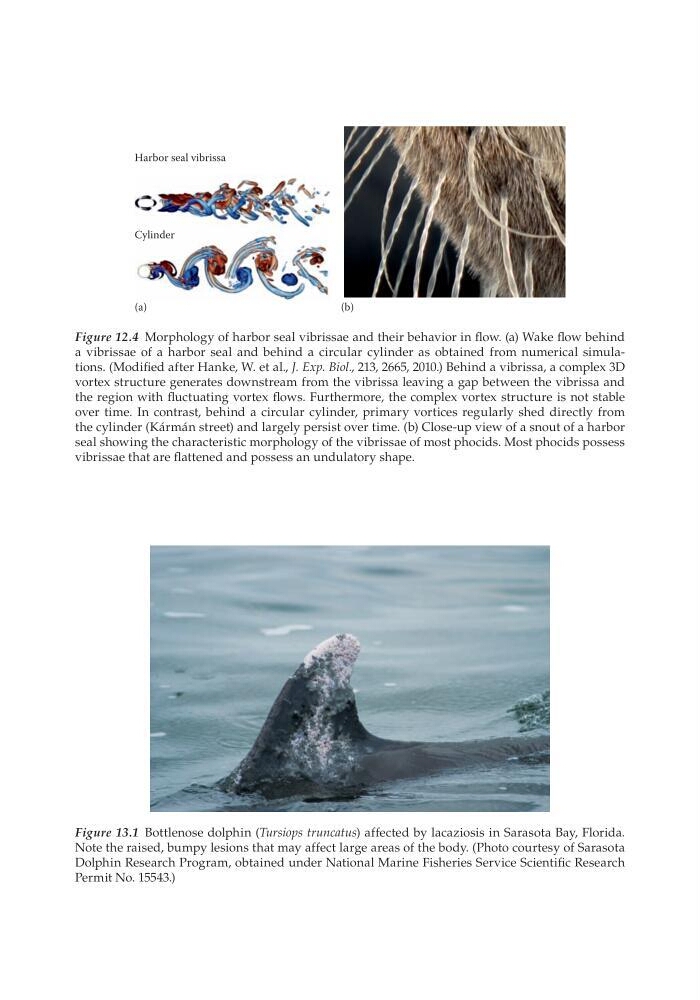
Figure 12.4 Morphology of harbor seal vibrissae and their behavior in flow. (a) Wake flow behind
a vibrissae of a harbor seal and behind a circular cylinder as obtained from numerical simulations. (Modified after Hanke, W. et al., J. Exp. Biol., 213, 2665, 2010.) Behind a vibrissa, a complex 3D
vortex structure generates downstream from the vibrissa leaving a gap between the vibrissa and
the region with fluctuating vortex flows. Furthermore, the complex vortex structure is not stable
over time. In contrast, behind a circular cylinder, primary vortices regularly shed directly from
the cylinder (Kármán street) and largely persist over time. (b) Close-up view of a snout of a harbor
seal showing the characteristic morphology of the vibrissae of most phocids. Most phocids possess
vibrissae that are flattened and possess an undulatory shape.
Note the raised, bumpy lesions that may affect large areas of the body. (Photo courtesy of Sarasota
Dolphin Research Program, obtained under National Marine Fisheries Service Scientific Research
Permit No. 15543.)
Harbor seal vibrissa
(a)
Cylinder
(b)
Figure 12.4 Morphology of harbor seal vibrissae and their behavior in flow. (a) Wake flow behind
a vibrissae of a harbor seal and behind a circular cylinder as obtained from numerical simulations. (Modified after Hanke, W. et al., J. Exp. Biol., 213, 2665, 2010.) Behind a vibrissa, a complex 3D
vortex structure generates downstream from the vibrissa leaving a gap between the vibrissa and
the region with fluctuating vortex flows. Furthermore, the complex vortex structure is not stable
over time. In contrast, behind a circular cylinder, primary vortices regularly shed directly from
the cylinder (Kármán street) and largely persist over time. (b) Close-up view of a snout of a harbor
seal showing the characteristic morphology of the vibrissae of most phocids. Most phocids possess
vibrissae that are flattened and possess an undulatory shape.