

197
Chapter nine: Thermoregulation
of air and buoyant, that the pup cannot dive and floats around on the surface waiting for
its mother to come back from foraging trips. The thick, luxurious fur of these two species
inspired the Russian exploration of Alaska, and fur trading fueled the regional economy
for many years. By contrast, the hair densities of harbor seals and sea lions are less than
25 hairs/mm 2 and of course, cetaceans do not have body hair (Liwanag et al. 2012a). Fish
et al. (2002) provide an excellent review of the buoyancy and hydrodynamic characteristics
of fur and hair. Thermal budgets for survival of newborn pups have been built for fur seals
and models how heat transfer, fur condition, weather, and other thermal factors can influence population survival (Trites 1990).
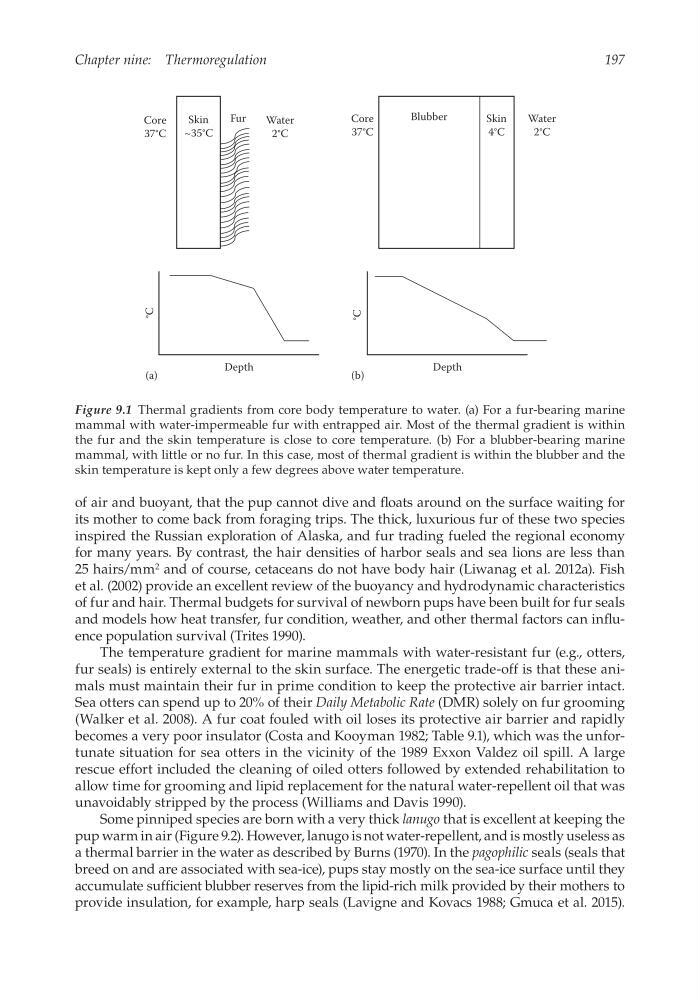
The temperature gradient for marine mammals with water-resistant fur (e.g., otters,
fur seals) is entirely external to the skin surface. The energetic trade-off is that these animals must maintain their fur in prime condition to keep the protective air barrier intact.
Sea otters can spend up to 20% of their Daily Metabolic Rate (DMR) solely on fur grooming
(Walker et al. 2008). A fur coat fouled with oil loses its protective air barrier and rapidly
becomes a very poor insulator (Costa and Kooyman 1982; Table 9.1), which was the unfortunate situation for sea otters in the vicinity of the 1989 Exxon Valdez oil spill. A large
rescue effort included the cleaning of oiled otters followed by extended rehabilitation to
allow time for grooming and lipid replacement for the natural water-repellent oil that was
unavoidably stripped by the process (Williams and Davis 1990).
Some pinniped species are born with a very thick lanugo that is excellent at keeping the
pup warm in air (Figure 9.2). However, lanugo is not water-repellent, and is mostly useless as
a thermal barrier in the water as described by Burns (1970). In the pagophilic seals (seals that
breed on and are associated with sea-ice), pups stay mostly on the sea-ice surface until they
accumulate sufficient blubber reserves from the lipid-rich milk provided by their mothers to
provide insulation, for example, harp seals (Lavigne and Kovacs 1988; Gmuca et al. 2015).
°C
Depth
(a)
Core
37°C
Skin
~35°C
Water
2°C
Fur
(b)
°C
Depth
Core
37°C
Water
2°C
Skin
4°C
Blubber
Figure 9.1 Thermal gradients from core body temperature to water. (a) For a fur-bearing marine
mammal with water-impermeable fur with entrapped air. Most of the thermal gradient is within
the fur and the skin temperature is close to core temperature. (b) For a blubber-bearing marine
mammal, with little or no fur. In this case, most of thermal gradient is within the blubber and the
skin temperature is kept only a few degrees above water temperature.
Chapter nine: Thermoregulation
of air and buoyant, that the pup cannot dive and floats around on the surface waiting for
its mother to come back from foraging trips. The thick, luxurious fur of these two species
inspired the Russian exploration of Alaska, and fur trading fueled the regional economy
for many years. By contrast, the hair densities of harbor seals and sea lions are less than
25 hairs/mm 2 and of course, cetaceans do not have body hair (Liwanag et al. 2012a). Fish
et al. (2002) provide an excellent review of the buoyancy and hydrodynamic characteristics
of fur and hair. Thermal budgets for survival of newborn pups have been built for fur seals
and models how heat transfer, fur condition, weather, and other thermal factors can influence population survival (Trites 1990).
The temperature gradient for marine mammals with water-resistant fur (e.g., otters,
fur seals) is entirely external to the skin surface. The energetic trade-off is that these animals must maintain their fur in prime condition to keep the protective air barrier intact.
Sea otters can spend up to 20% of their Daily Metabolic Rate (DMR) solely on fur grooming
(Walker et al. 2008). A fur coat fouled with oil loses its protective air barrier and rapidly
becomes a very poor insulator (Costa and Kooyman 1982; Table 9.1), which was the unfortunate situation for sea otters in the vicinity of the 1989 Exxon Valdez oil spill. A large
rescue effort included the cleaning of oiled otters followed by extended rehabilitation to
allow time for grooming and lipid replacement for the natural water-repellent oil that was
unavoidably stripped by the process (Williams and Davis 1990).
Some pinniped species are born with a very thick lanugo that is excellent at keeping the
pup warm in air (Figure 9.2). However, lanugo is not water-repellent, and is mostly useless as
a thermal barrier in the water as described by Burns (1970). In the pagophilic seals (seals that
breed on and are associated with sea-ice), pups stay mostly on the sea-ice surface until they
accumulate sufficient blubber reserves from the lipid-rich milk provided by their mothers to
provide insulation, for example, harp seals (Lavigne and Kovacs 1988; Gmuca et al. 2015).
°C
Depth
(a)
Core
37°C
Skin
~35°C
Water
2°C
Fur
(b)
°C
Depth
Core
37°C
Water
2°C
Skin
4°C
Blubber
Figure 9.1 Thermal gradients from core body temperature to water. (a) For a fur-bearing marine
mammal with water-impermeable fur with entrapped air. Most of the thermal gradient is within
the fur and the skin temperature is close to core temperature. (b) For a blubber-bearing marine
mammal, with little or no fur. In this case, most of thermal gradient is within the blubber and the
skin temperature is kept only a few degrees above water temperature.