

196
Marine Mammal Physiology: Requisites for Ocean Living
moving to cooler waters, or entering the water from the land. Northern elephant seals
(Mirounga angustirostris) will flip sand over their backs to reduce radiative heat gain on
hot and sunny days when they are hauled out along the California beaches (Heath and
Schusterman 1975).
9.2.2 What is insulation?
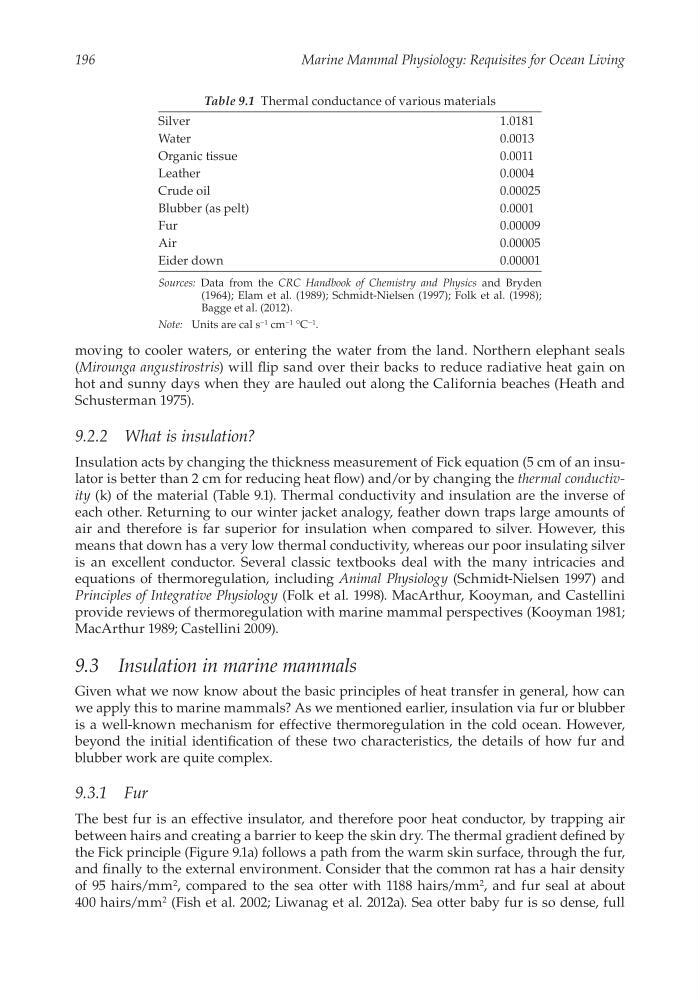
Insulation acts by changing the thickness measurement of Fick equation (5 cm of an insulator is better than 2 cm for reducing heat flow) and/or by changing the thermal conductivity (k) of the material (Table 9.1). Thermal conductivity and insulation are the inverse of
each other. Returning to our winter jacket analogy, feather down traps large amounts of
air and therefore is far superior for insulation when compared to silver. However, this
means that down has a very low thermal conductivity, whereas our poor insulating silver
is an excellent conductor. Several classic textbooks deal with the many intricacies and
equations of thermoregulation, including Animal Physiology (Schmidt-Nielsen 1997) and
Principles of Integrative Physiology (Folk et al. 1998). MacArthur, Kooyman, and Castellini
provide reviews of thermoregulation with marine mammal perspectives (Kooyman 1981;
MacArthur 1989; Castellini 2009).
9.3 Insulation in marine mammals
Given what we now know about the basic principles of heat transfer in general, how can
we apply this to marine mammals? As we mentioned earlier, insulation via fur or blubber
is a well-known mechanism for effective thermoregulation in the cold ocean. However,
beyond the initial identification of these two characteristics, the details of how fur and
blubber work are quite complex.
9.3.1 Fur
The best fur is an effective insulator, and therefore poor heat conductor, by trapping air
between hairs and creating a barrier to keep the skin dry. The thermal gradient defined by
the Fick principle (Figure 9.1a) follows a path from the warm skin surface, through the fur,
and finally to the external environment. Consider that the common rat has a hair density
of 95 hairs/mm 2 , compared to the sea otter with 1188 hairs/mm 2 , and fur seal at about
400 hairs/mm 2 (Fish et al. 2002; Liwanag et al. 2012a). Sea otter baby fur is so dense, full
Table 9.1 Thermal conductance of various materials
Silver
1.0181
Water
0.0013
Organic tissue
0.0011
Leather
0.0004
Crude oil
0.00025
Blubber (as pelt)
0.0001
Fur
0.00009
Air
0.00005
Eider down
0.00001
Sources: Data from the CRC Handbook of Chemistry and Physics and Bryden
(1964); Elam et al. (1989); Schmidt-Nielsen (1997); Folk et al. (1998);
Bagge et al. (2012).
Note: Units are cal s −1 cm −1 °C −1 .
Marine Mammal Physiology: Requisites for Ocean Living
moving to cooler waters, or entering the water from the land. Northern elephant seals
(Mirounga angustirostris) will flip sand over their backs to reduce radiative heat gain on
hot and sunny days when they are hauled out along the California beaches (Heath and
Schusterman 1975).
9.2.2 What is insulation?
Insulation acts by changing the thickness measurement of Fick equation (5 cm of an insulator is better than 2 cm for reducing heat flow) and/or by changing the thermal conductivity (k) of the material (Table 9.1). Thermal conductivity and insulation are the inverse of
each other. Returning to our winter jacket analogy, feather down traps large amounts of
air and therefore is far superior for insulation when compared to silver. However, this
means that down has a very low thermal conductivity, whereas our poor insulating silver
is an excellent conductor. Several classic textbooks deal with the many intricacies and
equations of thermoregulation, including Animal Physiology (Schmidt-Nielsen 1997) and
Principles of Integrative Physiology (Folk et al. 1998). MacArthur, Kooyman, and Castellini
provide reviews of thermoregulation with marine mammal perspectives (Kooyman 1981;
MacArthur 1989; Castellini 2009).
9.3 Insulation in marine mammals
Given what we now know about the basic principles of heat transfer in general, how can
we apply this to marine mammals? As we mentioned earlier, insulation via fur or blubber
is a well-known mechanism for effective thermoregulation in the cold ocean. However,
beyond the initial identification of these two characteristics, the details of how fur and
blubber work are quite complex.
9.3.1 Fur
The best fur is an effective insulator, and therefore poor heat conductor, by trapping air
between hairs and creating a barrier to keep the skin dry. The thermal gradient defined by
the Fick principle (Figure 9.1a) follows a path from the warm skin surface, through the fur,
and finally to the external environment. Consider that the common rat has a hair density
of 95 hairs/mm 2 , compared to the sea otter with 1188 hairs/mm 2 , and fur seal at about
400 hairs/mm 2 (Fish et al. 2002; Liwanag et al. 2012a). Sea otter baby fur is so dense, full
Table 9.1 Thermal conductance of various materials
Silver
1.0181
Water
0.0013
Organic tissue
0.0011
Leather
0.0004
Crude oil
0.00025
Blubber (as pelt)
0.0001
Fur
0.00009
Air
0.00005
Eider down
0.00001
Sources: Data from the CRC Handbook of Chemistry and Physics and Bryden
(1964); Elam et al. (1989); Schmidt-Nielsen (1997); Folk et al. (1998);
Bagge et al. (2012).
Note: Units are cal s −1 cm −1 °C −1 .