

198
Marine Mammal Physiology: Requisites for Ocean Living
They shed their lanugo as they approach weaning and begin to take on the coloration and
appearance of the adults with thinner, coarser hair. The extreme example of this is the
hooded seal, which is weaned in a mere 4 days due to a phenomenal efficiency of fat transfer (Bowen et al. 1985; Mellish et al. 1999). Hooded seals, however, have a pre-loaded fat
layer of about 15% body composition and, therefore, do not have as thick a lanugo, nor need
as much time as most other ice seals to deposit an insulatory layer of blubber.
Not all marine mammal fur is comparable to the water-impermeable coat on the sea
otter. Seals and sea lions have a very rough, short, and relatively low density fur that
affords little insulation because it allows the skin to become wet. The evolutionary pressure to maintain the fur likely comes from the protection it provides to the skin from the
rough surfaces of the ground, ice, and so on rather than thermal contributions. In this case,
the Fick equation dictates that the thermal gradient is internal to the animal, as the skin
surface may be only a few degrees warmer than the environment, if at all (Figure 9.1b).
In these pinniped species, and all cetaceans, the insulating layer is usually found in the
form of blubber. An interesting variant on this pattern is the heavily furred polar bear, in
that the fur allows water to permeate to the skin. For these bears, the fur acts mainly to
keep them warm in the air, but fat layers beneath the skin are the primary thermal barrier
when in water (Frisch et al. 1974).
Morphological differences in marine mammal hair are found on two levels: in general, not only is marine mammal hair shorter, denser, and flatter than other carnivores,
but those species that rely heavily on fur for heat retention have longer cuticle scales than
those that do not (Liwanag et al. 2012a).
9.3.2 Blubber
The first commonly held concept to dismiss when considering blubber is that it is simply a
collection of homogenous fat cells, similar to body fat in most terrestrial mammals. By contrast, blubber is a highly specialized organ comprised of a loose collagen protein matrix,
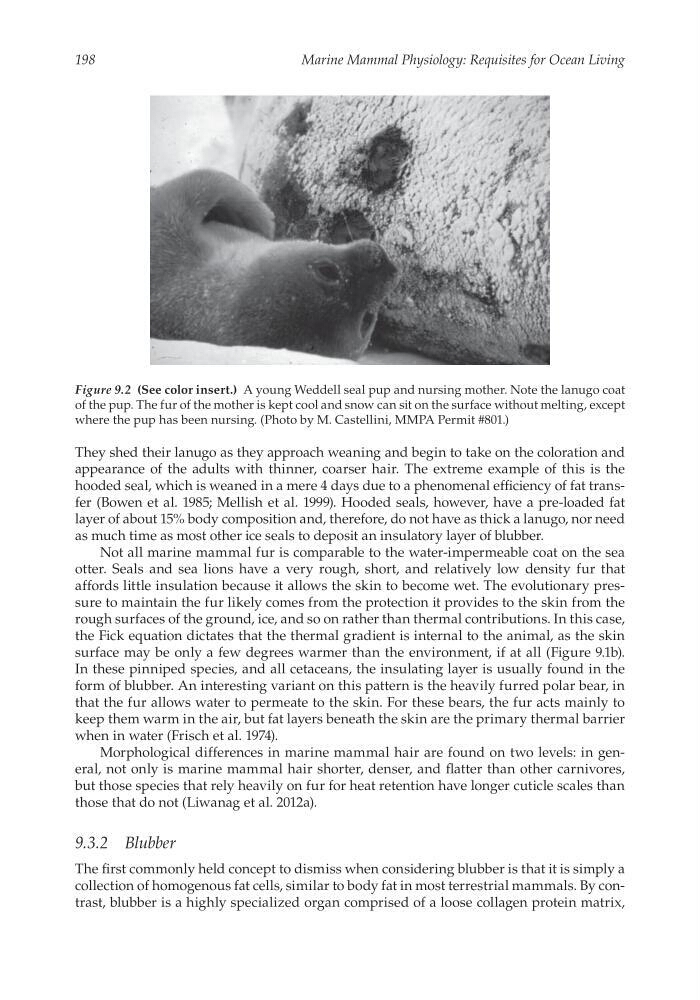
Figure 9.2 (See color insert.) A young Weddell seal pup and nursing mother. Note the lanugo coat
of the pup. The fur of the mother is kept cool and snow can sit on the surface without melting, except
where the pup has been nursing. (Photo by M. Castellini, MMPA Permit #801.)
Marine Mammal Physiology: Requisites for Ocean Living
They shed their lanugo as they approach weaning and begin to take on the coloration and
appearance of the adults with thinner, coarser hair. The extreme example of this is the
hooded seal, which is weaned in a mere 4 days due to a phenomenal efficiency of fat transfer (Bowen et al. 1985; Mellish et al. 1999). Hooded seals, however, have a pre-loaded fat
layer of about 15% body composition and, therefore, do not have as thick a lanugo, nor need
as much time as most other ice seals to deposit an insulatory layer of blubber.
Not all marine mammal fur is comparable to the water-impermeable coat on the sea
otter. Seals and sea lions have a very rough, short, and relatively low density fur that
affords little insulation because it allows the skin to become wet. The evolutionary pressure to maintain the fur likely comes from the protection it provides to the skin from the
rough surfaces of the ground, ice, and so on rather than thermal contributions. In this case,
the Fick equation dictates that the thermal gradient is internal to the animal, as the skin
surface may be only a few degrees warmer than the environment, if at all (Figure 9.1b).
In these pinniped species, and all cetaceans, the insulating layer is usually found in the
form of blubber. An interesting variant on this pattern is the heavily furred polar bear, in
that the fur allows water to permeate to the skin. For these bears, the fur acts mainly to
keep them warm in the air, but fat layers beneath the skin are the primary thermal barrier
when in water (Frisch et al. 1974).
Morphological differences in marine mammal hair are found on two levels: in general, not only is marine mammal hair shorter, denser, and flatter than other carnivores,
but those species that rely heavily on fur for heat retention have longer cuticle scales than
those that do not (Liwanag et al. 2012a).
9.3.2 Blubber
The first commonly held concept to dismiss when considering blubber is that it is simply a
collection of homogenous fat cells, similar to body fat in most terrestrial mammals. By contrast, blubber is a highly specialized organ comprised of a loose collagen protein matrix,
Figure 9.2 (See color insert.) A young Weddell seal pup and nursing mother. Note the lanugo coat
of the pup. The fur of the mother is kept cool and snow can sit on the surface without melting, except
where the pup has been nursing. (Photo by M. Castellini, MMPA Permit #801.)