

84
2. Basic Finite-Difference Methods
SOl.
0.0
-0.2
a::
§ -0.4
< u,
Cl
Z
CL -0.6
::;
< 0
-0.8
-1.0
0
1lI46
WAVELENGTH
46
IM
4
7l/2lJ.
WAVE NUMBER
6
36
311146
1lI6
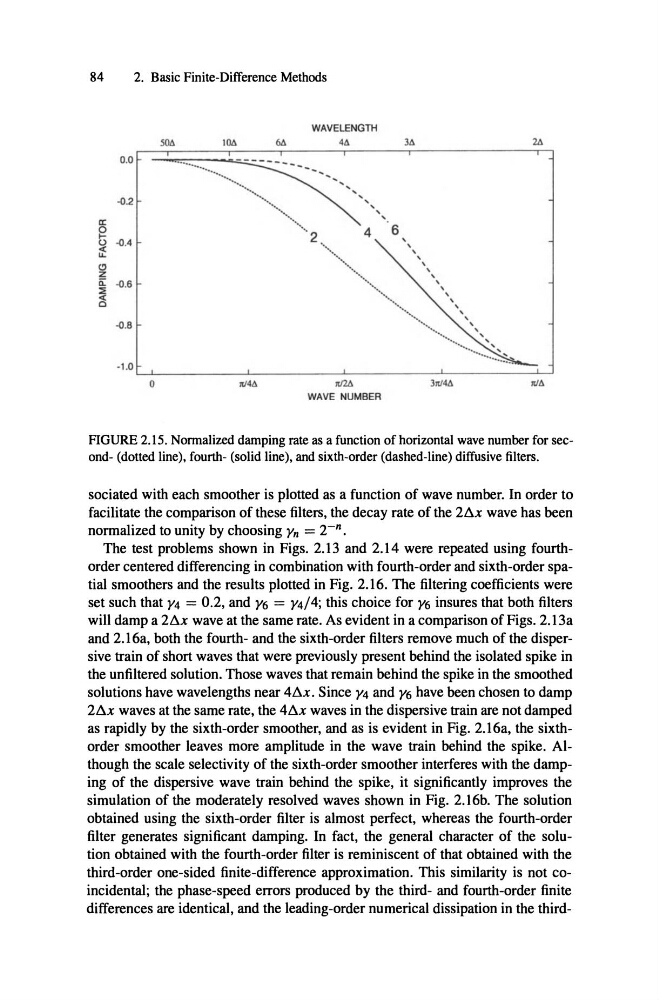
FIGURE 2.15. Normalized damping rate as a function of horizontal wave number for second- (dotted line), fourth- (solid line), and sixth-order (dashed-line) diffusive filters.
sociated with each smoother is plotted as a function of wave number. In order to
facilitate the comparison of these filters, the decay rate of the 2ßx wave has been
normalized to unity by choosing Yn = 2- n.
The test problems shown in Figs. 2.13 and 2.14 were repeated using fourthorder centered differencing in combination with fourth-order and sixth-order spatial smoothers and the results plotted in Fig. 2.16. The filtering coefficients were
set such that Y4 = 0.2, and Y6 = Y4/4; this choice for Y6 insures that both filters
will damp a 2ßx wave at the same rate. As evident in a comparison of Figs. 2.13a
and 2.16a, both the fourth- and the sixth-order filters remove much of the dispersive train of short waves that were previously present behind the isolated spike in
the unfiltered solution. Those waves that remain behind the spike in the smoothed
solutions have wavelengths near 4ßx . Since Y4 and Y6 have been chosen to damp
2ßx waves at the same rate, the 4ßx waves in the dispersive train are not damped
as rapidly by the sixth-order smoother, and as is evident in Fig. 2.16a, the sixthorder smoother leaves more amplitude in the wave train behind the spike. AIthough the scale selectivity of the sixth-order smoother interferes with the damping of the dispersive wave train behind the spike, it significantly improves the
simulation of the moderately resolved waves shown in Fig. 2.16b. The solution
obtained using the sixth-order filter is almost perfect, whereas the fourth-order
filter generates significant damping. In fact, the general character of the solution obtained with the fourth-order filter is reminiscent of that obtained with the
third-order one-sided finite-difference approximation. This similarity is not coincidental; the phase-speed errors produced by the third- and fourth-order finite
differences are identical, and the leading-order numerical dissipation in the third-
2. Basic Finite-Difference Methods
SOl.
0.0
-0.2
a::
§ -0.4
< u,
Cl
Z
CL -0.6
::;
< 0
-0.8
-1.0
0
1lI46
WAVELENGTH
46
IM
4
7l/2lJ.
WAVE NUMBER
6
36
311146
1lI6
FIGURE 2.15. Normalized damping rate as a function of horizontal wave number for second- (dotted line), fourth- (solid line), and sixth-order (dashed-line) diffusive filters.
sociated with each smoother is plotted as a function of wave number. In order to
facilitate the comparison of these filters, the decay rate of the 2ßx wave has been
normalized to unity by choosing Yn = 2- n.
The test problems shown in Figs. 2.13 and 2.14 were repeated using fourthorder centered differencing in combination with fourth-order and sixth-order spatial smoothers and the results plotted in Fig. 2.16. The filtering coefficients were
set such that Y4 = 0.2, and Y6 = Y4/4; this choice for Y6 insures that both filters
will damp a 2ßx wave at the same rate. As evident in a comparison of Figs. 2.13a
and 2.16a, both the fourth- and the sixth-order filters remove much of the dispersive train of short waves that were previously present behind the isolated spike in
the unfiltered solution. Those waves that remain behind the spike in the smoothed
solutions have wavelengths near 4ßx . Since Y4 and Y6 have been chosen to damp
2ßx waves at the same rate, the 4ßx waves in the dispersive train are not damped
as rapidly by the sixth-order smoother, and as is evident in Fig. 2.16a, the sixthorder smoother leaves more amplitude in the wave train behind the spike. AIthough the scale selectivity of the sixth-order smoother interferes with the damping of the dispersive wave train behind the spike, it significantly improves the
simulation of the moderately resolved waves shown in Fig. 2.16b. The solution
obtained using the sixth-order filter is almost perfect, whereas the fourth-order
filter generates significant damping. In fact, the general character of the solution obtained with the fourth-order filter is reminiscent of that obtained with the
third-order one-sided finite-difference approximation. This similarity is not coincidental; the phase-speed errors produced by the third- and fourth-order finite
differences are identical, and the leading-order numerical dissipation in the third-