

2.4 Space-Differencing
83
into (2.73) yields
dA
-
dt
= -2n(l -
implying that
undergo an
waves are damped most rapidly, and that well-resolved waves
dissipation. Indeed, if the second -derivative smoother is
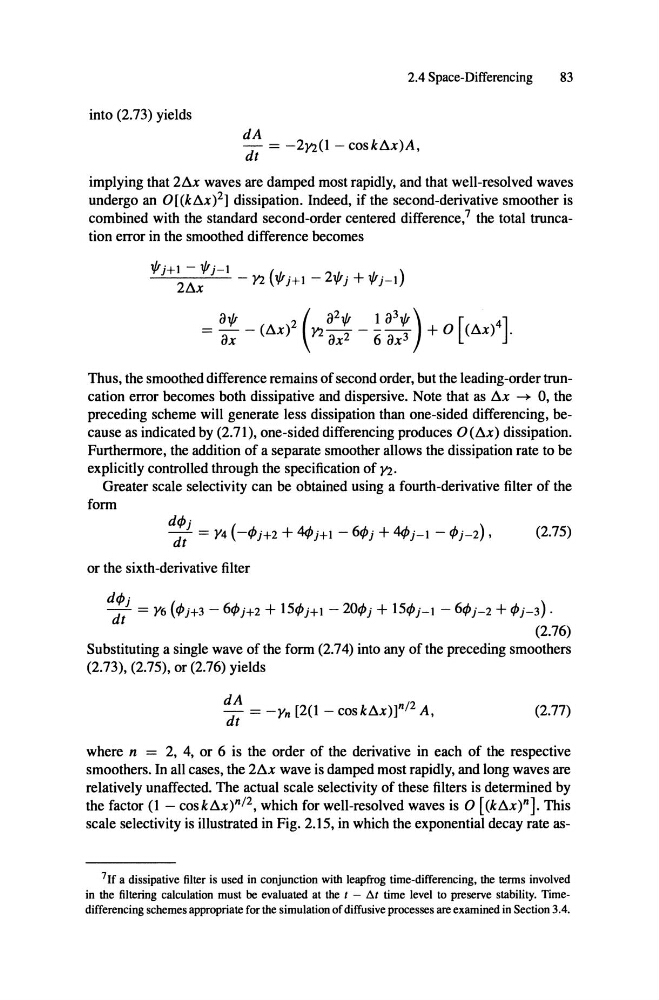
combined with the standard second-order centered difference,? the total truncation error in the smoothed difference becomes
Thus, the smoothed difference remains of second order, but the leading-order truncation error becomes both dissipative and dispersive . Note that as
0, the
preceding scheme will generate less dissipation than one-sided differencing, because as indicated by (2.71) , one-sided differencing produces
dissipation.
Furthermore, the addition of aseparate smoother allows the dissipation rate to be
explicitly controlled through the specification of n.
Greater scale selectivity can be obtained using a fourth-derivative filter of the
form
(2.75)
or the sixth-derivative filter
dr/Jj = Y6 (r/Jj+3 - 6r/Jj+2 + 15r/Jj+1 - 20r/Jj + 15r/Jj-1 - 6r/Jj-2 + r/Jj-3).
dt
(2.76)
Substituting a single wave of the form (2.74) into any of the preceding smoothers
(2.73), (2.75), or (2.76) yields
dA
-
dt
= -Yn [2(1 -
A ,
(2.77)
where n = 2, 4, or 6 is the order of the derivative in each of the respective
smoothers. In all cases, the
wave is damped most rapidly, and long waves are
relatively unaffected. The actual scale selectivity of these filters is determined by
the factor (l -
which for well-resolved waves is 0
This
scale selectivity is illustrated in Fig. 2.15, in which the exponential decay rate as71f a dissipative filter is used in conjunction with leapfrog time-differencing, the terms involved
in the filtering calculation must be evaluated at the 1 - 6.1 time level to preserve stability. Timedifferencingschemesappropriatefor the simulationof diffusiveprocesses are examined in Section 3.4.
83
into (2.73) yields
dA
-
dt
= -2n(l -
implying that
undergo an
waves are damped most rapidly, and that well-resolved waves
dissipation. Indeed, if the second -derivative smoother is
combined with the standard second-order centered difference,? the total truncation error in the smoothed difference becomes
Thus, the smoothed difference remains of second order, but the leading-order truncation error becomes both dissipative and dispersive . Note that as
0, the
preceding scheme will generate less dissipation than one-sided differencing, because as indicated by (2.71) , one-sided differencing produces
dissipation.
Furthermore, the addition of aseparate smoother allows the dissipation rate to be
explicitly controlled through the specification of n.
Greater scale selectivity can be obtained using a fourth-derivative filter of the
form
(2.75)
or the sixth-derivative filter
dr/Jj = Y6 (r/Jj+3 - 6r/Jj+2 + 15r/Jj+1 - 20r/Jj + 15r/Jj-1 - 6r/Jj-2 + r/Jj-3).
dt
(2.76)
Substituting a single wave of the form (2.74) into any of the preceding smoothers
(2.73), (2.75), or (2.76) yields
dA
-
dt
= -Yn [2(1 -
A ,
(2.77)
where n = 2, 4, or 6 is the order of the derivative in each of the respective
smoothers. In all cases, the
wave is damped most rapidly, and long waves are
relatively unaffected. The actual scale selectivity of these filters is determined by
the factor (l -
which for well-resolved waves is 0
This
scale selectivity is illustrated in Fig. 2.15, in which the exponential decay rate as71f a dissipative filter is used in conjunction with leapfrog time-differencing, the terms involved
in the filtering calculation must be evaluated at the 1 - 6.1 time level to preserve stability. Timedifferencingschemesappropriatefor the simulationof diffusiveprocesses are examined in Section 3.4.