

82
2. BasicFinite-Difference Methods
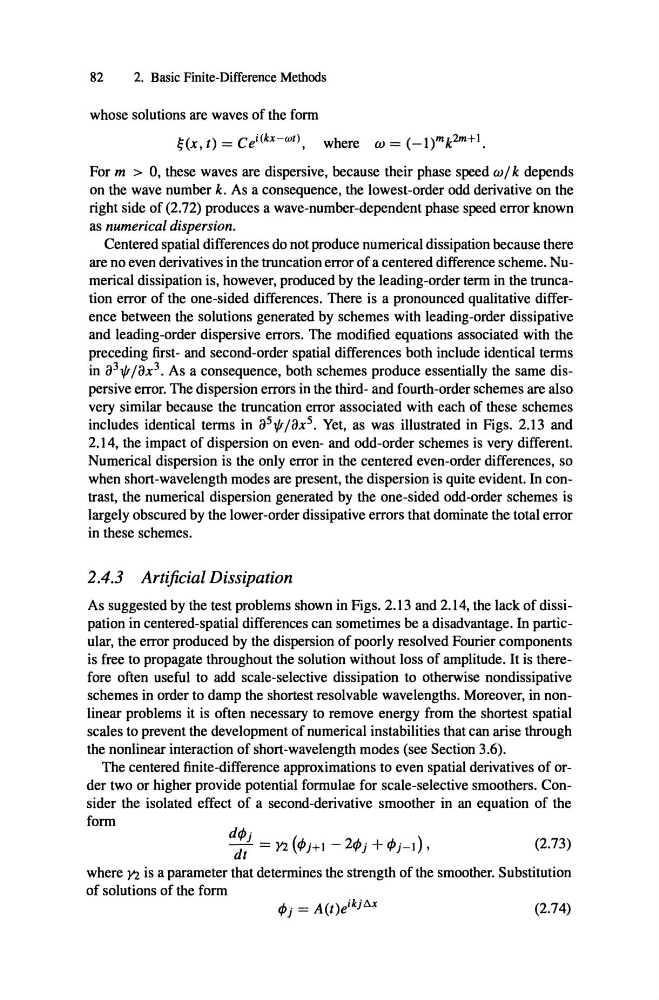
whose solutions are waves of the form
where w=(_I)mk 2m + I •
For m > 0, these waves are dispersive, because their phase speed to] k depends
on the wave number k. As a consequence, the lowest-order odd derivative on the
right side of (2.72) produces a wave-number-dependent phase speed error known
as numerical dispersion.
Centered spatial differences do not produce numerical dissipation because there
are no even derivatives in the truncation error of a centered difference scheme. Numerical dissipation is, however, produced by the leading-order tenn in the truncation error of the one-sided differences . There is a pronounced qualitative difference between the solutions generated by schemes with leading-order dissipative
and leading-order dispersive errors. The modified equations associated with the
preceding first- and second-order spatial differences both include identical terms
in 0 3 ",, / ox 3 • As a consequence, both schemes produce essentially the same dispersive error. The dispersion errors in the third- and fourth-order schemes are also
very similar because the truncation error associated with each of these schemes
includes identical terms in os""/ox s . Yet, as was illustrated in Figs. 2.13 and
2.14, the impact of dispersion on even- and odd-order schemes is very different.
Numerical dispersion is the only error in the centered even-order differences, so
when short-wavelength modes are present, the dispersion is quite evident. In contrast, the numerical dispersion generated by the one-sided odd-order schemes is
largely obscured by the lower-order dissipative errors that dominate the total error
in these schemes .
2.4.3 Artificial Dissipation
As suggested by the test problems shown in Figs . 2.13 and 2.14, the lack of dissi -
pation in centered-spatial differences can sometimes be a disadvantage. In particular, the error produced by the dispersion of poorly resolved Fourier components
is free to propagate throughout the solution without loss of amplitude . It is therefore often useful to add scale-selective dissipation to otherwise nondissipative
schemes in order to damp the shortest resolvable wavelengths. Moreover, in nonlinear problems it is often necessary to remove energy from the shortest spatial
scales to prevent the development of numerical instabilities that can arise through
the nonlinear interaction of short-wavelength modes (see Section 3.6).
The centered finite-difference approximations to even spatial derivatives of order two or higher provide potential formulae for scale-selective smoothers. Consider the isolated effect of a second-derivative smoother in an equation of the
form
dl/l'
d/ = Y2 (l/lj+1 - 2l/lj + l/lj-I) ,
(2.73)
where Y2 is a parameter that detennines the strength of the smoother. Substitution
of solutions of the form
l/lj = A(t)eikj6x
2. BasicFinite-Difference Methods
whose solutions are waves of the form
where w=(_I)mk 2m + I •
For m > 0, these waves are dispersive, because their phase speed to] k depends
on the wave number k. As a consequence, the lowest-order odd derivative on the
right side of (2.72) produces a wave-number-dependent phase speed error known
as numerical dispersion.
Centered spatial differences do not produce numerical dissipation because there
are no even derivatives in the truncation error of a centered difference scheme. Numerical dissipation is, however, produced by the leading-order tenn in the truncation error of the one-sided differences . There is a pronounced qualitative difference between the solutions generated by schemes with leading-order dissipative
and leading-order dispersive errors. The modified equations associated with the
preceding first- and second-order spatial differences both include identical terms
in 0 3 ",, / ox 3 • As a consequence, both schemes produce essentially the same dispersive error. The dispersion errors in the third- and fourth-order schemes are also
very similar because the truncation error associated with each of these schemes
includes identical terms in os""/ox s . Yet, as was illustrated in Figs. 2.13 and
2.14, the impact of dispersion on even- and odd-order schemes is very different.
Numerical dispersion is the only error in the centered even-order differences, so
when short-wavelength modes are present, the dispersion is quite evident. In contrast, the numerical dispersion generated by the one-sided odd-order schemes is
largely obscured by the lower-order dissipative errors that dominate the total error
in these schemes .
2.4.3 Artificial Dissipation
As suggested by the test problems shown in Figs . 2.13 and 2.14, the lack of dissi -
pation in centered-spatial differences can sometimes be a disadvantage. In particular, the error produced by the dispersion of poorly resolved Fourier components
is free to propagate throughout the solution without loss of amplitude . It is therefore often useful to add scale-selective dissipation to otherwise nondissipative
schemes in order to damp the shortest resolvable wavelengths. Moreover, in nonlinear problems it is often necessary to remove energy from the shortest spatial
scales to prevent the development of numerical instabilities that can arise through
the nonlinear interaction of short-wavelength modes (see Section 3.6).
The centered finite-difference approximations to even spatial derivatives of order two or higher provide potential formulae for scale-selective smoothers. Consider the isolated effect of a second-derivative smoother in an equation of the
form
dl/l'
d/ = Y2 (l/lj+1 - 2l/lj + l/lj-I) ,
(2.73)
where Y2 is a parameter that detennines the strength of the smoother. Substitution
of solutions of the form
l/lj = A(t)eikj6x