

2.4 Space-Differencing
81
Centered, second-order:
4 a
One-sided, third-order:
21/1j+1 + 31/1j - 61/1j-1 + 1/Ij-2 _ 81/1 ßx
3841/1 _ ßx
4851/1
0 [ ßX 5]
( ) .
6ßx
- 8x + 12 8x4
30 8x 5 +
Centered, fourth-order:
(1/Ij+1 -1/Ij-l) _
(1/Ij+2 -1/Ij-2) = 81/1 _ ßx
51/1 + 0 [(ßX)6].
3
2ßx
3
4ßx
8x
30 8x 5
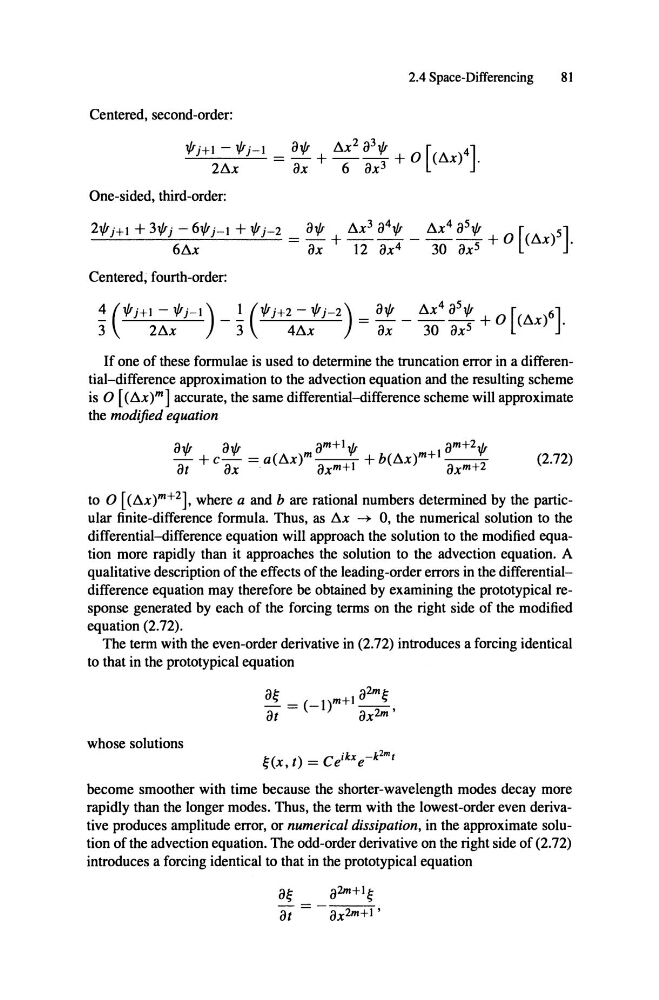
If one of these formulae is used to determine the truncation error in a differential-difference approximation to the advection equation and the resulting scheme
is 0 [(ßx)m] accurate, the same differential-difference scheme will approximate
the modified equation
(2.72)
8.1,
8.1,
am+I."
8 m+2•1,
ts: + c--'" = a(ßx)m--'" + b(ßx)m+1 - - ' "
8t
Bx
ax m+ 1
8x m+2
to 0 [(ßx)m+2], where a and b are rational numbers determined by the particular finite -difference formula. Thus, as ßx
0, the numerical solution to the
differential-difference equation will approach the solution to the modified equation more rapidly than it approaches the solution to the advection equation. A
qualitative description of the effects of the leading-order errors in the differentialdifference equation may therefore be obtained by examining the prototypical response generated by each of the forcing terms on the right side of the modified
equation (2.72).
The term with the even-order derivative in (2.72) introduces a forcing identical
to that in the prototypical equation
whose solutions
t) = Ceikxe-k2m,
become smoother with time because the shorter-wavelength modes decay more
rapidly than the longer modes. Thus, the term with the lowest-order even derivative produces amplitude error, or numerical dissipation, in the approximate solution of the advection equation. The odd-order derivative on the right side of (2.72)
introduces a forcing identical to that in the prototypical equation
at = - ax2m+1 '
81
Centered, second-order:
4 a
One-sided, third-order:
21/1j+1 + 31/1j - 61/1j-1 + 1/Ij-2 _ 81/1 ßx
3841/1 _ ßx
4851/1
0 [ ßX 5]
( ) .
6ßx
- 8x + 12 8x4
30 8x 5 +
Centered, fourth-order:
(1/Ij+1 -1/Ij-l) _
(1/Ij+2 -1/Ij-2) = 81/1 _ ßx
51/1 + 0 [(ßX)6].
3
2ßx
3
4ßx
8x
30 8x 5
If one of these formulae is used to determine the truncation error in a differential-difference approximation to the advection equation and the resulting scheme
is 0 [(ßx)m] accurate, the same differential-difference scheme will approximate
the modified equation
(2.72)
8.1,
8.1,
am+I."
8 m+2•1,
ts: + c--'" = a(ßx)m--'" + b(ßx)m+1 - - ' "
8t
Bx
ax m+ 1
8x m+2
to 0 [(ßx)m+2], where a and b are rational numbers determined by the particular finite -difference formula. Thus, as ßx
0, the numerical solution to the
differential-difference equation will approach the solution to the modified equation more rapidly than it approaches the solution to the advection equation. A
qualitative description of the effects of the leading-order errors in the differentialdifference equation may therefore be obtained by examining the prototypical response generated by each of the forcing terms on the right side of the modified
equation (2.72).
The term with the even-order derivative in (2.72) introduces a forcing identical
to that in the prototypical equation
whose solutions
t) = Ceikxe-k2m,
become smoother with time because the shorter-wavelength modes decay more
rapidly than the longer modes. Thus, the term with the lowest-order even derivative produces amplitude error, or numerical dissipation, in the approximate solution of the advection equation. The odd-order derivative on the right side of (2.72)
introduces a forcing identical to that in the prototypical equation
at = - ax2m+1 '