

2.4 Space-Differencing
85
(a)
L .
I (b)
I
I
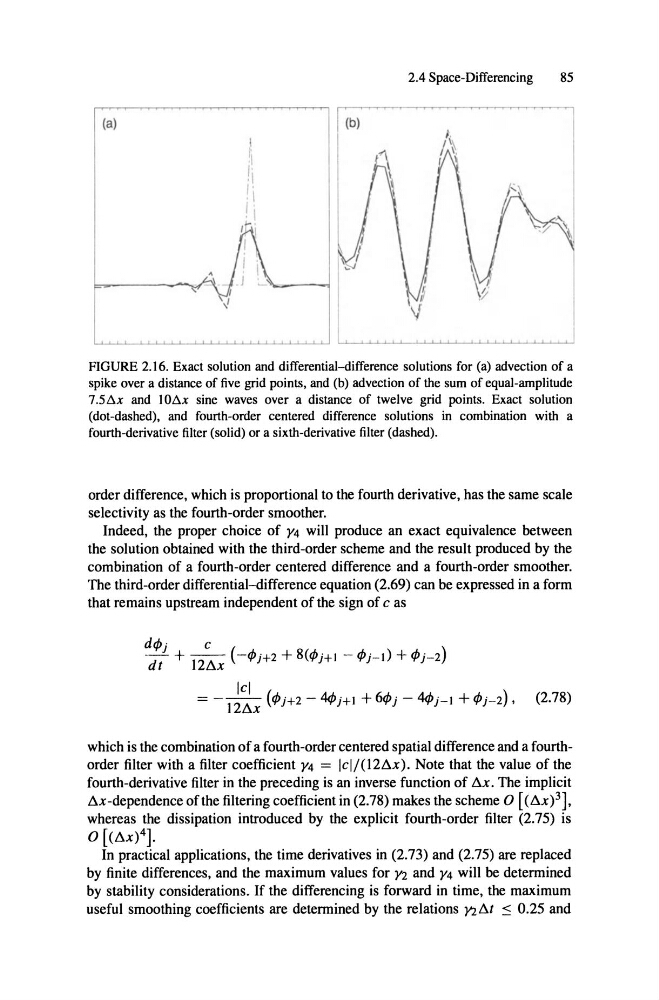
FIGURE 2.16. Exact solution and differential-difference solutions for (a) advection of a
spike over a distance of five grid points, and (b) advection of the sum of equal-amplitude
7.5tu and
sine waves over a distance of twelve grid points. Exact solution
(dot-dashed), and fourth-order centered difference solutions in combination with a
fourth-derivative filter (solid) or a sixth-derivative filter (dashed).
order difference, which is proportional to the fourth derivative, has the same scale
selectivity as the fourth-order smoother.
Indeed, the proper choice of Y4 will produce an exact equivalence between
the solution obtained with the third-order scheme and the result produced by the
combination of a fourth-order centered difference and a fourth-order smoother.
The third-order differential-difference equation (2.69) can be expressed in a form
that remains upstream independent of the sign of e as
dr/J ·
'd/ +
e
12ßX (-r/Jj+2+ 8(r/Jj+J -r/Jj-I)+r/Jj-2)
[c]
= -12ßx (r/Jj+2 - 4r/Jj+1 +6r/Jj - 4r/Jj-1 + r/Jj-2) , (2.78)
which is the combination of a fourth-order centered spatial difference and a fourthorder filter with a filter coefficient Y4 = lel/(l2ßx). Note that the value of the
fourth-derivative filter in the preceding is an inverse function of Sx, The implicit
Sx-dependence of the filtering coefficient in (2.78) makes the scheme 0 [( ßx)3],
whereas the dissipation introduced by the explicit fourth-order filter (2.75) is
o [(ßx)4].
In practical applications, the time derivatives in (2.73) and (2.75) are replaced
by finite differences, and the maximum values for Y2 and Y4 will be determined
by stability considerations. If the differencing is forward in time, the maximum
useful smoothing coefficients are determincd by the relations Y2 ßl :::: 0.25 and
85
(a)
L .
I (b)
I
I
FIGURE 2.16. Exact solution and differential-difference solutions for (a) advection of a
spike over a distance of five grid points, and (b) advection of the sum of equal-amplitude
7.5tu and
sine waves over a distance of twelve grid points. Exact solution
(dot-dashed), and fourth-order centered difference solutions in combination with a
fourth-derivative filter (solid) or a sixth-derivative filter (dashed).
order difference, which is proportional to the fourth derivative, has the same scale
selectivity as the fourth-order smoother.
Indeed, the proper choice of Y4 will produce an exact equivalence between
the solution obtained with the third-order scheme and the result produced by the
combination of a fourth-order centered difference and a fourth-order smoother.
The third-order differential-difference equation (2.69) can be expressed in a form
that remains upstream independent of the sign of e as
dr/J ·
'd/ +
e
12ßX (-r/Jj+2+ 8(r/Jj+J -r/Jj-I)+r/Jj-2)
[c]
= -12ßx (r/Jj+2 - 4r/Jj+1 +6r/Jj - 4r/Jj-1 + r/Jj-2) , (2.78)
which is the combination of a fourth-order centered spatial difference and a fourthorder filter with a filter coefficient Y4 = lel/(l2ßx). Note that the value of the
fourth-derivative filter in the preceding is an inverse function of Sx, The implicit
Sx-dependence of the filtering coefficient in (2.78) makes the scheme 0 [( ßx)3],
whereas the dissipation introduced by the explicit fourth-order filter (2.75) is
o [(ßx)4].
In practical applications, the time derivatives in (2.73) and (2.75) are replaced
by finite differences, and the maximum values for Y2 and Y4 will be determined
by stability considerations. If the differencing is forward in time, the maximum
useful smoothing coefficients are determincd by the relations Y2 ßl :::: 0.25 and