

420
8. Nonreflecting Boundary Conditions
a
a)
( at
- + U -
ax
ap
w+-=b,
az
at
+
ax b+ N
2
w = 0,
au aw
- + - = 0 ,
Bx
az
(8.38)
(8.39)
(8.40)
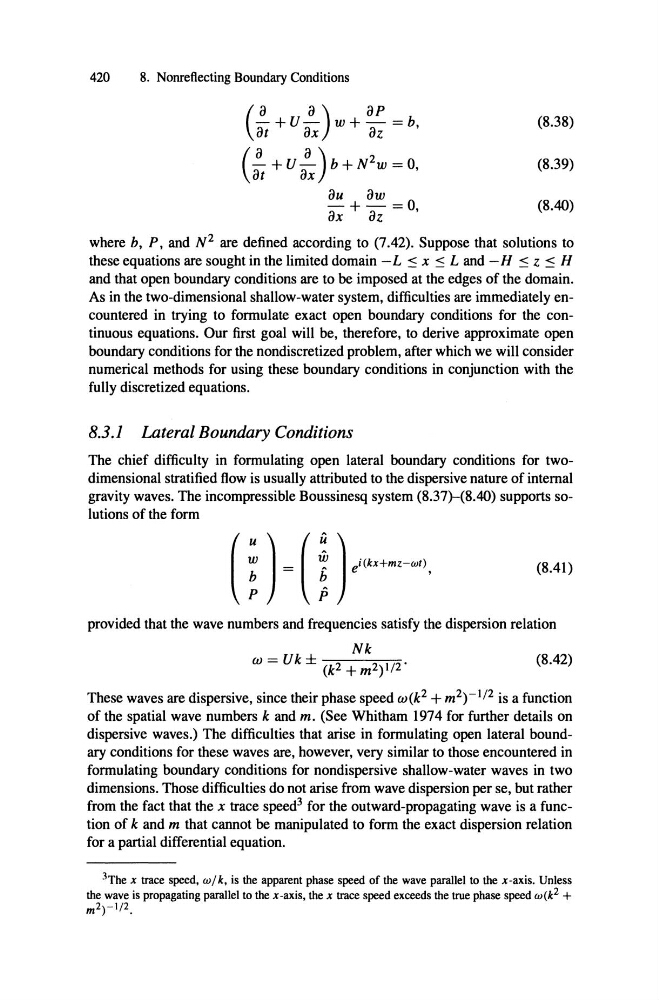
where b, P, and N 2 are defined according to (7.42). Suppose that solutions to
these equations are sought in the limited domain - L
x
Land - H
z H
and that open boundary conditions are to be imposed at the edges of the domain .
As in the two-dimensional shallow-water system, difficulties are immediately encountered in trying to formulate exact open boundary conditions for the continuous equations. Our first goal will be, therefore, to derive approximate open
boundary conditions for the nondiscretized problem, after which we will consider
numerical methods for using these boundary conditions in conjunction with the
fully discretized equations.
8.3.1 Lateral Boundary Conditions
The chief difficulty in formulating open lateral boundary conditions for twodimensional stratified flow is usually attributed to the dispersive nature of internal
gravity waves. The incompressible Boussinesq system (8.37)-(8.40) supports solutions of the form
(8.41)
provided that the wave numbers and frequencies satisfy the dispersion relation
Nk
w = Uk ± (k2 +m2) 1/2 .
(8.42)
These waves are dispersive, since their phase speed w(k 2 + m 2 ) - 1/ 2 is a function
of the spatial wave numbers k and m. (See Whitham 1974 for further details on
dispersive waves.) The difficulties that arise in formulating open lateral boundary conditions for these waves are, however, very similar to those encountered in
formulating boundary conditions for nondispersive shallow-water waves in two
dimensions. Those difficulties do not arise from wave dispersion per se, but rather
from the fact that the x trace speed'' for the outward-propagating wave is a function of k and m that cannot be manipulated to form the exact dispersion relation
for a partial differential equation.
3The x trace speed, co]k, is the apparent phase speed of the wave parallel to the x-axis . Unless
the wave is propagating parallel to the x- axis, the x trace speed exceeds the true phase speed w (k 2 +
m 2 )- 1/ 2.
8. Nonreflecting Boundary Conditions
a
a)
( at
- + U -
ax
ap
w+-=b,
az
at
+
ax b+ N
2
w = 0,
au aw
- + - = 0 ,
Bx
az
(8.38)
(8.39)
(8.40)
where b, P, and N 2 are defined according to (7.42). Suppose that solutions to
these equations are sought in the limited domain - L
x
Land - H
z H
and that open boundary conditions are to be imposed at the edges of the domain .
As in the two-dimensional shallow-water system, difficulties are immediately encountered in trying to formulate exact open boundary conditions for the continuous equations. Our first goal will be, therefore, to derive approximate open
boundary conditions for the nondiscretized problem, after which we will consider
numerical methods for using these boundary conditions in conjunction with the
fully discretized equations.
8.3.1 Lateral Boundary Conditions
The chief difficulty in formulating open lateral boundary conditions for twodimensional stratified flow is usually attributed to the dispersive nature of internal
gravity waves. The incompressible Boussinesq system (8.37)-(8.40) supports solutions of the form
(8.41)
provided that the wave numbers and frequencies satisfy the dispersion relation
Nk
w = Uk ± (k2 +m2) 1/2 .
(8.42)
These waves are dispersive, since their phase speed w(k 2 + m 2 ) - 1/ 2 is a function
of the spatial wave numbers k and m. (See Whitham 1974 for further details on
dispersive waves.) The difficulties that arise in formulating open lateral boundary conditions for these waves are, however, very similar to those encountered in
formulating boundary conditions for nondispersive shallow-water waves in two
dimensions. Those difficulties do not arise from wave dispersion per se, but rather
from the fact that the x trace speed'' for the outward-propagating wave is a function of k and m that cannot be manipulated to form the exact dispersion relation
for a partial differential equation.
3The x trace speed, co]k, is the apparent phase speed of the wave parallel to the x-axis . Unless
the wave is propagating parallel to the x- axis, the x trace speed exceeds the true phase speed w (k 2 +
m 2 )- 1/ 2.