

8.3Two-Dimensional Stratified Flow
419
8.2.2 Numericallmplementation
The second-order approximation of Engquist and Majda (8.31) requires the evaluation of derivatives parallel to the boundary, which can be a problem near the
corners of a reetangular domain . Engquist and Majda (1979) suggested using a
first-order approximation at the corner and at the two mesh points closest to the
corner. They assumed that the waves propagated into the corner along a diagonal,
in which case the boundary condition at the "northeast" corner of a reetangular
domain would be
8
C (8 8)
8t + .fi 8x + 8y 1J = O.
This equation can be approximated using upstream differencing.
Higdon 's higher-order boundary condition (8.35) does not involve derivatives
parallel to the boundary and thereby avoids problems in the corners. Care must
nevertheless be taken to ensure the stability of the numerical approximation to
the higher-order derivatives that appear in (8.35) when p
2. Define
as
the numerical approximation to 1J(r!i.x,s!i.y,n!i.t) and Sj as a shift operator
with respect to the jth coordinate such that
=
and
=
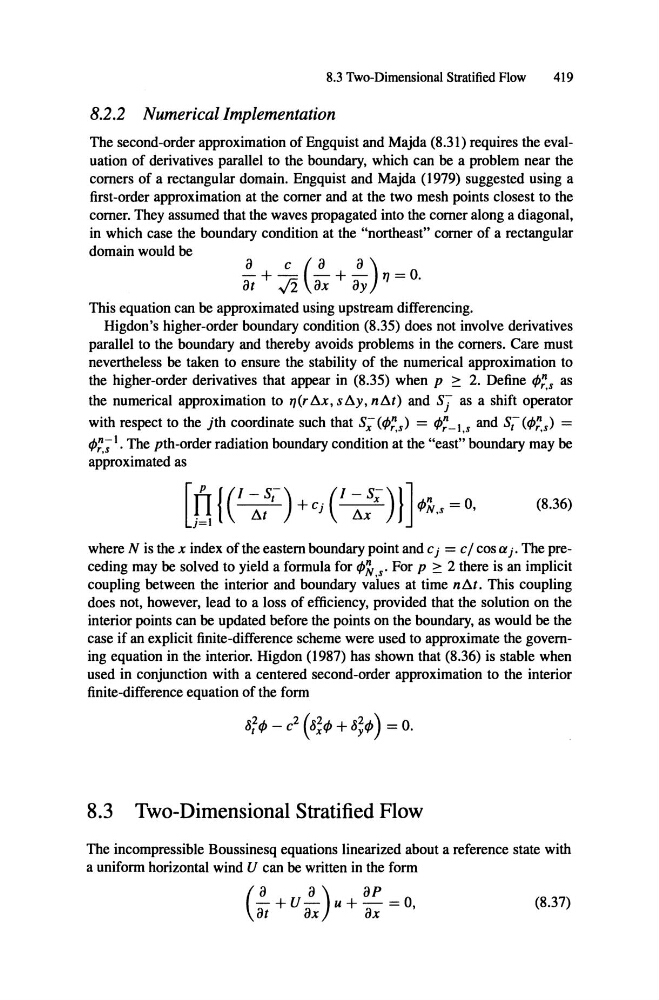
1 • The pth-order radiation boundary condition at the "east" boundary may be
approximated as
(8.36)
where N is the x index of the eastern boundary point and C j = C/ cos at- The preceding may be solved to yield a fonnula for tP' N.s:For p 2 there is an implicit
coupling between the interior and boundary values at time n St . This coupling
does not, however, lead to a loss of efficiency, provided that the solution on the
interior points can be updated before the points on the boundary, as would be the
case if an explicit finite-difference scheme were used to approximate the governing equation in the interior. Higdon (1987) has shown that (8.36) is stable when
used in conjunction with a centered second-order approximation to the interior
finite-difference equation of the form
8;tP - c
2
(8;tP + 8;tP) = o.
8.3 Two-Dimensional Stratified Flow
The incompressible Boussinesq equations linearized about a reference state with
a uniform horizontal wind U can be written in the form
( -+U8
8 )
u+- =0,
8P
(8.37)
8t
8x
8x
419
8.2.2 Numericallmplementation
The second-order approximation of Engquist and Majda (8.31) requires the evaluation of derivatives parallel to the boundary, which can be a problem near the
corners of a reetangular domain . Engquist and Majda (1979) suggested using a
first-order approximation at the corner and at the two mesh points closest to the
corner. They assumed that the waves propagated into the corner along a diagonal,
in which case the boundary condition at the "northeast" corner of a reetangular
domain would be
8
C (8 8)
8t + .fi 8x + 8y 1J = O.
This equation can be approximated using upstream differencing.
Higdon 's higher-order boundary condition (8.35) does not involve derivatives
parallel to the boundary and thereby avoids problems in the corners. Care must
nevertheless be taken to ensure the stability of the numerical approximation to
the higher-order derivatives that appear in (8.35) when p
2. Define
as
the numerical approximation to 1J(r!i.x,s!i.y,n!i.t) and Sj as a shift operator
with respect to the jth coordinate such that
=
and
=
1 • The pth-order radiation boundary condition at the "east" boundary may be
approximated as
(8.36)
where N is the x index of the eastern boundary point and C j = C/ cos at- The preceding may be solved to yield a fonnula for tP' N.s:For p 2 there is an implicit
coupling between the interior and boundary values at time n St . This coupling
does not, however, lead to a loss of efficiency, provided that the solution on the
interior points can be updated before the points on the boundary, as would be the
case if an explicit finite-difference scheme were used to approximate the governing equation in the interior. Higdon (1987) has shown that (8.36) is stable when
used in conjunction with a centered second-order approximation to the interior
finite-difference equation of the form
8;tP - c
2
(8;tP + 8;tP) = o.
8.3 Two-Dimensional Stratified Flow
The incompressible Boussinesq equations linearized about a reference state with
a uniform horizontal wind U can be written in the form
( -+U8
8 )
u+- =0,
8P
(8.37)
8t
8x
8x