

8.2 Two-Dimensional Shallow-Water Flow
417
Suppose that a wave of unit amplitude in 11 strikes the boundary and is reftected
as a wave of amplitude r , Since both the first- and second-order one-way wave
equations are linear functions of 11, they cannot be satisfied at x = L unless the
incident and reftected waves are linearly dependent functions of y and t, The frequency and the wave number parallel to the y-axis must therefore be the same
in the incident and reftected waves. Then it follows from the dispersion relation
(8.27) that the wave numbers parallel to the x-axis have the same magnitude and
opposite sign and that the sum of the incident and reftected waves may be expressed in the form
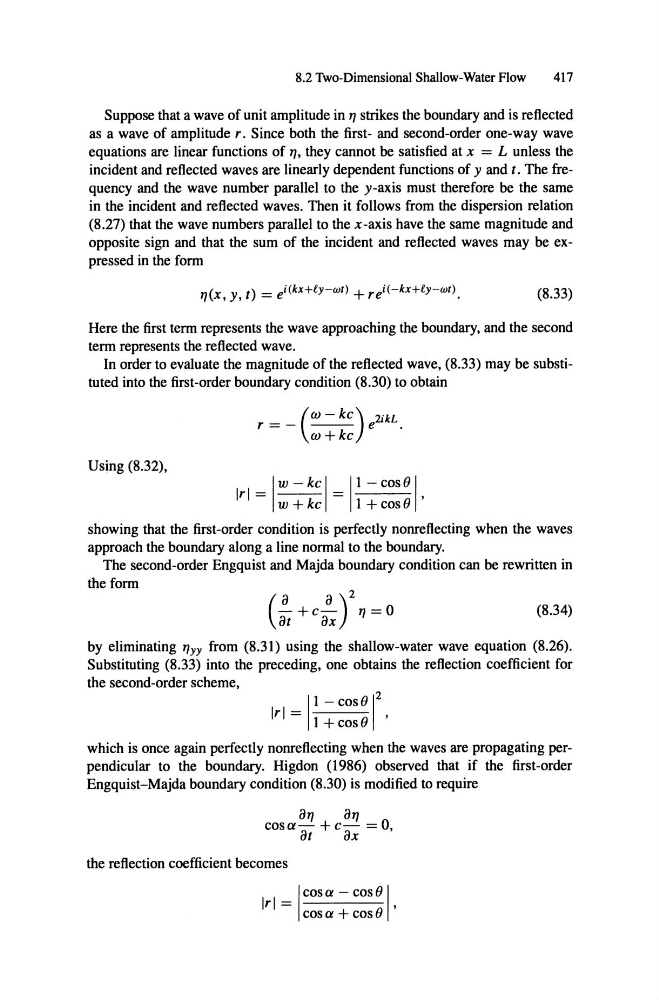
11(X, y, t) = ei (kx +ly-wt ) + rei (-kx +ly-wt ).
(8.33)
Here the first term represents the wave approaching the boundary, and the second
term represents the reftected wave.
In order to evaluate the magnitude of the reftected wave, (8.33) may be substituted into the first-order boundary condition (8.30) to obtain
r = _ (w -kC) e2ikL.
co + kc
=
a
-
a )2
+c_li - cosO 1
I + cos 0 •
2
Ir I = I: I I ::::I ·
Using (8.32),
showing that the first-order condition is perfectly nonreftecting when the waves
approach the boundary along a line normal to the boundary.
The second-order Engquist and Majda boundary condition can be rewritten in
the form
( at ax
11 = 0
(8.34)
by eliminating 11yy from (8.31) using the shallow-water wave equation (8.26).
Substituting (8.33) into the preceding, one obtains the reftection coefficient for
the second-order scheme,
IrI -
which is once again perfectly nonreftecting when the waves are propagating perpendicular to the boundary. Higdon (1986) observed that if the first-order
Engquist-Majda boundary condition (8.30) is modified to require
cosa- + c - = 0,
a11
a11
at ax
the reftection coefficient becomes
_I
rl- cos o + cosO
I
cos a - cos 0 I ,
417
Suppose that a wave of unit amplitude in 11 strikes the boundary and is reftected
as a wave of amplitude r , Since both the first- and second-order one-way wave
equations are linear functions of 11, they cannot be satisfied at x = L unless the
incident and reftected waves are linearly dependent functions of y and t, The frequency and the wave number parallel to the y-axis must therefore be the same
in the incident and reftected waves. Then it follows from the dispersion relation
(8.27) that the wave numbers parallel to the x-axis have the same magnitude and
opposite sign and that the sum of the incident and reftected waves may be expressed in the form
11(X, y, t) = ei (kx +ly-wt ) + rei (-kx +ly-wt ).
(8.33)
Here the first term represents the wave approaching the boundary, and the second
term represents the reftected wave.
In order to evaluate the magnitude of the reftected wave, (8.33) may be substituted into the first-order boundary condition (8.30) to obtain
r = _ (w -kC) e2ikL.
co + kc
=
a
-
a )2
+c_li - cosO 1
I + cos 0 •
2
Ir I = I: I I ::::I ·
Using (8.32),
showing that the first-order condition is perfectly nonreftecting when the waves
approach the boundary along a line normal to the boundary.
The second-order Engquist and Majda boundary condition can be rewritten in
the form
( at ax
11 = 0
(8.34)
by eliminating 11yy from (8.31) using the shallow-water wave equation (8.26).
Substituting (8.33) into the preceding, one obtains the reftection coefficient for
the second-order scheme,
IrI -
which is once again perfectly nonreftecting when the waves are propagating perpendicular to the boundary. Higdon (1986) observed that if the first-order
Engquist-Majda boundary condition (8.30) is modified to require
cosa- + c - = 0,
a11
a11
at ax
the reftection coefficient becomes
_I
rl- cos o + cosO
I
cos a - cos 0 I ,