

7.6 Primitive Equation Models
387
In addition to conserving total energy, the preceding vertical discretization also
conserves total mass (see Problem 8). This scheme does not conserve the integrated angular momentum or the integrated potential temperature. Arakawa and
Lamb (1977), Simmons and Burridge (1981), and Arakawa and Konor (1996)
describe alternative vertical discretizations that conserve angular momentum, potential temperature, or various other vertically integrated functions.
7.6.5 Semi-implicit Time-Differencing
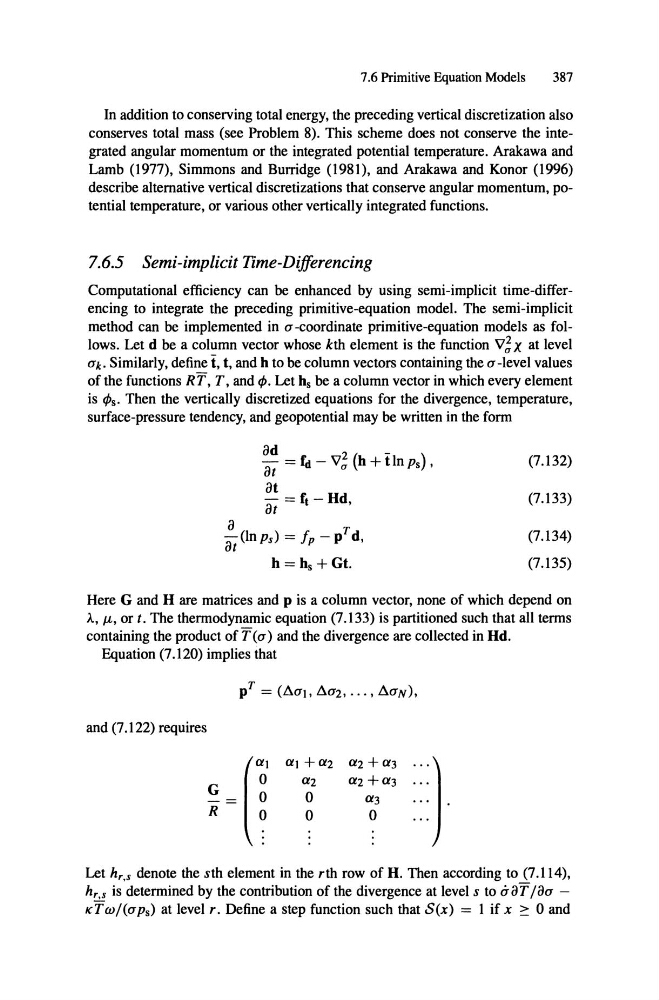
Computational efficiency can be enhanced by using semi-implicit time-differencing to integrate the preceding primitive-equation model. The semi-implicit
method can be implemented in a-coordinate primitive-equation models as follows. Let d be a column vector whose kth element is the function V'; X at level
ak. Similarly, define t, t, and h to be column vectors containing the o -level values
of the functions RT, T, and e. Let h, be a column vector in which every element
is ,ps. Then the vertically discretized equations for the divergence, temperature,
surface-pressure tendency, and geopotential may be written in the form
ad
- = fd - Va h +
2 (
-
t In Ps ,
)
ar
at = f l -Hd,
-
ar
a
T
-(In Ps) = fp -
ar
p d,
h = h, +Gt.
(7.132)
(7.133)
(7.134)
(7.135)
Here G and H are matrices and p is a column vector, none of which depend on
A, JL, or t , The thermodynamic equation (7.133) is partitioned such that all terms
containing the product ofT(a) and the divergence are collected in Hd .
Equation (7.120) implies that
and (7.122) requires
o
o
· ·
·
G
_=
R
0
(
0
Cl )
0
Cl) +Cl2
Cl2
Cl2 +Cl3
Cl2 +Cl3
" ' )
•••
• • •
...
•
Cl3
0
. . .
Let h r • s denote the sth element in the rth row of H . Then according to (7.114),
h r • s is determined by the contribution of the divergence at level s to äaT /aa -
KTw/(aps) at level r . Define a step function such that S(x) = 1 if x 0 and
387
In addition to conserving total energy, the preceding vertical discretization also
conserves total mass (see Problem 8). This scheme does not conserve the integrated angular momentum or the integrated potential temperature. Arakawa and
Lamb (1977), Simmons and Burridge (1981), and Arakawa and Konor (1996)
describe alternative vertical discretizations that conserve angular momentum, potential temperature, or various other vertically integrated functions.
7.6.5 Semi-implicit Time-Differencing
Computational efficiency can be enhanced by using semi-implicit time-differencing to integrate the preceding primitive-equation model. The semi-implicit
method can be implemented in a-coordinate primitive-equation models as follows. Let d be a column vector whose kth element is the function V'; X at level
ak. Similarly, define t, t, and h to be column vectors containing the o -level values
of the functions RT, T, and e. Let h, be a column vector in which every element
is ,ps. Then the vertically discretized equations for the divergence, temperature,
surface-pressure tendency, and geopotential may be written in the form
ad
- = fd - Va h +
2 (
-
t In Ps ,
)
ar
at = f l -Hd,
-
ar
a
T
-(In Ps) = fp -
ar
p d,
h = h, +Gt.
(7.132)
(7.133)
(7.134)
(7.135)
Here G and H are matrices and p is a column vector, none of which depend on
A, JL, or t , The thermodynamic equation (7.133) is partitioned such that all terms
containing the product ofT(a) and the divergence are collected in Hd .
Equation (7.120) implies that
and (7.122) requires
o
o
· ·
·
G
_=
R
0
(
0
Cl )
0
Cl) +Cl2
Cl2
Cl2 +Cl3
Cl2 +Cl3
" ' )
•••
• • •
...
•
Cl3
0
. . .
Let h r • s denote the sth element in the rth row of H . Then according to (7.114),
h r • s is determined by the contribution of the divergence at level s to äaT /aa -
KTw/(aps) at level r . Define a step function such that S(x) = 1 if x 0 and