

hr s
- '- =
t::.a s
KTrS(r-s) [
]
ct r +Str - s - l)ct r - 1
So,
388
7. PhysicallyInsignificant Fast Waves
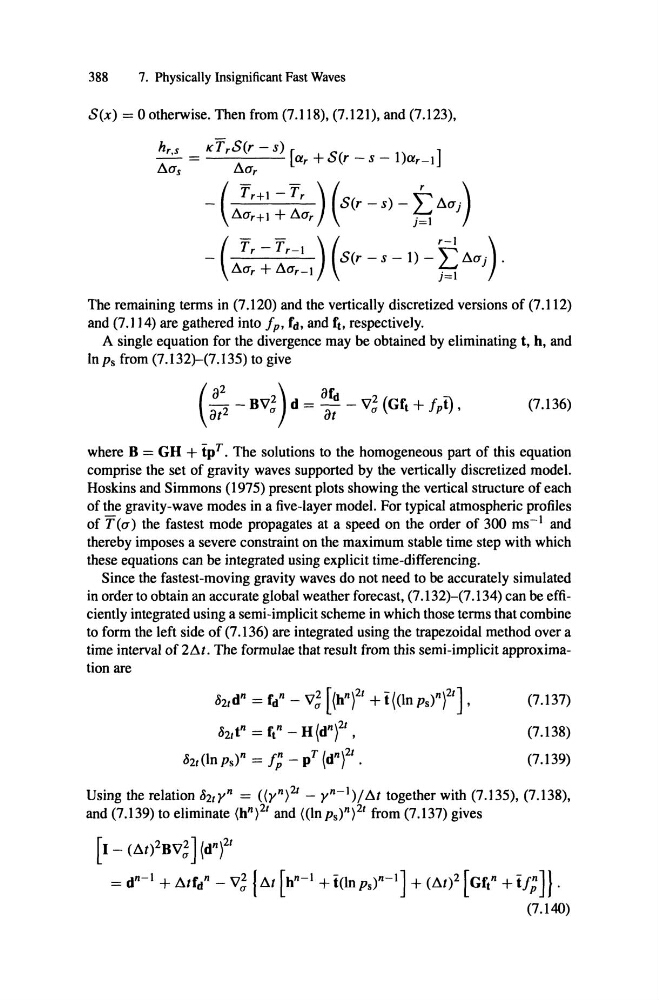
S(x) = 0 otherwise. Then from (7.118), (7.121), and (7.123) ,
-
Tr+1 - r , ) ( S(r -s) -
(
+1 +
j=1
- ( T
r - Tr-I ) (S(r -s -1) - I:t::.a j).
+
j=1
The remaining terms in (7.120) and the vertically discretized versions of (7.112)
and (7.114) are gathered into !p, fd, and f t , respectively.
A single equation for the divergence may be obtained by eliminating t, h, and
In Ps from (7.132)-(7.135) to give
(7.136)
(
where B = GH + tpT . The solutions to the homogeneous part of this equation
comprise the set of gravity waves supported by the vertically discretized model.
Hoskins and Simmons (1975) present plots showing the vertical structure of each
of the gravity-wave modes in a five-layer model. For typical atmospheric profiles
of T(a) the fastest mode propagates at a speed on the order of 300 ms " ! and
thereby imposes a severe constraint on the maximum stable time step with which
these equations can be integrated using explicit time -differencing.
Since the fastest-moving gravity waves do not need to be accurately simulated
in order to obtain an accurate global weather forecast, (7.132)-(7.134) can be efficiently integrated using a serni-implicit scheme in which those terms that combine
to form the left side of (7.136) are integrated using the trapezoidal method over a
time interval of 2t::.t . The formulae that result from this semi-implicit approxirnation are
D2t d" = fd
n - V; [{h n }2t + t{
n - H{d n }2t ,
D2t(1nps)n =!; - pT {d n }2t .
(7.137)
(7.138)
(7.139)
Using the relation D2tyn = «(yn)2t - yn-I)/t::.t togetber with (7.135), (7.138),
and (7.139) to eliminate (h n )2t and ((1nps)n)2t from (7.137) gives
[I - (M)2BV;] {d n }2t
= d
n -
I
+ t::.tfdn - V; {t::.t [h
n -
I
+ t(1n ps)n-I ] + (t::.t)2 [Gf t
n
+ tt;J} .
(7.140)
- '- =
t::.a s
KTrS(r-s) [
]
ct r +Str - s - l)ct r - 1
So,
388
7. PhysicallyInsignificant Fast Waves
S(x) = 0 otherwise. Then from (7.118), (7.121), and (7.123) ,
-
Tr+1 - r , ) ( S(r -s) -
(
+1 +
j=1
- ( T
r - Tr-I ) (S(r -s -1) - I:t::.a j).
+
j=1
The remaining terms in (7.120) and the vertically discretized versions of (7.112)
and (7.114) are gathered into !p, fd, and f t , respectively.
A single equation for the divergence may be obtained by eliminating t, h, and
In Ps from (7.132)-(7.135) to give
(7.136)
(
where B = GH + tpT . The solutions to the homogeneous part of this equation
comprise the set of gravity waves supported by the vertically discretized model.
Hoskins and Simmons (1975) present plots showing the vertical structure of each
of the gravity-wave modes in a five-layer model. For typical atmospheric profiles
of T(a) the fastest mode propagates at a speed on the order of 300 ms " ! and
thereby imposes a severe constraint on the maximum stable time step with which
these equations can be integrated using explicit time -differencing.
Since the fastest-moving gravity waves do not need to be accurately simulated
in order to obtain an accurate global weather forecast, (7.132)-(7.134) can be efficiently integrated using a serni-implicit scheme in which those terms that combine
to form the left side of (7.136) are integrated using the trapezoidal method over a
time interval of 2t::.t . The formulae that result from this semi-implicit approxirnation are
D2t d" = fd
n - V; [{h n }2t + t{
n - H{d n }2t ,
D2t(1nps)n =!; - pT {d n }2t .
(7.137)
(7.138)
(7.139)
Using the relation D2tyn = «(yn)2t - yn-I)/t::.t togetber with (7.135), (7.138),
and (7.139) to eliminate (h n )2t and ((1nps)n)2t from (7.137) gives
[I - (M)2BV;] {d n }2t
= d
n -
I
+ t::.tfdn - V; {t::.t [h
n -
I
+ t(1n ps)n-I ] + (t::.t)2 [Gf t
n
+ tt;J} .
(7.140)