

386
7. Physically Insignificant Fast Waves
therefore conserve total energy, provided that it satisfies the discrete analogues of
1 8
-(Eä)da = 0
o 8a
(7.130)
and
1
1
8
o
F da = -(cPsPs) .
81
(7.131)
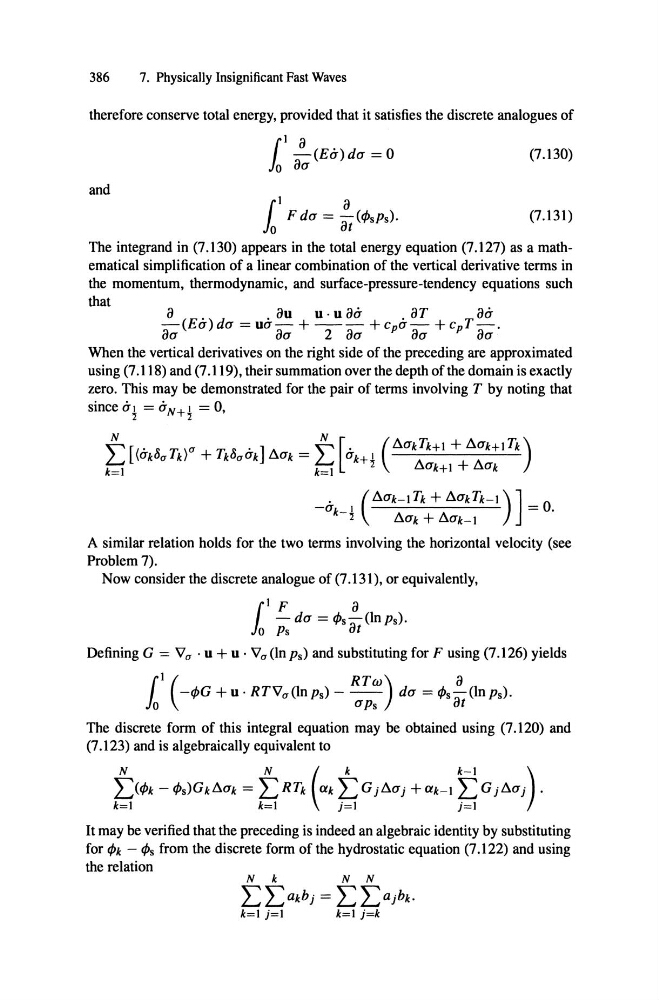
The integrand in (7.130) appears in the total energy equation (7.127) as a mathematical simplification of a linear combination of the vertical derivative terms in
the momentum, thermodynamic, and surface-pressure-tendency equations such
that
-(Ea) o = ua- + ---- + cpa- + cpT8
. d
. 8u
u - u 8ä
. 8T
8ä
Ba
Ba
2 8a
Ba
Ba
When the vertical derivatives on the right side of the preceding are approximated
using (7.118) and (7.119), their summation over the depth of the domain is exactly
zero. This may be demonstrated for the pair of terms involving T by noting that
since äl = ä N +
1
1 = 0,
1
L...J (akDa Tk) + nDaak L\ak =
•
o
. ]
L...J ak+
(L\akn+1 +L\ak+ITk)
J
k=1
k=1
1
L\ak+1 + L\ak
-ak
. I
(L\ak-I Tk + L\akTk-l) ] = O.
-1
L\ak + L\ak-I
A similar relation holds for the two terms involving the horizontal velocity (see
Problem 7).
Now consider the discrete analogue of (7.131), or equivalently,
1
1 F
- da = cPs-(1nps) .
8
o Ps
81
Defining G = Va . U + U . Va (1n Ps) and substituting for F using (7.126) yields
-cPG + u· RTV a (1n Ps) - -
1 o
1 (
RTW) -
o p,
da = cPs-(1nps) .
8
81
The discrete form of this integral equation may be obtained using (7.120) and
-
t,Rr. (••t
(7.123) and is algebraically equivalent to
1
G jMj +.k-1 Gi""j) ,
It may be verified that the preceding is indeed an algebraic identity by substituting
for cPk - cPs from the discrete form of the hydrostatic equation (7.122) and using
the relation
7. Physically Insignificant Fast Waves
therefore conserve total energy, provided that it satisfies the discrete analogues of
1 8
-(Eä)da = 0
o 8a
(7.130)
and
1
1
8
o
F da = -(cPsPs) .
81
(7.131)
The integrand in (7.130) appears in the total energy equation (7.127) as a mathematical simplification of a linear combination of the vertical derivative terms in
the momentum, thermodynamic, and surface-pressure-tendency equations such
that
-(Ea) o = ua- + ---- + cpa- + cpT8
. d
. 8u
u - u 8ä
. 8T
8ä
Ba
Ba
2 8a
Ba
Ba
When the vertical derivatives on the right side of the preceding are approximated
using (7.118) and (7.119), their summation over the depth of the domain is exactly
zero. This may be demonstrated for the pair of terms involving T by noting that
since äl = ä N +
1
1 = 0,
1
L...J (akDa Tk) + nDaak L\ak =
•
o
. ]
L...J ak+
(L\akn+1 +L\ak+ITk)
J
k=1
k=1
1
L\ak+1 + L\ak
-ak
. I
(L\ak-I Tk + L\akTk-l) ] = O.
-1
L\ak + L\ak-I
A similar relation holds for the two terms involving the horizontal velocity (see
Problem 7).
Now consider the discrete analogue of (7.131), or equivalently,
1
1 F
- da = cPs-(1nps) .
8
o Ps
81
Defining G = Va . U + U . Va (1n Ps) and substituting for F using (7.126) yields
-cPG + u· RTV a (1n Ps) - -
1 o
1 (
RTW) -
o p,
da = cPs-(1nps) .
8
81
The discrete form of this integral equation may be obtained using (7.120) and
-
t,Rr. (••t
(7.123) and is algebraically equivalent to
1
G jMj +.k-1 Gi""j) ,
It may be verified that the preceding is indeed an algebraic identity by substituting
for cPk - cPs from the discrete form of the hydrostatic equation (7.122) and using
the relation