

7.6 Primitive Equation Models
385
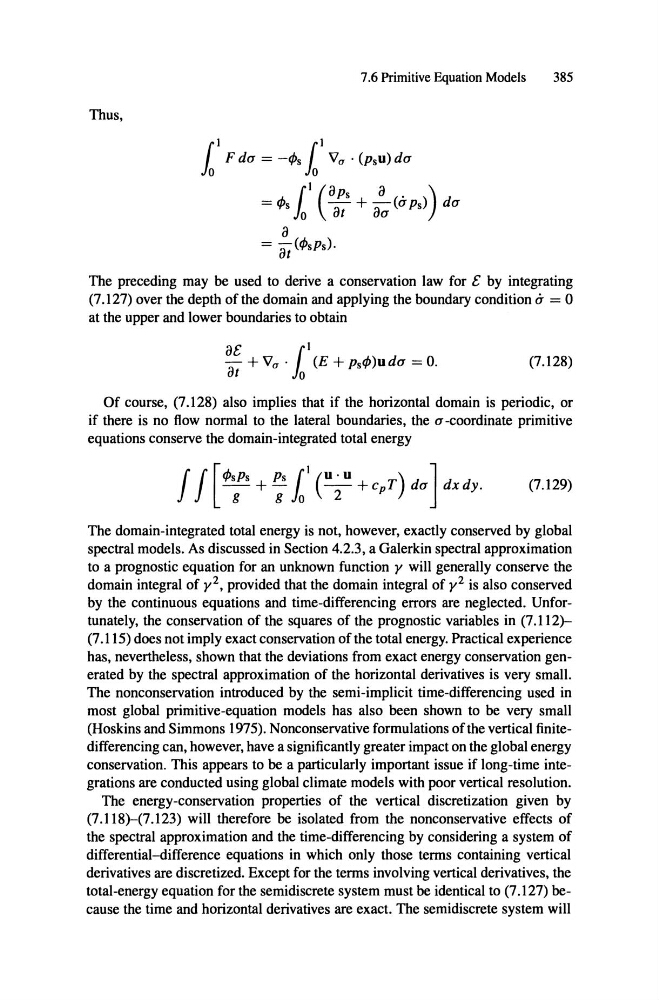
Thus,
The preceding may be used to derive a conservation law for e by integrating
(7.127) over the depth of the domain and applying the boundary condition Ö' = 0
1
0
at the upper and lower boundaries to obtain
- »e
at
+ Va' 1 (E + ps1J)oda = o.
(7.128)
Of course, (7.128) also implies that if the horizontal domain is periodic , or
if there is no flow normal to the lateral boundaries, the a -coordinate primitive
equations conserve the domain-integrated total energy
ff [ -g- 1Jsps g Ps l« r (0 2 '0
+
- .
+cpT da dxdy.
(7.129)
The dornain-integrated total energy is not, however, exactly conserved by global
spectral models. As discussed in Section 4.2.3, a Galerkin spectral approximation
to a prognostic equation for an unknown function y will generally conserve the
domain integral of y2 , provided that the domain integral of y2 is also conserved
by the continuous equations and time-differencing errors are neglected. Unfortunately, the conservation of the squares of the prognostic variables in (7.112)(7.115) does not imply exact conservation of the total energy. Practical experience
has, nevertheless, shown that the deviations from exact energy conservation generated by the spectral approximation of the horizontal derivatives is very small .
The nonconservation introduced by the semi-implicit time-differencing used in
most global primitive-equation models has also been shown to be very small
(Hoskins and Simmons 1975). Nonconservative formulations of the vertical finitedifferencing can, however, have a significantly greater impact on the global energy
conservation. This appears to be a particularly important issue if long-time integrations are conducted using global c1imate models with poor vertical resolution.
The energy-conservation properties of the vertical discretization given by
(7.118)-(7.123) will therefore be isolated from the nonconservative effects of
the spectral approximation and the time-differencing by considering a system of
differential-difference equations in which only those terms containing vertical
derivatives are discretized. Except for the terms involving vertical derivatives, the
total-energy equation for the semidiscrete system must be identical to (7.127) 00cause the time and horizontal derivatives are exact. The semidiscrete system will
385
Thus,
The preceding may be used to derive a conservation law for e by integrating
(7.127) over the depth of the domain and applying the boundary condition Ö' = 0
1
0
at the upper and lower boundaries to obtain
- »e
at
+ Va' 1 (E + ps1J)oda = o.
(7.128)
Of course, (7.128) also implies that if the horizontal domain is periodic , or
if there is no flow normal to the lateral boundaries, the a -coordinate primitive
equations conserve the domain-integrated total energy
ff [ -g- 1Jsps g Ps l« r (0 2 '0
+
- .
+cpT da dxdy.
(7.129)
The dornain-integrated total energy is not, however, exactly conserved by global
spectral models. As discussed in Section 4.2.3, a Galerkin spectral approximation
to a prognostic equation for an unknown function y will generally conserve the
domain integral of y2 , provided that the domain integral of y2 is also conserved
by the continuous equations and time-differencing errors are neglected. Unfortunately, the conservation of the squares of the prognostic variables in (7.112)(7.115) does not imply exact conservation of the total energy. Practical experience
has, nevertheless, shown that the deviations from exact energy conservation generated by the spectral approximation of the horizontal derivatives is very small .
The nonconservation introduced by the semi-implicit time-differencing used in
most global primitive-equation models has also been shown to be very small
(Hoskins and Simmons 1975). Nonconservative formulations of the vertical finitedifferencing can, however, have a significantly greater impact on the global energy
conservation. This appears to be a particularly important issue if long-time integrations are conducted using global c1imate models with poor vertical resolution.
The energy-conservation properties of the vertical discretization given by
(7.118)-(7.123) will therefore be isolated from the nonconservative effects of
the spectral approximation and the time-differencing by considering a system of
differential-difference equations in which only those terms containing vertical
derivatives are discretized. Except for the terms involving vertical derivatives, the
total-energy equation for the semidiscrete system must be identical to (7.127) 00cause the time and horizontal derivatives are exact. The semidiscrete system will