

7.6 Primitive EquationModels
377
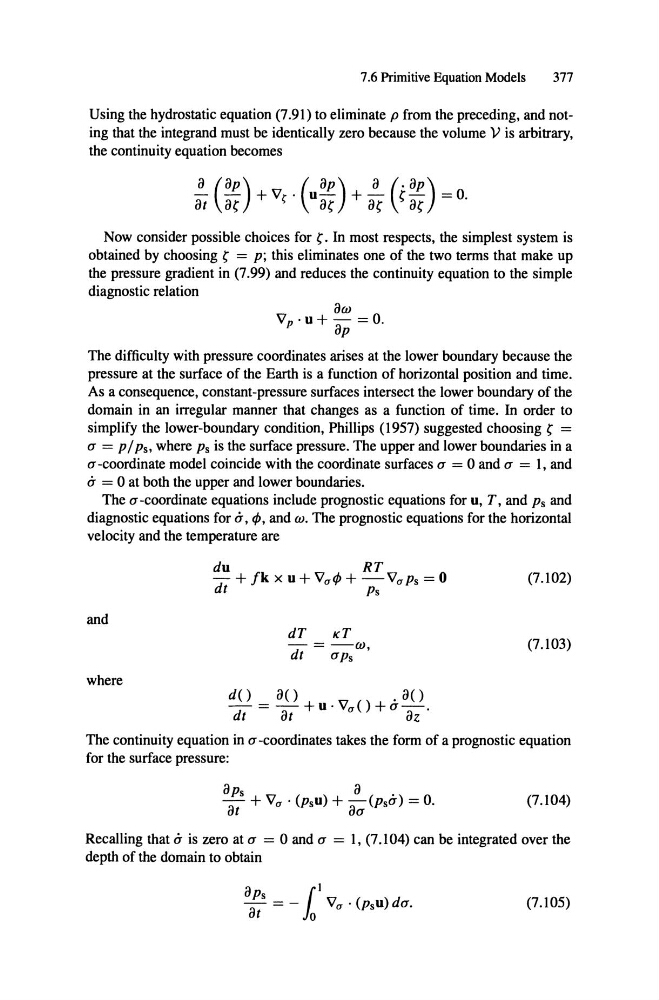
Using the hydrostatic equation (7.91) to eliminate p from the preceding, and noting that the integrand must be identically zero because the volume V is arbitrary,
the continuity equation becomes
8 (8 P) +
(8 u
P)
P)
+ 8 ( .8 = O.
8t
Now consider possible choices for
In most respects, the simplest system is
obtained by choosing = P; this eliminates one of the two terms that make up
the pressure gradient in (7.99) and reduces the continuity equation to the simple
diagnostic relation
8w
'Vp ·u+- =0.
8p
The difficulty with pressure coordinates arises at the lower boundary because the
pressure at the surface of the Earth is a function of horizontal position and time .
As a consequence, constant-pressure surfaces intersect the lower boundary of the
domain in an irregular manner that changes as a function of time. In order to
simplify the lower-boundary condition , Phillips (1957) suggested choosing =
a = p]Ps, where Ps is the surface pressure . The upper and lower boundaries in a
a -coordinate model coincide with the coordinate surfaces a = 0 and a = I , and
ä = 0 at both the upper and lower boundaries .
The o -coordinate equations include prognostic equations for u, T , and Ps and
diagnostic equations for ä, rjJ, and to. The prognostic equations for the horizontal
velocity and the temperature are
du
-
RT
+ fk x u + 'VurjJ + -'VuPs = 0
dt
Ps
(7.102)
and
dT
KT
- = - w ,
dt
o p,
(7.103)
where
dO = 80 + u . 'V 0 + ä 8 0.
dt
8t
u
8z
The continuity equation in o -coordinates takes the form of a prognostic equation
for the surface pressure:
-
8ps
+ 'V u' (Psu) + -(psa) = O.
8
.
8t
8a
(7.104)
Recalling that ä is zero at a = 0 and a = I , (7.104) can be integrated over the
depth of the domain to obtain
8ps = - 1
(7.105)
- 8t
1
'V u . (Psu) da.
0
377
Using the hydrostatic equation (7.91) to eliminate p from the preceding, and noting that the integrand must be identically zero because the volume V is arbitrary,
the continuity equation becomes
8 (8 P) +
(8 u
P)
P)
+ 8 ( .8 = O.
8t
Now consider possible choices for
In most respects, the simplest system is
obtained by choosing = P; this eliminates one of the two terms that make up
the pressure gradient in (7.99) and reduces the continuity equation to the simple
diagnostic relation
8w
'Vp ·u+- =0.
8p
The difficulty with pressure coordinates arises at the lower boundary because the
pressure at the surface of the Earth is a function of horizontal position and time .
As a consequence, constant-pressure surfaces intersect the lower boundary of the
domain in an irregular manner that changes as a function of time. In order to
simplify the lower-boundary condition , Phillips (1957) suggested choosing =
a = p]Ps, where Ps is the surface pressure . The upper and lower boundaries in a
a -coordinate model coincide with the coordinate surfaces a = 0 and a = I , and
ä = 0 at both the upper and lower boundaries .
The o -coordinate equations include prognostic equations for u, T , and Ps and
diagnostic equations for ä, rjJ, and to. The prognostic equations for the horizontal
velocity and the temperature are
du
-
RT
+ fk x u + 'VurjJ + -'VuPs = 0
dt
Ps
(7.102)
and
dT
KT
- = - w ,
dt
o p,
(7.103)
where
dO = 80 + u . 'V 0 + ä 8 0.
dt
8t
u
8z
The continuity equation in o -coordinates takes the form of a prognostic equation
for the surface pressure:
-
8ps
+ 'V u' (Psu) + -(psa) = O.
8
.
8t
8a
(7.104)
Recalling that ä is zero at a = 0 and a = I , (7.104) can be integrated over the
depth of the domain to obtain
8ps = - 1
(7.105)
- 8t
1
'V u . (Psu) da.
0