

376
7. Physically Insignificant Fast Waves
Using the hydrostatic relation (7.91) and defining the geopotentia1 if> = sz,
and the horizontal momentum equations in the transforrned coordinates become
where
du
-
RT
+ fk x u+ Vi;if>+ -Vi;P =0,
dt
P
dO = 00 + u . V () + i 00
dt
ot
i;
(7.99)
(7.100)
and i = d / d t. The thermodynamic equation in the transforrned coordinates is
identical to (7.98), except that the total time derivative is computed using (7.100).
The hydrostatic equation may be written as
oif>
RT op
- = - - -
P
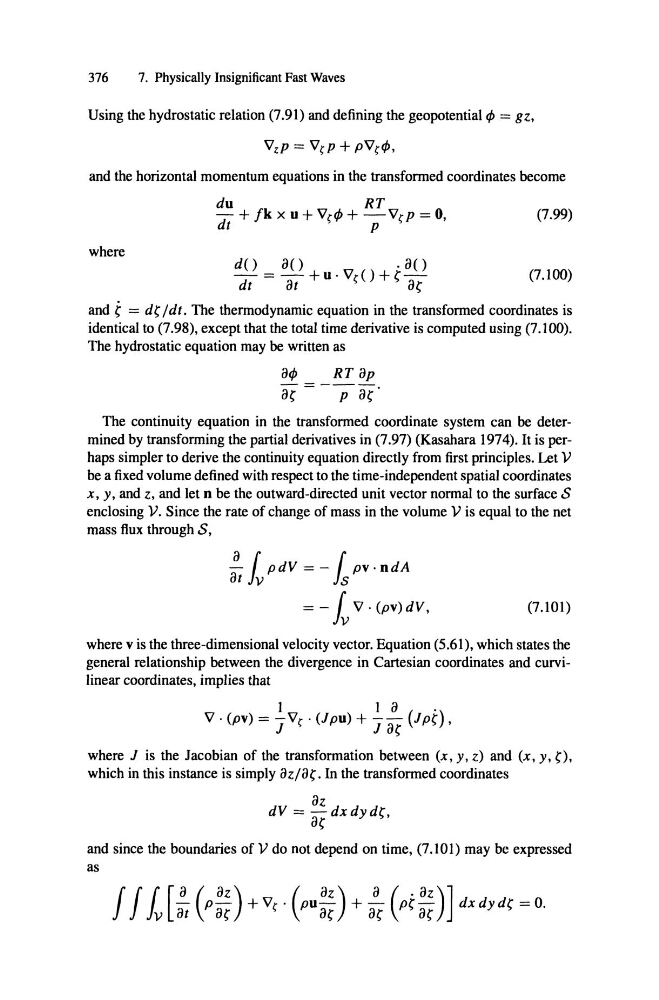
The continuity equation in the transforrned coordinate system can be determined by transforrning the partial derivatives in (7.97) (Kasahara 1974). It is perhaps simpler to derive the continuity equation directly from first principles. Let V
be a fixed volume defined with respect to the tirne-independent spatial coordinates
x, y, and z. and let n be the outward-directed unit vector normal to the surface S
enclosing V. Since the rate of change of mass in the volume V is equal to the net
mass flux through S,
{pdV=ot Jv
(pv .ndA
Js
= - [ V· (pv) dV,
(7.101)
where v is the three-dirnensional velocity vector. Equation (5.61), which states the
general relationship between the divergence in Cartesian coordinates and curvilinear coordinates, implies that
1
1 0 ( ')
where J is the Jacobian of the transformation between (x, y , z) and (x, y, 0,
which in this instance is simply
In the transforrned coordinates
dV = oz
and since the boundaries of V do not depend on time, (7.101) may be expressed
as
7. Physically Insignificant Fast Waves
Using the hydrostatic relation (7.91) and defining the geopotentia1 if> = sz,
and the horizontal momentum equations in the transforrned coordinates become
where
du
-
RT
+ fk x u+ Vi;if>+ -Vi;P =0,
dt
P
dO = 00 + u . V () + i 00
dt
ot
i;
(7.99)
(7.100)
and i = d / d t. The thermodynamic equation in the transforrned coordinates is
identical to (7.98), except that the total time derivative is computed using (7.100).
The hydrostatic equation may be written as
oif>
RT op
- = - - -
P
The continuity equation in the transforrned coordinate system can be determined by transforrning the partial derivatives in (7.97) (Kasahara 1974). It is perhaps simpler to derive the continuity equation directly from first principles. Let V
be a fixed volume defined with respect to the tirne-independent spatial coordinates
x, y, and z. and let n be the outward-directed unit vector normal to the surface S
enclosing V. Since the rate of change of mass in the volume V is equal to the net
mass flux through S,
{pdV=ot Jv
(pv .ndA
Js
= - [ V· (pv) dV,
(7.101)
where v is the three-dirnensional velocity vector. Equation (5.61), which states the
general relationship between the divergence in Cartesian coordinates and curvilinear coordinates, implies that
1
1 0 ( ')
where J is the Jacobian of the transformation between (x, y , z) and (x, y, 0,
which in this instance is simply
In the transforrned coordinates
dV = oz
and since the boundaries of V do not depend on time, (7.101) may be expressed
as