

364
7. Physieally InsignifieantFast Waves
(b)
5
(c)
;
"
,.,.....
E
......,
N
\)
-5
"
L
- '
- L
(d)
r
l
35
J_.
-15
x (km)
35 -15
x (km)
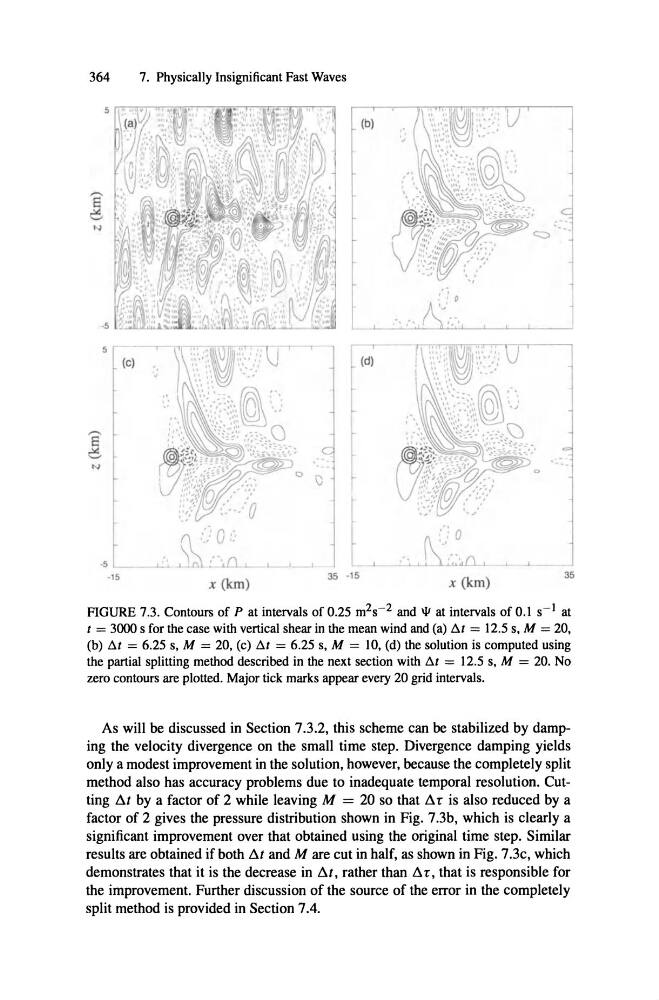
FIGURE 7.3. Contours of P at intervals of 0.25 m 2s- 2 and \l1 at intervals of 0.1 s-l at
I = 3000 s for the ease with vertieal shear in the mean wind and (a) Öl = 12,5 s, M = 20,
(b) Öl = 6.25 s, M = 20, (e) M = 6.25 s, M = 10, (d) the solution is computed using
the partial splitting method deseribed in the next section with Öl = 12.5 s, M = 20. No
zero eontoursare plotted. Major tick marks appear every20 grid intervals.
As will be discussed in Section 7.3 .2, this scheme can be stabilized by damping the velocity divergence on the small time step. Divergence damping yields
only a modest improvement in the solution, however, because the completely split
method also has accuracy problems due to inadequate temporal resolution. Cutting At by a factor of 2 while leaving M = 20 so that At" is also reduced by a
factor of 2 gives the pressure distribution shown in Fig. 7.3b, which is clearly a
significant improvement over that obtained using the original time step . Similar
results are obtained if both At and M are cut in half, as shown in Fig . 7.3c, which
demonstrates that it is the decrease in At, rather than At", that is responsible for
the improvement. Further discussion of the source of the error in the completely
split method is provided in Section 7.4.
7. Physieally InsignifieantFast Waves
(b)
5
(c)
;
"
,.,.....
E
......,
N
\)
-5
"
L
- '
- L
(d)
r
l
35
J_.
-15
x (km)
35 -15
x (km)
FIGURE 7.3. Contours of P at intervals of 0.25 m 2s- 2 and \l1 at intervals of 0.1 s-l at
I = 3000 s for the ease with vertieal shear in the mean wind and (a) Öl = 12,5 s, M = 20,
(b) Öl = 6.25 s, M = 20, (e) M = 6.25 s, M = 10, (d) the solution is computed using
the partial splitting method deseribed in the next section with Öl = 12.5 s, M = 20. No
zero eontoursare plotted. Major tick marks appear every20 grid intervals.
As will be discussed in Section 7.3 .2, this scheme can be stabilized by damping the velocity divergence on the small time step. Divergence damping yields
only a modest improvement in the solution, however, because the completely split
method also has accuracy problems due to inadequate temporal resolution. Cutting At by a factor of 2 while leaving M = 20 so that At" is also reduced by a
factor of 2 gives the pressure distribution shown in Fig. 7.3b, which is clearly a
significant improvement over that obtained using the original time step . Similar
results are obtained if both At and M are cut in half, as shown in Fig . 7.3c, which
demonstrates that it is the decrease in At, rather than At", that is responsible for
the improvement. Further discussion of the source of the error in the completely
split method is provided in Section 7.4.