

7.3 Fractional-Step Methods
365
7.3.2 Partially Split Operators
The first task involved in implementing the fractional-step methods discussed in
the previous section is to identify those terms in the goveming equations that need
to be updated on a shorter time step. Having made this identification , it is possible
to leave all the terms in the goveming equations coupled together and to update
those terms goveming the slowly evolving processes less frequently than those
terms responsible for the propagation of high-frequency physically insignificant
waves. This technique will be referred to as a partial splitting, since the individual
fractional steps are never completely decoupled in the conventional manner given
by (7.64) and (7.65).
Once again the linearized one-dimensional shallow-water system provides a
simple context in which to illustrate partial splitting. As before, it is assumed
that the gravity-wave phase speed is much larger than the velocity of the mean
flow U . Klemp and Wilhelmson (1978) and Tatsumi (1983) have suggested a
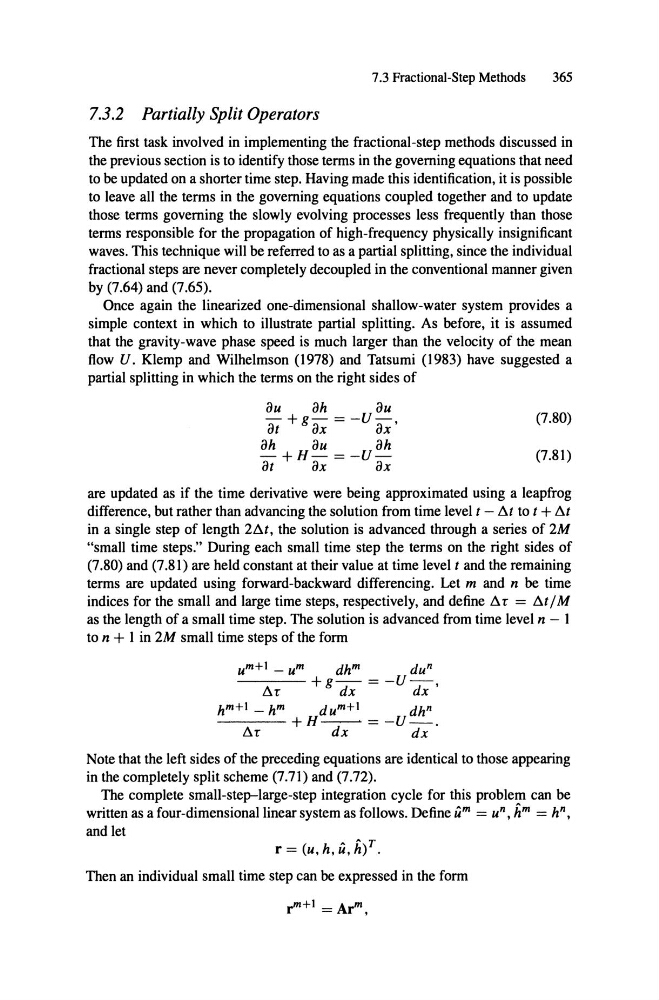
partial splitting in which the terms on the right sides of
Bu
oh
OU
- + g - = - U - ,
01
OX
OX
oh
OU
oh
- + H - = - U -
01
OX
OX
(7.80)
(7.81)
are updated as if the time derivative were being approximated using a leapfrog
difference, but rather than advancing the solution from time level 1- l:!..t to 1+ l:!..1
in a single step of length 2l:!..1, the solution is advanced through aseries of 2M
"small time steps," During each small time step the terms on the right sides of
(7.80) and (7.81) are held constant at their value at time levelland the remaining
terms are updated using fotward-backward differencing. Let m and n be time
indices for the small and large time steps, respectively, and define l:!.. r = l:!..t / M
as the length of a small time step. The solution is advanced from time level n - 1
to n + 1 in 2M small time steps of the form
u m +I _ um
l:!..r
h m + 1 - h m
dh'"
dun
+ g dx = -U dx '
du m + 1
dh n
- - - - + H - = - U - .
l:!..r
dx
dx
Note that the left sides of the preceding equations are identical to those appearing
in the completely split scheme (7.71) and (7.72).
The complete small-step-large-step integration cycle for this problem can be
written as a four-dimensionallinear system as folIows. Define um = u",j,m = h" ,
and let
r = (u, h, u, h)
T .
Then an individual small time step can be expressed in the form
365
7.3.2 Partially Split Operators
The first task involved in implementing the fractional-step methods discussed in
the previous section is to identify those terms in the goveming equations that need
to be updated on a shorter time step. Having made this identification , it is possible
to leave all the terms in the goveming equations coupled together and to update
those terms goveming the slowly evolving processes less frequently than those
terms responsible for the propagation of high-frequency physically insignificant
waves. This technique will be referred to as a partial splitting, since the individual
fractional steps are never completely decoupled in the conventional manner given
by (7.64) and (7.65).
Once again the linearized one-dimensional shallow-water system provides a
simple context in which to illustrate partial splitting. As before, it is assumed
that the gravity-wave phase speed is much larger than the velocity of the mean
flow U . Klemp and Wilhelmson (1978) and Tatsumi (1983) have suggested a
partial splitting in which the terms on the right sides of
Bu
oh
OU
- + g - = - U - ,
01
OX
OX
oh
OU
oh
- + H - = - U -
01
OX
OX
(7.80)
(7.81)
are updated as if the time derivative were being approximated using a leapfrog
difference, but rather than advancing the solution from time level 1- l:!..t to 1+ l:!..1
in a single step of length 2l:!..1, the solution is advanced through aseries of 2M
"small time steps," During each small time step the terms on the right sides of
(7.80) and (7.81) are held constant at their value at time levelland the remaining
terms are updated using fotward-backward differencing. Let m and n be time
indices for the small and large time steps, respectively, and define l:!.. r = l:!..t / M
as the length of a small time step. The solution is advanced from time level n - 1
to n + 1 in 2M small time steps of the form
u m +I _ um
l:!..r
h m + 1 - h m
dh'"
dun
+ g dx = -U dx '
du m + 1
dh n
- - - - + H - = - U - .
l:!..r
dx
dx
Note that the left sides of the preceding equations are identical to those appearing
in the completely split scheme (7.71) and (7.72).
The complete small-step-large-step integration cycle for this problem can be
written as a four-dimensionallinear system as folIows. Define um = u",j,m = h" ,
and let
r = (u, h, u, h)
T .
Then an individual small time step can be expressed in the form