

7.2 The Semi-implicit Method
349
earized system
821 Un +un_+g dun
(d 7Jn )21
-
= 0.
(7.32)
dx
dx
Leaving aside possible problems with nonlinear instability, one would intuitively
expeet that solutions to (7.31) and (7.32) would be uneonditionally stable, provided that 7J « H, which is to say that stability would require the gravity-wave
phase speed determined by the mean fluid depth to greatly exeeed any loeal augmentation of the phase speed indueed by a loeal inereasc in depth.
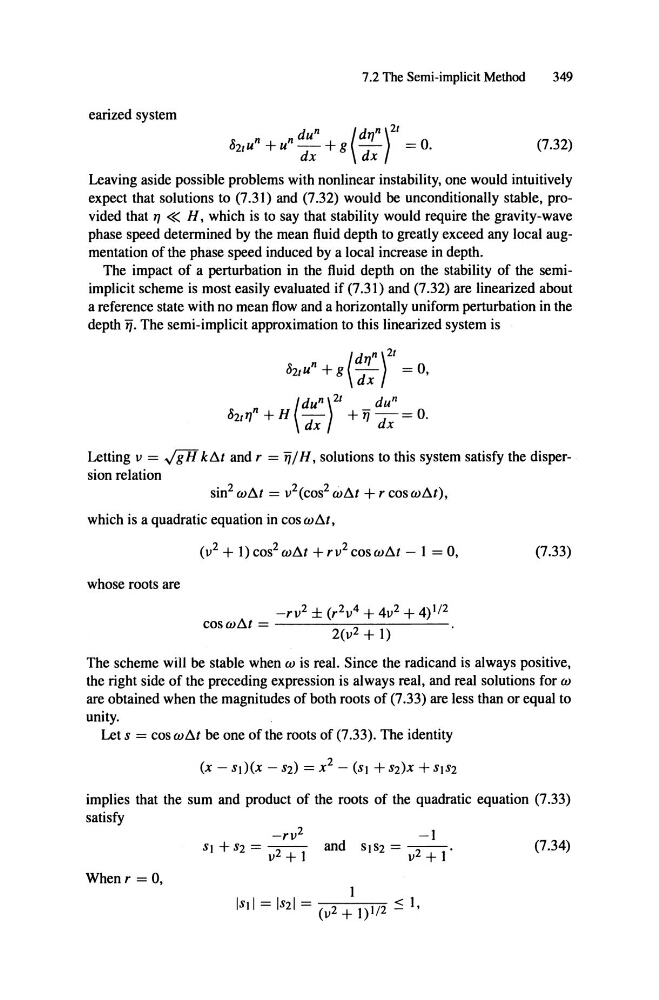
The impact of a perturbation in the fluid depth on the stability of the semiimplieit seheme is most easily evaluated if (7.31) and (7.32) are linearized about
a referenee state with no mean flow and a horizontally uniform perturbation in the
depth Tj. The semi-implicit approximation to this linearized system is
Letting v = Jg H k!i.t and r = Tj / H , solutions to this system satisfy the dispersion relation
sin
2 w!i.t = v
2(eos2 w!i.t + r eos w!i.t) ,
which is a quadratie equation in eos w!i.t,
(v
2
+ I) eos
2 w!i.t +rv
2eosw!i.t - 1= 0,
(7.33)
whose roots are
The seheme will be stable when to is real. Sinee the radicand is always positive,
the right side of the preeeding expression is always real, and real solutions for to
are obtained when the magnitudes of both roots of (7.33) are less than or equal to
unity.
Let S = eos w!i.t be one of the roots of (7.33). The identity
(x - s))(x - S2) = x
2 - (SI + S2)X + SIS2
implies that the sum and produet of the roots of the quadratic equation (7.33)
satisfy
-rv 2
-I
SI +S2 = - 2 - -
v + I
and
(7.34)
SlS2 = - 2 - - '
V + I
Whenr = 0,
349
earized system
821 Un +un_+g dun
(d 7Jn )21
-
= 0.
(7.32)
dx
dx
Leaving aside possible problems with nonlinear instability, one would intuitively
expeet that solutions to (7.31) and (7.32) would be uneonditionally stable, provided that 7J « H, which is to say that stability would require the gravity-wave
phase speed determined by the mean fluid depth to greatly exeeed any loeal augmentation of the phase speed indueed by a loeal inereasc in depth.
The impact of a perturbation in the fluid depth on the stability of the semiimplieit seheme is most easily evaluated if (7.31) and (7.32) are linearized about
a referenee state with no mean flow and a horizontally uniform perturbation in the
depth Tj. The semi-implicit approximation to this linearized system is
Letting v = Jg H k!i.t and r = Tj / H , solutions to this system satisfy the dispersion relation
sin
2 w!i.t = v
2(eos2 w!i.t + r eos w!i.t) ,
which is a quadratie equation in eos w!i.t,
(v
2
+ I) eos
2 w!i.t +rv
2eosw!i.t - 1= 0,
(7.33)
whose roots are
The seheme will be stable when to is real. Sinee the radicand is always positive,
the right side of the preeeding expression is always real, and real solutions for to
are obtained when the magnitudes of both roots of (7.33) are less than or equal to
unity.
Let S = eos w!i.t be one of the roots of (7.33). The identity
(x - s))(x - S2) = x
2 - (SI + S2)X + SIS2
implies that the sum and produet of the roots of the quadratic equation (7.33)
satisfy
-rv 2
-I
SI +S2 = - 2 - -
v + I
and
(7.34)
SlS2 = - 2 - - '
V + I
Whenr = 0,