

348
7. Physically Insignificant Fast Waves
where the finite-difference operator 0/ and the averaging operator { }/ are defined
by (A.1) and (A.2) in the Appendix. Solutions to (7.27) and (7.28) exist of the
form ei(kx-wjM), provided that k and w satisfy the semidiscrete dispersion relation
sinwl:i.t = Uk Sr ± ckAtcoswAt ,
in which c = JgH . This dispersion relation has the same form as (7.25), and
as demonstrated in the preceding section, the method will be stable , provided
that IU I Sc, or equivalently, whenever the phase speed of shallow-water gravity
waves exceeds the speed of the mean flow.
The Coriolis force has been neglected in the preceding shallow-water system,
and as a consequence, there are no Rossby-wave solutions to (7.27) and (7.28). In
a more general system that does include the Coriolis force.' semi-implicit timedifferencing leads to a system that is stable whenever the CFL condition for the
Rossby waves is satisfied. This general case is examincd in more detail in Problems 1-3 at the end of this chapter.
Instead of considering the complications introduced by the presence of Rossby
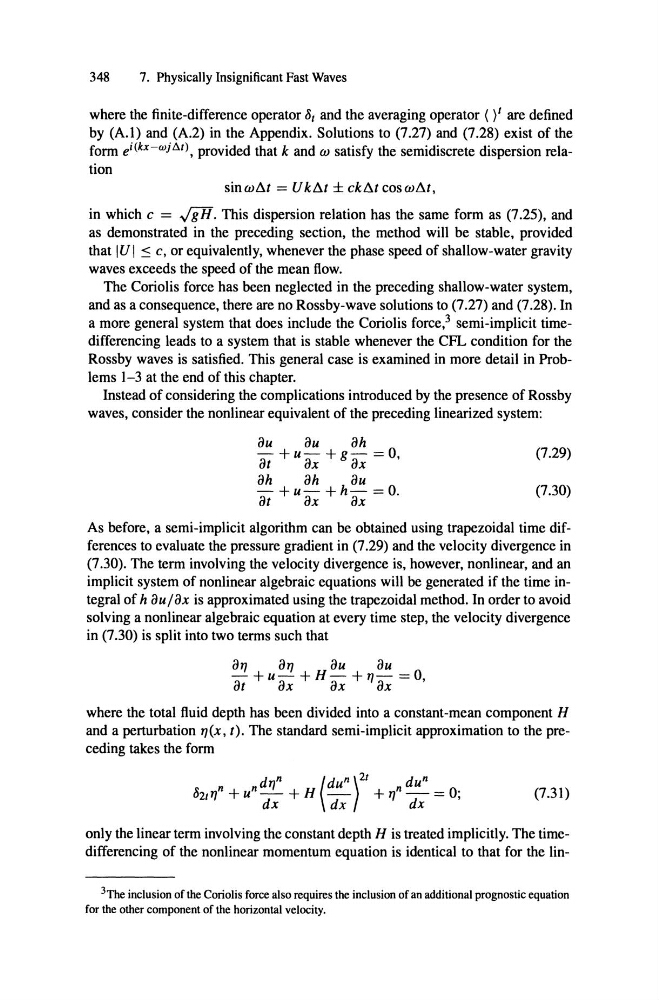
waves, consider the nonlinear equivalent of the preceding linearized system:
Bu
Bu
8h
-+u-+g-=O,
8t
8h
8x
8h
8x
8u
-+u-+h-=O.
8t
Bx
Bx
(7.29)
(7.30)
As before, a semi-implicit algorithm can be obtained using trapezoidal time differences to evaluate the pressure gradient in (7.29) and the velocity divergence in
(7.30). The term involving the velocity divergencc is, however, nonlinear, and an
implicit system of nonlinear algebraic equations will be generated if the time integral of h 8u/8x is approximated using the trapezoidal method . In order to avoid
solving a nonlinear algebraic equation at every time step, the velocity divergence
in (7.30) is split into two terms such that
81]
8t
-
81]
8u
8u
+u- +H- +1]- =0,
8x
8x
Bx
where the total fluid depth has been divided into a constant-mean component H
and aperturbation 1](x, t) . The standard serni-implicit approximation to the preceding takes the form
(7.31)
only the linear term involving the constant depth H is treated implicitly. The timedifferencing of the nonlinear momentum equation is identical to that for the lin3The inclusion of the Coriolisforcealso requires the inclusion of an additionalprognosticequation
for the other componentof the horizontal velocity.
7. Physically Insignificant Fast Waves
where the finite-difference operator 0/ and the averaging operator { }/ are defined
by (A.1) and (A.2) in the Appendix. Solutions to (7.27) and (7.28) exist of the
form ei(kx-wjM), provided that k and w satisfy the semidiscrete dispersion relation
sinwl:i.t = Uk Sr ± ckAtcoswAt ,
in which c = JgH . This dispersion relation has the same form as (7.25), and
as demonstrated in the preceding section, the method will be stable , provided
that IU I Sc, or equivalently, whenever the phase speed of shallow-water gravity
waves exceeds the speed of the mean flow.
The Coriolis force has been neglected in the preceding shallow-water system,
and as a consequence, there are no Rossby-wave solutions to (7.27) and (7.28). In
a more general system that does include the Coriolis force.' semi-implicit timedifferencing leads to a system that is stable whenever the CFL condition for the
Rossby waves is satisfied. This general case is examincd in more detail in Problems 1-3 at the end of this chapter.
Instead of considering the complications introduced by the presence of Rossby
waves, consider the nonlinear equivalent of the preceding linearized system:
Bu
Bu
8h
-+u-+g-=O,
8t
8h
8x
8h
8x
8u
-+u-+h-=O.
8t
Bx
Bx
(7.29)
(7.30)
As before, a semi-implicit algorithm can be obtained using trapezoidal time differences to evaluate the pressure gradient in (7.29) and the velocity divergence in
(7.30). The term involving the velocity divergencc is, however, nonlinear, and an
implicit system of nonlinear algebraic equations will be generated if the time integral of h 8u/8x is approximated using the trapezoidal method . In order to avoid
solving a nonlinear algebraic equation at every time step, the velocity divergence
in (7.30) is split into two terms such that
81]
8t
-
81]
8u
8u
+u- +H- +1]- =0,
8x
8x
Bx
where the total fluid depth has been divided into a constant-mean component H
and aperturbation 1](x, t) . The standard serni-implicit approximation to the preceding takes the form
(7.31)
only the linear term involving the constant depth H is treated implicitly. The timedifferencing of the nonlinear momentum equation is identical to that for the lin3The inclusion of the Coriolisforcealso requires the inclusion of an additionalprognosticequation
for the other componentof the horizontal velocity.