

7.2 The Semi-implicit Method
347
Since by assumption kVL I kVIlI, (7.24) is stable for all /),.t. Note that (7.26) will
also be satisfied whenever IWL/),.tl 1, implying that semi-implicit differencing
permits an increase in the maximum stable time step relative to that for a fully
explicit approximation even in those cases where IWLI > IWHI , because the terms
approximated with the trapezoidal difference do not restriet the maximum stable
time step.
As discussed in Section 3.4.2, semi-irnplicit time-differencing mayaiso be used
to stabilize the diffusion operator in some advection-diffusion problems . The gain
in the maximum stable time step achieved using a trapezoidal time difference for
the diffusion term in conjunction with a leapfrog approximation to the advection is not, however, particularly impressive. A much more stable approximation to the advection-diffusion problem is obtained using the third-order AdamsBashforth method to integrate the advection terms and trapezoidal differencing to
approximate the diffusion term, but the advantages of the serni-implicit AdamsBashforth-trapezoidal formulation do not carry over to the fast-wave-slow-wave
problem in a completely straightforward manner. If, for example , A is replaced by
iWH in (3.81) so that the trapezoidally differenced term represents a fast-rnoving
wave, the stability of the resulting scheme is still quite limited (the scheme is
unstable for all WH /),.t greater than approximately 1.8).
7.2.3 Semi-implicit Solution ofthe Shallow-Water Equations
The shallow -water equations (1.25)-( 1.27) support rapidly moving gravity waves.
If there are spatial variations in the potential vorticity of the undisturbed system
f / H , the shallow -water equations can also support slowly propagating potentialvorticity (or Rossby) waves. In many large-scale atmospheric and oceanic models, the Rossby waves are of greater physical significance than the faster-moving
gravity waves, and the Rossby waves can be efficiently simulated using serniimplicit time-differencing to circumvent the CFL stability condition associated
with gravity-wave propagation. The simplest example in which to illustrate the
influence of semi-implicit differencing on the CFL condition for gravity waves is
provided by (3.1) and (3.2), which are the one-dimensional shallow-water equations linearized about a reference state with a constant fluid velocity U and fluid
depth H. If the mean-flow velocity is less than the phase speed of a shallow-water
gravity wave, the numerical integration can be stabilized by evaluating those terms
responsible for gravity -wave propagation with trapezoidal differencing; leapfrog
differencing can be used for the remaining terms (Kwizak and Robert 197 I).
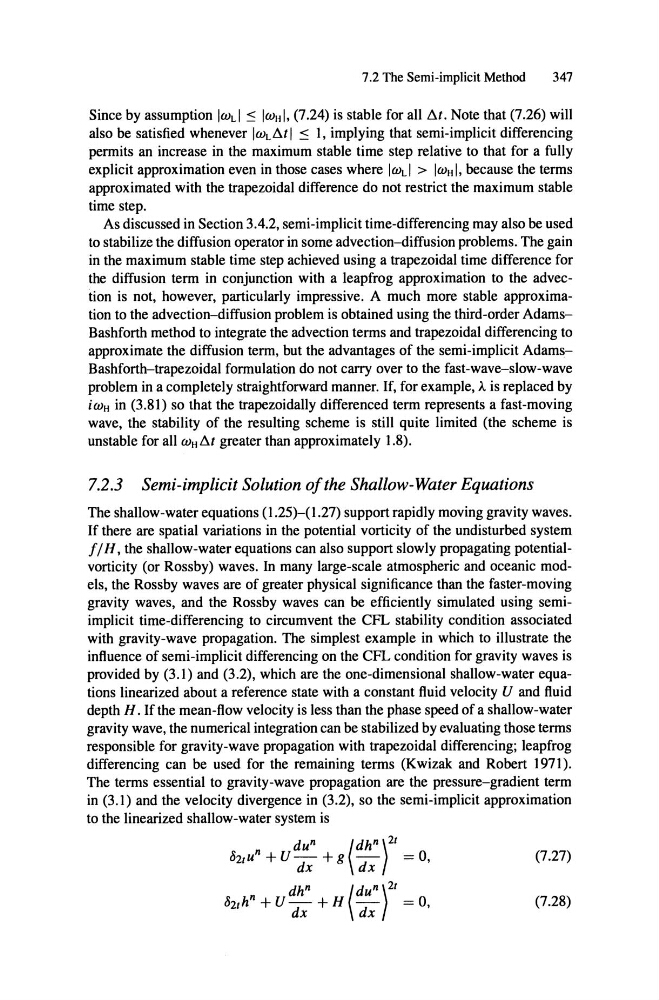
The terms essential to gravity-wave propagation are the pressure-gradient term
in (3.1) and the velocity divergence in (3.2), so the semi-implicit approximation
to the linearized shallow-water system is
(7.27)
(7.28)
dun
(dhn )21
82IUn+U-+g -
=0,
dx
dhn
dx
(dUn )21
821 hn + U dx + H dx = 0,
347
Since by assumption kVL I kVIlI, (7.24) is stable for all /),.t. Note that (7.26) will
also be satisfied whenever IWL/),.tl 1, implying that semi-implicit differencing
permits an increase in the maximum stable time step relative to that for a fully
explicit approximation even in those cases where IWLI > IWHI , because the terms
approximated with the trapezoidal difference do not restriet the maximum stable
time step.
As discussed in Section 3.4.2, semi-irnplicit time-differencing mayaiso be used
to stabilize the diffusion operator in some advection-diffusion problems . The gain
in the maximum stable time step achieved using a trapezoidal time difference for
the diffusion term in conjunction with a leapfrog approximation to the advection is not, however, particularly impressive. A much more stable approximation to the advection-diffusion problem is obtained using the third-order AdamsBashforth method to integrate the advection terms and trapezoidal differencing to
approximate the diffusion term, but the advantages of the serni-implicit AdamsBashforth-trapezoidal formulation do not carry over to the fast-wave-slow-wave
problem in a completely straightforward manner. If, for example , A is replaced by
iWH in (3.81) so that the trapezoidally differenced term represents a fast-rnoving
wave, the stability of the resulting scheme is still quite limited (the scheme is
unstable for all WH /),.t greater than approximately 1.8).
7.2.3 Semi-implicit Solution ofthe Shallow-Water Equations
The shallow -water equations (1.25)-( 1.27) support rapidly moving gravity waves.
If there are spatial variations in the potential vorticity of the undisturbed system
f / H , the shallow -water equations can also support slowly propagating potentialvorticity (or Rossby) waves. In many large-scale atmospheric and oceanic models, the Rossby waves are of greater physical significance than the faster-moving
gravity waves, and the Rossby waves can be efficiently simulated using serniimplicit time-differencing to circumvent the CFL stability condition associated
with gravity-wave propagation. The simplest example in which to illustrate the
influence of semi-implicit differencing on the CFL condition for gravity waves is
provided by (3.1) and (3.2), which are the one-dimensional shallow-water equations linearized about a reference state with a constant fluid velocity U and fluid
depth H. If the mean-flow velocity is less than the phase speed of a shallow-water
gravity wave, the numerical integration can be stabilized by evaluating those terms
responsible for gravity -wave propagation with trapezoidal differencing; leapfrog
differencing can be used for the remaining terms (Kwizak and Robert 197 I).
The terms essential to gravity-wave propagation are the pressure-gradient term
in (3.1) and the velocity divergence in (3.2), so the semi-implicit approximation
to the linearized shallow-water system is
(7.27)
(7.28)
dun
(dhn )21
82IUn+U-+g -
=0,
dx
dhn
dx
(dUn )21
821 hn + U dx + H dx = 0,