

350
7. Physically Insignificant Fast Waves
and the scheme is stable. As IrI increases, the magnitude of one of the roots eventually exceeds unity, and the scheme becomes unstable . The critical values of r
beyond which the scheme becomes unstable may be determined by substituting
SI = 1 and then SI = -1 into (7.34) to obtain the stability criterion [r]
1 or
liJl H . Instability will not occur unless the perturbation fluid depth exceeds the
mean depth (in the U = 0 case). This may appear to be a very generous criterion ;
however, the local phase speed of a shallow-water gravity wave is
c = Jg(H + 1]),
so numerical stability requires that the local wave speed be no faster than a factor
of .J2 times the mean wave speed. As will be discussed in the next section , the
horizontal phase speed of hydrostatic intemal gravity waves is proportional to the
Brunt-Väisälä frequency, and the ratio of the local mean Brunt-Väisälä frequency
in the polar regions of the Earth 's atmosphere to that in the middle latitudes can
easily exceed the square root of two. Thus, it is generally necessary to specify the
horizontally uniform reference state using numerical values from that region in
the domain where gravity waves propagate at maximum speed. As a consequence,
the reference-state stratification in most global atmospheric models is chosen to
be isothermal (Simmons et aJ. 1978). The application of the semi-implicit method
to global atmospheric models is discussed further in Section 7.6.5.
7.2.4 Semi-implicit Solution ofthe Euler Equations
Now consider how semi-implicit differencing can be used to eliminate the stability constraint imposed by sound waves in the numerical solution of the Euler
equations for stratified flow. In order to present the numerical approach with a
minimum of extraneous detail, it is useful to consider a simplified set of compressible equations that can be obtained from the linearized system (1.41)-(1.44)
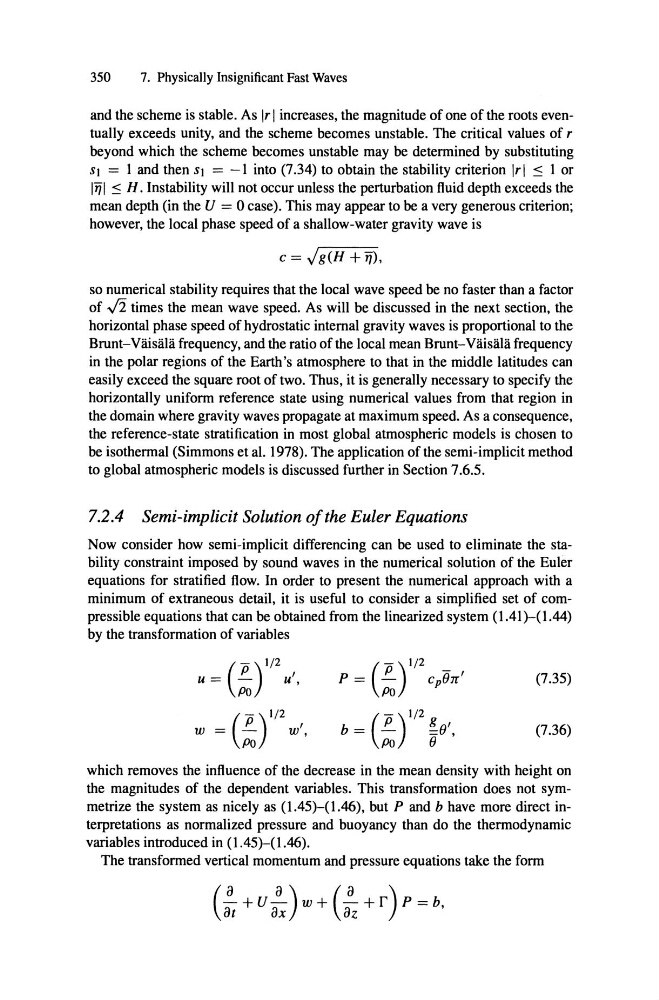
by the transformation of variables
u =
u',
W =
w',
-)1 /2
P
-)1 /2
(
p = PO
-
cpfhr
b = (
,
(7.35)
(7.36)
which removes the influence of the decrease in the mean density with height on
the magnitudes of the dependent variables. This transformation does not syrnmetrize the system as nicely as (1.45)-(1.46), but P and b have more direct interpretations as normalized pressure and buoyancy than do the thermodynamic
variables introduced in (1.45)-(1.46).
The transformed vertical momentum and pressure equations take the form
+
w +
+ r) P=b,
ßx
ßz
ßt
7. Physically Insignificant Fast Waves
and the scheme is stable. As IrI increases, the magnitude of one of the roots eventually exceeds unity, and the scheme becomes unstable . The critical values of r
beyond which the scheme becomes unstable may be determined by substituting
SI = 1 and then SI = -1 into (7.34) to obtain the stability criterion [r]
1 or
liJl H . Instability will not occur unless the perturbation fluid depth exceeds the
mean depth (in the U = 0 case). This may appear to be a very generous criterion ;
however, the local phase speed of a shallow-water gravity wave is
c = Jg(H + 1]),
so numerical stability requires that the local wave speed be no faster than a factor
of .J2 times the mean wave speed. As will be discussed in the next section , the
horizontal phase speed of hydrostatic intemal gravity waves is proportional to the
Brunt-Väisälä frequency, and the ratio of the local mean Brunt-Väisälä frequency
in the polar regions of the Earth 's atmosphere to that in the middle latitudes can
easily exceed the square root of two. Thus, it is generally necessary to specify the
horizontally uniform reference state using numerical values from that region in
the domain where gravity waves propagate at maximum speed. As a consequence,
the reference-state stratification in most global atmospheric models is chosen to
be isothermal (Simmons et aJ. 1978). The application of the semi-implicit method
to global atmospheric models is discussed further in Section 7.6.5.
7.2.4 Semi-implicit Solution ofthe Euler Equations
Now consider how semi-implicit differencing can be used to eliminate the stability constraint imposed by sound waves in the numerical solution of the Euler
equations for stratified flow. In order to present the numerical approach with a
minimum of extraneous detail, it is useful to consider a simplified set of compressible equations that can be obtained from the linearized system (1.41)-(1.44)
by the transformation of variables
u =
u',
W =
w',
-)1 /2
P
-)1 /2
(
p = PO
-
cpfhr
b = (
,
(7.35)
(7.36)
which removes the influence of the decrease in the mean density with height on
the magnitudes of the dependent variables. This transformation does not syrnmetrize the system as nicely as (1.45)-(1.46), but P and b have more direct interpretations as normalized pressure and buoyancy than do the thermodynamic
variables introduced in (1.45)-(1.46).
The transformed vertical momentum and pressure equations take the form
+
w +
+ r) P=b,
ßx
ßz
ßt