

7.2 Tbe Serni-irnplicitMethod
343
to improve numerical stability is through the use of implicit time differences such
as the backward and the trapezoidal methods .i Implicit methods can, however,
produce rather inaccurate solutions when the time step is too large. It is therefore useful to analyze the effect of the time step on the accuracy of fully implicit
solutions to wave-propagation problems before discussing the true semi-implicit
method.
7.2.1 Large TIme Steps and Paar Accuracy
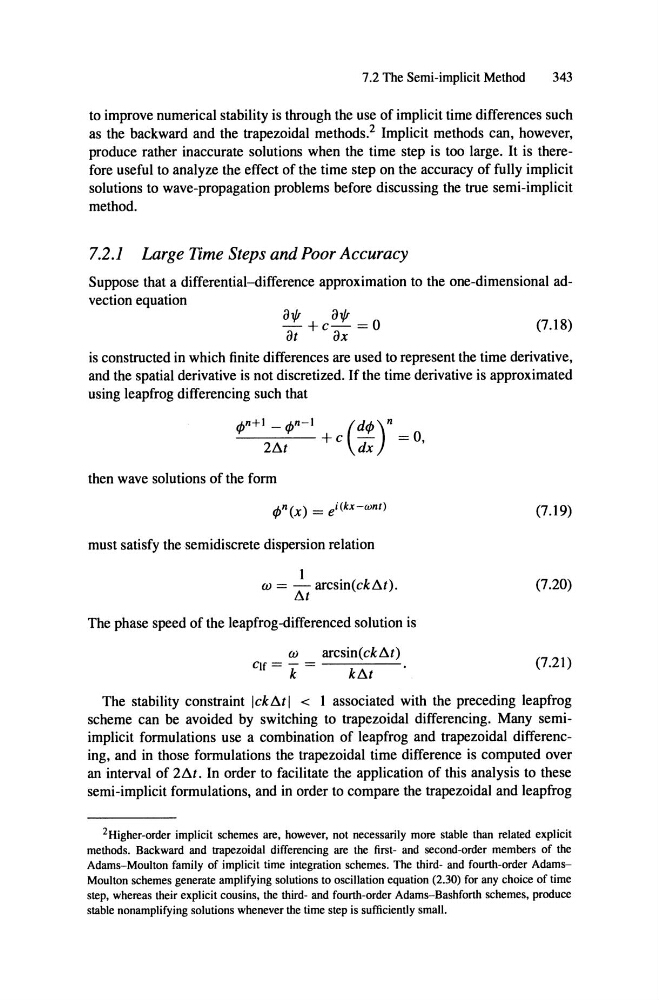
Suppose that a differential-difference approximation to the one-dimensional advection equation
-+c-=o
at/l
at/l
at
ax
(7.18)
is constructed in which finite differences are used to represent the time derivative,
and the spatial derivative is not discretized. If the time derivative is approximated
using leapfrog differencing such that
rjJn +1 _ rjJn -l
2flt
= 0,
(drjJ)n
+c dx
then wave solutions of the form
rjJn(x) = ei(kx -wnt )
must satisfy the semidiscrete dispersion relation
(7.19)
.
w = - arcsm(ckflt ).
(J)
CIf = k =
I
flt
(7.20)
(7.21)
The phase speed of the leapfrog-differenced solution is
arcsin(ckflt)
kflt
The stability constraint Ickfltl < I associated with the preceding leapfrog
scheme can be avoided by switching to trapezoidal differencing. Many semiimplicit formulations use a combination of leapfrog and trapezoidal differencing, and in those formulations the trapezoidal time difference is computed over
an interval of 2M. In order to facilitate the application of this analysis to these
semi-implicit formulations, and in order to compare the trapezoidal and leapfrog
2Higher-order implicit schemes are, however, not necessarily more stable than related explicit
methods. Backward and trapezoidal differencing are the first- and second-order members of the
Adams-Moulton family of implicit time integration schemes . The third- and fourth-order AdamsMoulton schemes generate amplifying solutions to oscillation equation (2.30) for any choice of time
step, whereas their explicit cousins, the third- and fourth-order Adams-Bashforth schemes, produce
stable nonamplifying solutions whenever the time step is sufficiently smalI.
343
to improve numerical stability is through the use of implicit time differences such
as the backward and the trapezoidal methods .i Implicit methods can, however,
produce rather inaccurate solutions when the time step is too large. It is therefore useful to analyze the effect of the time step on the accuracy of fully implicit
solutions to wave-propagation problems before discussing the true semi-implicit
method.
7.2.1 Large TIme Steps and Paar Accuracy
Suppose that a differential-difference approximation to the one-dimensional advection equation
-+c-=o
at/l
at/l
at
ax
(7.18)
is constructed in which finite differences are used to represent the time derivative,
and the spatial derivative is not discretized. If the time derivative is approximated
using leapfrog differencing such that
rjJn +1 _ rjJn -l
2flt
= 0,
(drjJ)n
+c dx
then wave solutions of the form
rjJn(x) = ei(kx -wnt )
must satisfy the semidiscrete dispersion relation
(7.19)
.
w = - arcsm(ckflt ).
(J)
CIf = k =
I
flt
(7.20)
(7.21)
The phase speed of the leapfrog-differenced solution is
arcsin(ckflt)
kflt
The stability constraint Ickfltl < I associated with the preceding leapfrog
scheme can be avoided by switching to trapezoidal differencing. Many semiimplicit formulations use a combination of leapfrog and trapezoidal differencing, and in those formulations the trapezoidal time difference is computed over
an interval of 2M. In order to facilitate the application of this analysis to these
semi-implicit formulations, and in order to compare the trapezoidal and leapfrog
2Higher-order implicit schemes are, however, not necessarily more stable than related explicit
methods. Backward and trapezoidal differencing are the first- and second-order members of the
Adams-Moulton family of implicit time integration schemes . The third- and fourth-order AdamsMoulton schemes generate amplifying solutions to oscillation equation (2.30) for any choice of time
step, whereas their explicit cousins, the third- and fourth-order Adams-Bashforth schemes, produce
stable nonamplifying solutions whenever the time step is sufficiently smalI.