

342
7. Physically Insignificant FastWaves
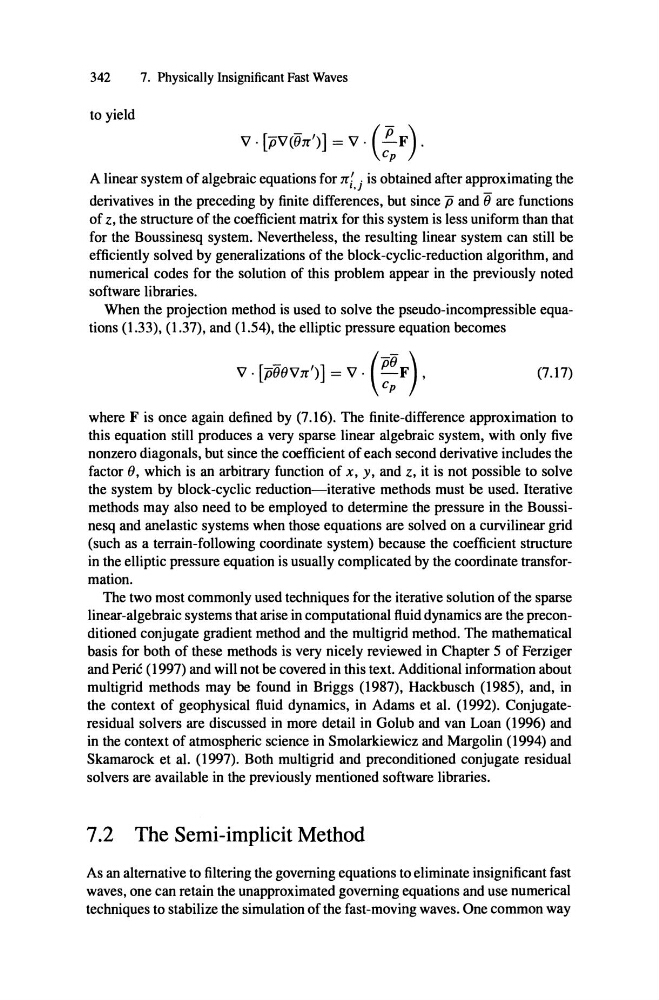
to yield
V· [;oV(9Jr')] = V·
F) .
A linear system of algebraic equations for Jr[,i is obtained after approximating the
derivatives in the preceding by finite differences, but since ;0 and 9 are functions
of z, the structure of the coefficient matrix for this system is less uniform than that
for the Boussinesq system. Nevertheless, the resulting linear system can still be
efficiently solved by generalizations of the block-cyclic-reduction algorithm, and
numerical codes for the solution of this problem appear in the previously noted
software libraries.
When the projection method is used to solve the pseudo-incompressible equations (1.33) , (1.37), and (1.54), the elliptic pressure equation becomes
(7.17)
where F is once again defined by (7.16). The finite-difference approximation to
this equation still produces a very sparse linear algebraic system, with only five
nonzero diagonals, but since the coefficient of each second derivative includes the
factor (}, which is an arbitrary function of x, y, and z, it is not possible to solve
the system by block-cyclic reduction-iterative methods must be used. Iterative
methods mayaiso need to be employed to determine the pressure in the Boussinesq and anelastic systems when those equations are solved on a curvilinear grid
(such as a terrain-following coordinate system) because the coefficient structure
in the elliptic pressure equation is usually complicated by the coordinate transformation.
The two most commonly used techniques for the iterative solution of the sparse
linear-algebraic systems that arise in computational fluid dynamics are the preconditioned conjugate gradient method and the multigrid method. The mathematical
basis for both of these methods is very nicely reviewed in Chapter 5 of Ferziger
and Peric (1997) and will not be covered in this text. Additional information about
multigrid methods may be found in Briggs (1987), Hackbusch (1985), and, in
the context of geophysical fluid dynamics, in Adams et aI. (1992) . Conjugateresidual solvers are discussed in more detail in Golub and van Loan (1996) and
in the context of atmospheric science in Smolarkiewicz and Margolin (1994) and
Skamarock et aI. (1997) . Both multigrid and preconditioned conjugate residual
solvers are available in the previously mentioned software libraries.
7.2 The Semi-implicit Method
As an alternative to filtering the governing equations to eliminate insignificant fast
waves, one can retain the unapproximated governing equations and use numerical
techniques to stabilize the simulation ofthe fast-moving waves. One common way
7. Physically Insignificant FastWaves
to yield
V· [;oV(9Jr')] = V·
F) .
A linear system of algebraic equations for Jr[,i is obtained after approximating the
derivatives in the preceding by finite differences, but since ;0 and 9 are functions
of z, the structure of the coefficient matrix for this system is less uniform than that
for the Boussinesq system. Nevertheless, the resulting linear system can still be
efficiently solved by generalizations of the block-cyclic-reduction algorithm, and
numerical codes for the solution of this problem appear in the previously noted
software libraries.
When the projection method is used to solve the pseudo-incompressible equations (1.33) , (1.37), and (1.54), the elliptic pressure equation becomes
(7.17)
where F is once again defined by (7.16). The finite-difference approximation to
this equation still produces a very sparse linear algebraic system, with only five
nonzero diagonals, but since the coefficient of each second derivative includes the
factor (}, which is an arbitrary function of x, y, and z, it is not possible to solve
the system by block-cyclic reduction-iterative methods must be used. Iterative
methods mayaiso need to be employed to determine the pressure in the Boussinesq and anelastic systems when those equations are solved on a curvilinear grid
(such as a terrain-following coordinate system) because the coefficient structure
in the elliptic pressure equation is usually complicated by the coordinate transformation.
The two most commonly used techniques for the iterative solution of the sparse
linear-algebraic systems that arise in computational fluid dynamics are the preconditioned conjugate gradient method and the multigrid method. The mathematical
basis for both of these methods is very nicely reviewed in Chapter 5 of Ferziger
and Peric (1997) and will not be covered in this text. Additional information about
multigrid methods may be found in Briggs (1987), Hackbusch (1985), and, in
the context of geophysical fluid dynamics, in Adams et aI. (1992) . Conjugateresidual solvers are discussed in more detail in Golub and van Loan (1996) and
in the context of atmospheric science in Smolarkiewicz and Margolin (1994) and
Skamarock et aI. (1997) . Both multigrid and preconditioned conjugate residual
solvers are available in the previously mentioned software libraries.
7.2 The Semi-implicit Method
As an alternative to filtering the governing equations to eliminate insignificant fast
waves, one can retain the unapproximated governing equations and use numerical
techniques to stabilize the simulation ofthe fast-moving waves. One common way