

7.1 The ProjectionMethod
341
In practical applications the number of unknown pressures can easily exceed one
million, and in order to solve (7.14) efficiently, it is important to take advantage
of the sparseness of A. Direct methods based on some variant of Gaussian elimination are therefore not appropriate . Direct methods for band matrices are also
not suitable because the bandwidth of A is not 5, but 2N + 1, and direct methods
for band matrices do not preserve sparseness within the band.
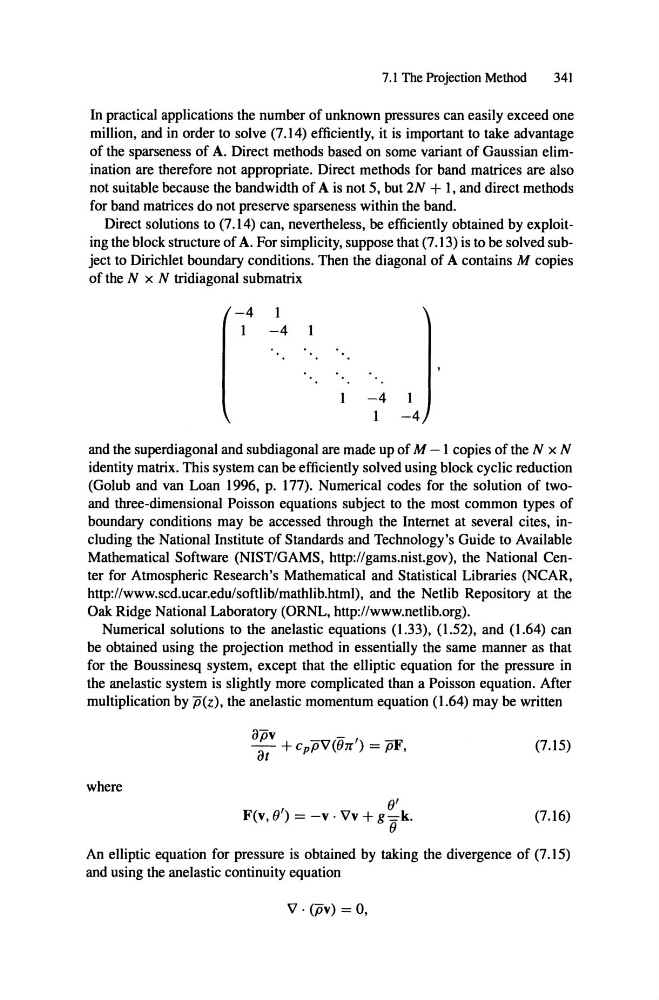
Direct solutions to (7.14) can, nevertheless, be efficiently obtained by exploiting the block structure of A. For simplicity, suppose that (7.13) is to be solved subject to Dirichlet boundary conditions. Then the diagonal of A contains M copies
of the N x N tridiagonal submatrix
-4 1
1 -4
- 4 1
1 - 4
and the superdiagonal and subdiagonal are made up of M -1 copies ofthe N x N
identity matrix. This system can be efficiently solved using block cyclic reduction
(Golub and van Loan 1996, p. 177). Numerical codes for the solution of twoand three-dimensional Poisson equations subject to the most common types of
boundary conditions may be accessed through the Internet at several cites, including the National Institute of Standards and Technology 's Guide to Available
Mathematical Software (NIST/GAMS, http://gams .nist.gov), the National Center for Atmospheric Research's Mathematical and Statistical Libraries (NCAR,
http://www.scd.ucar.edu/softlib/mathlib.html). and the Netlib Repository at the
Oak Ridge National Laboratory (ORNL, h ht ttp tp:/ ://www /www. .netlib. netlib.o org rg).
Numerical solutions to the anelastic equations (1.33), (1.52), and (1.64) can
be obtained using the projection method in essentially the same manner as that
for the Boussinesq system, except that the elliptic equation for the pressure in
the anelastic system is slightly more complicated than a Poisson equation . After
multiplication by p(z), the anelastic momentum equation (1.64) may be written
at
apv
+ cppV((hr') = {fF,
-
(7.15)
where
()'
F(v, B') = - v· Vv + g=k.
(7.16)
B
An elliptic equation for pressure is obtained by taking the divergence of (7.15)
and using the anelastic continuity equation
V · (pv) = 0,
341
In practical applications the number of unknown pressures can easily exceed one
million, and in order to solve (7.14) efficiently, it is important to take advantage
of the sparseness of A. Direct methods based on some variant of Gaussian elimination are therefore not appropriate . Direct methods for band matrices are also
not suitable because the bandwidth of A is not 5, but 2N + 1, and direct methods
for band matrices do not preserve sparseness within the band.
Direct solutions to (7.14) can, nevertheless, be efficiently obtained by exploiting the block structure of A. For simplicity, suppose that (7.13) is to be solved subject to Dirichlet boundary conditions. Then the diagonal of A contains M copies
of the N x N tridiagonal submatrix
-4 1
1 -4
- 4 1
1 - 4
and the superdiagonal and subdiagonal are made up of M -1 copies ofthe N x N
identity matrix. This system can be efficiently solved using block cyclic reduction
(Golub and van Loan 1996, p. 177). Numerical codes for the solution of twoand three-dimensional Poisson equations subject to the most common types of
boundary conditions may be accessed through the Internet at several cites, including the National Institute of Standards and Technology 's Guide to Available
Mathematical Software (NIST/GAMS, http://gams .nist.gov), the National Center for Atmospheric Research's Mathematical and Statistical Libraries (NCAR,
http://www.scd.ucar.edu/softlib/mathlib.html). and the Netlib Repository at the
Oak Ridge National Laboratory (ORNL, h ht ttp tp:/ ://www /www. .netlib. netlib.o org rg).
Numerical solutions to the anelastic equations (1.33), (1.52), and (1.64) can
be obtained using the projection method in essentially the same manner as that
for the Boussinesq system, except that the elliptic equation for the pressure in
the anelastic system is slightly more complicated than a Poisson equation . After
multiplication by p(z), the anelastic momentum equation (1.64) may be written
at
apv
+ cppV((hr') = {fF,
-
(7.15)
where
()'
F(v, B') = - v· Vv + g=k.
(7.16)
B
An elliptic equation for pressure is obtained by taking the divergence of (7.15)
and using the anelastic continuity equation
V · (pv) = 0,