

344
7. Physically Insignificant Fast Waves
M
10/1
WAVELENGTH
.sä
JA
.. ... ......
"
.............................................................................. LFl
-- -------- -- - -- - -
-'- --- -- --T5
---- - T l-_ - - - - -
_
"'2&
WAVE NUMBER
ß c
W
Q.
lI>
. .
a:
lI>
W
2&
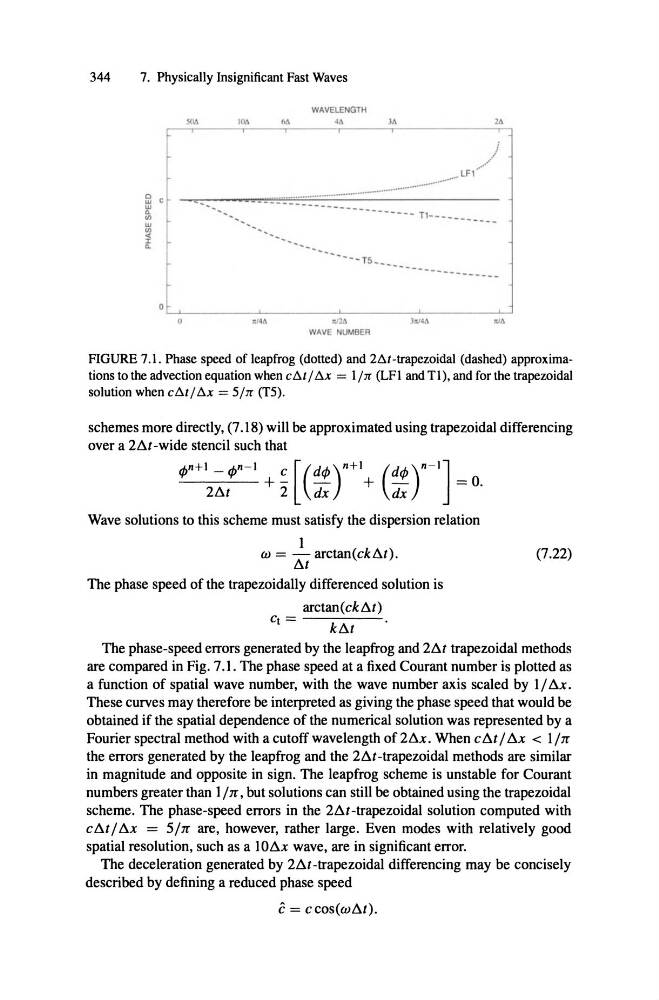
FIGURE 7.1. Phase speed of leapfrog (dotted) and 2t!.t-trapezoidal (dashed) approxima -
tions to the advection equation when ctxt I t!.x = I Irr (LFI and TI), and fOT the trapezoidal
solution when et!.tlt!.x = 5/rr (T5).
schemes more directly, (7.18) will be approximated using trapezoidal differencing
over a 2ßt-wide stencil such that
+
2M
2
dx
dx
Wave solutions to this scheme must satisfy the dispersion relation
I
(7.22)
W = - arctan(ckM).
ßt
The phase speed of the trapezoidally differenced solution is
arctan(ckßt)
Cl =
kßt
The phase-speed errors generated by the leapfrog and 2M trapezoidal methods
are compared in Fig. 7.1. The phase speed at a fixed Courant number is plotted as
a function of spatial wave number, with the wave number axis scaled by 1/S».
These curves may therefore be interpreted as giving the phase speed that would be
obtained if the spatial dependence of the numerical solution was represented by a
Fourier spectral method with a cutoff wavelength of 2ßx. When c ßt / Sx < 1/7T
the errors generated by the leapfrog and the 2M-trapezoidal methods are similar
in magnitude and opposite in sign. The leapfrog scheme is unstable for Courant
numbers greater than I /7T, but solutions can still be obtained using the trapezoidal
scheme. The phase-speed errors in the 2ßt-trapezoidal solution computed with
ctst] Sx = 5/7T are, however, rather large. Even modes with relatively good
spatial resolution, such as a lOßx wave, are in significant error.
The deceleration generated by 2ßt-trapezoidal differencing may be concisely
described by defining a reduced phase speed
c= c cos(wßt) .
-'------.:.....- rP n+ - rP n- + -
C [(drP)n+l -
(drP)n-IJ_ -
- O.
1
1
7. Physically Insignificant Fast Waves
M
10/1
WAVELENGTH
.sä
JA
.. ... ......
"
.............................................................................. LFl
-- -------- -- - -- - -
-'- --- -- --T5
---- - T l-_ - - - - -
_
"'2&
WAVE NUMBER
ß c
W
Q.
lI>
. .
a:
lI>
W
2&
FIGURE 7.1. Phase speed of leapfrog (dotted) and 2t!.t-trapezoidal (dashed) approxima -
tions to the advection equation when ctxt I t!.x = I Irr (LFI and TI), and fOT the trapezoidal
solution when et!.tlt!.x = 5/rr (T5).
schemes more directly, (7.18) will be approximated using trapezoidal differencing
over a 2ßt-wide stencil such that
+
2M
2
dx
dx
Wave solutions to this scheme must satisfy the dispersion relation
I
(7.22)
W = - arctan(ckM).
ßt
The phase speed of the trapezoidally differenced solution is
arctan(ckßt)
Cl =
kßt
The phase-speed errors generated by the leapfrog and 2M trapezoidal methods
are compared in Fig. 7.1. The phase speed at a fixed Courant number is plotted as
a function of spatial wave number, with the wave number axis scaled by 1/S».
These curves may therefore be interpreted as giving the phase speed that would be
obtained if the spatial dependence of the numerical solution was represented by a
Fourier spectral method with a cutoff wavelength of 2ßx. When c ßt / Sx < 1/7T
the errors generated by the leapfrog and the 2M-trapezoidal methods are similar
in magnitude and opposite in sign. The leapfrog scheme is unstable for Courant
numbers greater than I /7T, but solutions can still be obtained using the trapezoidal
scheme. The phase-speed errors in the 2ßt-trapezoidal solution computed with
ctst] Sx = 5/7T are, however, rather large. Even modes with relatively good
spatial resolution, such as a lOßx wave, are in significant error.
The deceleration generated by 2ßt-trapezoidal differencing may be concisely
described by defining a reduced phase speed
c= c cos(wßt) .
-'------.:.....- rP n+ - rP n- + -
C [(drP)n+l -
(drP)n-IJ_ -
- O.
1
1