

324
6. Semi-Lagrangian Methods
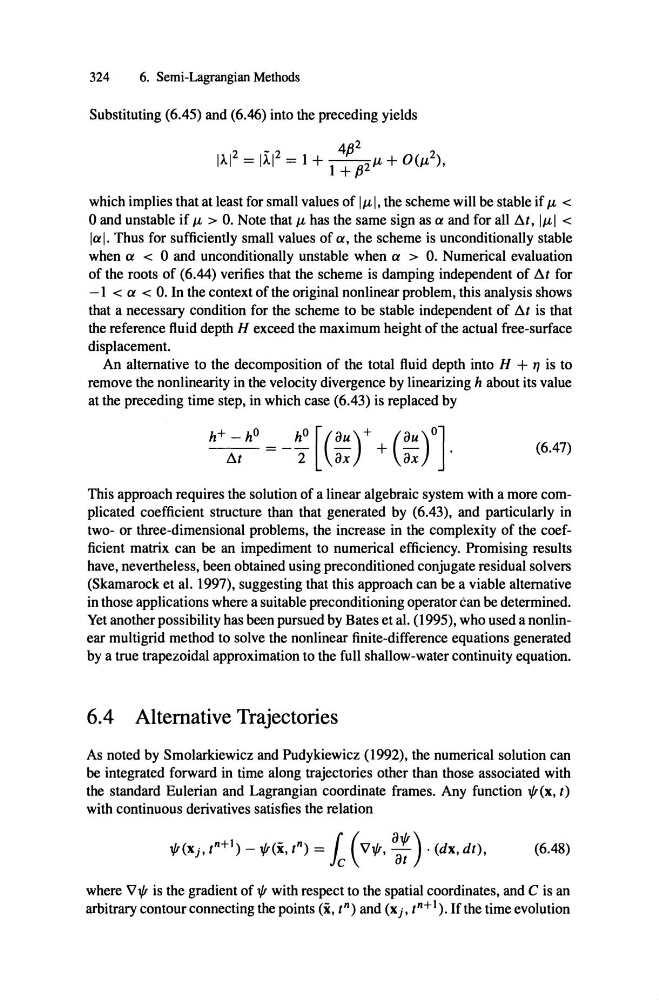
Substituting (6.45) and (6.46) into the preceding yields
which implies that at least for small values of IJ.LI, the scheme will be stable if J.L <
oand unstable if J.L > O. Note that J.L has the same sign as a and for all t!t, IJ.LI <
lai. Thus for sufficiently small values of a, the scheme is unconditionally stable
when a < 0 and unconditionally unstable when a > O. Numerical evaluation
of the roots of (6.44) verifies that the scheme is damping independent of t!t for
-1 < a < O. In the context of the original non linear problem, this analysis shows
that a necessary condition for the scheme to be stable independent of t!t is that
the reference fluid depth H exceed the maximum height of the actual free-surface
displacement.
An alternative to the decomposition of the total fluid depth into H + IJ is to
remove the nonlinearity in the velocity divergence by linearizing habout its value
at the preceding time step, in which case (6.43) is replaced by
h+ - hO = _ hO [(OU)+ + (OU)OJ .
(6.47)
M
2
OX
OX
This approach requires the solution of a linear algebraic system with a more complicated coefficient structure than that generated by (6.43), and particularly in
two- or three-dimensional problems, the increase in the complexity of the coefficient matrix can be an impediment to numerical efficiency. Promising results
have, nevertheless, been obtained using preconditioned conjugate residual solvers
(Skamarock et al. 1997), suggesting that this approach can be a viable alternative
in those applications where a suitable preconditioning operator can be determined.
Yet another possibility has been pursued by Bates et al. (1995), who used a nonlinear multigrid method to solve the nonlinear finite-difference equations generated
by a true trapezoidal approximation to the full shallow-water continuity equation.
6.4 Alternative Trajectories
As noted by Smolarkiewicz and Pudykiewicz (1992), the numerical solution can
be integrated forward in time along trajectories other than those associated with
the standard Eulerian and Lagrangian coordinate frames . Any function 1/I(x,t)
with continuous derivatives satisfies the relation
(6.48)
where ' \/1/1 is the gradient of 1/1 with respect to the spatial coordinates, and C is an
arbitrary contour connecting the points (x, t") and (xi- t n +I). If the time evolution
6. Semi-Lagrangian Methods
Substituting (6.45) and (6.46) into the preceding yields
which implies that at least for small values of IJ.LI, the scheme will be stable if J.L <
oand unstable if J.L > O. Note that J.L has the same sign as a and for all t!t, IJ.LI <
lai. Thus for sufficiently small values of a, the scheme is unconditionally stable
when a < 0 and unconditionally unstable when a > O. Numerical evaluation
of the roots of (6.44) verifies that the scheme is damping independent of t!t for
-1 < a < O. In the context of the original non linear problem, this analysis shows
that a necessary condition for the scheme to be stable independent of t!t is that
the reference fluid depth H exceed the maximum height of the actual free-surface
displacement.
An alternative to the decomposition of the total fluid depth into H + IJ is to
remove the nonlinearity in the velocity divergence by linearizing habout its value
at the preceding time step, in which case (6.43) is replaced by
h+ - hO = _ hO [(OU)+ + (OU)OJ .
(6.47)
M
2
OX
OX
This approach requires the solution of a linear algebraic system with a more complicated coefficient structure than that generated by (6.43), and particularly in
two- or three-dimensional problems, the increase in the complexity of the coefficient matrix can be an impediment to numerical efficiency. Promising results
have, nevertheless, been obtained using preconditioned conjugate residual solvers
(Skamarock et al. 1997), suggesting that this approach can be a viable alternative
in those applications where a suitable preconditioning operator can be determined.
Yet another possibility has been pursued by Bates et al. (1995), who used a nonlinear multigrid method to solve the nonlinear finite-difference equations generated
by a true trapezoidal approximation to the full shallow-water continuity equation.
6.4 Alternative Trajectories
As noted by Smolarkiewicz and Pudykiewicz (1992), the numerical solution can
be integrated forward in time along trajectories other than those associated with
the standard Eulerian and Lagrangian coordinate frames . Any function 1/I(x,t)
with continuous derivatives satisfies the relation
(6.48)
where ' \/1/1 is the gradient of 1/1 with respect to the spatial coordinates, and C is an
arbitrary contour connecting the points (x, t") and (xi- t n +I). If the time evolution