

6.3 Systemsof Equations
323
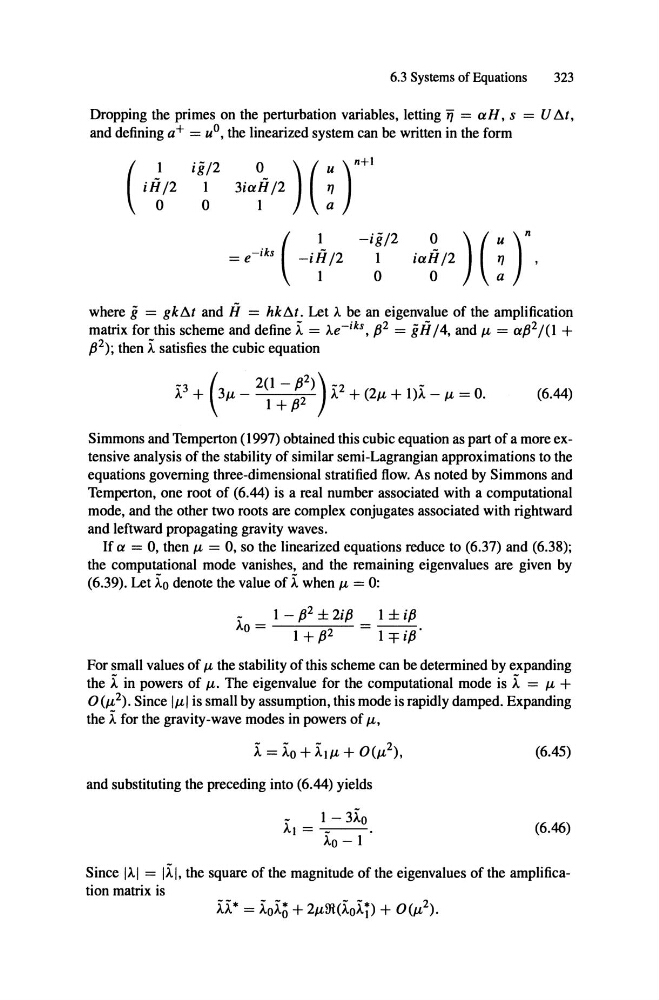
Dropping the primes on the perturbation variables, letting Ti = a H, S = U!:lt,
and defining a+ = u
O
, the linearized system can be written in the form
ig/2
0_) (
3iaH /2
u )n+1
I
11
o
1
a
- igj2
1
I
= eiks
(
- i iI /2
1
0
where g = gk!:lt and iJ = hk tst , Let A be an eigenvalue of the amplification
matrix for this scheme and define X= Ae- iks , ß2 = giJ/4, and JL = aß2/(1 +
ß2); then Xsatisfies the cubic equation
(6.44)
Simmons and Temperton (1997) obtained this cubic equation as part of a more extensive analysis of the stability of similar semi-Lagrangian approximations to the
equations goveming three-dimensional stratified flow. As noted by Simmons and
Temperton, one root of (6.44) is areal number associated with a computational
mode, and the other two roots are complex conjugates associated with rightward
and leftward propagating gravity waves.
If a = 0, then JL = 0, so the linearized equations reduce to (6.37) and (6.38);
the computational mode vanishes, and the remaining eigenvalues are given by
(6.39) . Let X o denote the value of Xwhen JL = 0:
-
1 - ß2 ± 2iß
1 ± iß
AO =
I + ß2 = 1 =F iß'
For small values of JL the stability of this scheme can be determined by expanding
the X. in powers of JL. The eigenvalue for the computational mode is X = JL +
O(JL 2) . Since IJLI is small by assumption, this mode is rapidly damped. Expanding
the Xfor the gravity-wave modes in powers of JL,
(6.45)
and substituting the preceding into (6.44) yields
-
1 - 3X o
(6.46)
AI = --= _,..--AO - 1
Since lAI = ,XI, the square of the magnitude of the eigenvalues of the amplification matrix is
323
Dropping the primes on the perturbation variables, letting Ti = a H, S = U!:lt,
and defining a+ = u
O
, the linearized system can be written in the form
ig/2
0_) (
3iaH /2
u )n+1
I
11
o
1
a
- igj2
1
I
= eiks
(
- i iI /2
1
0
where g = gk!:lt and iJ = hk tst , Let A be an eigenvalue of the amplification
matrix for this scheme and define X= Ae- iks , ß2 = giJ/4, and JL = aß2/(1 +
ß2); then Xsatisfies the cubic equation
(6.44)
Simmons and Temperton (1997) obtained this cubic equation as part of a more extensive analysis of the stability of similar semi-Lagrangian approximations to the
equations goveming three-dimensional stratified flow. As noted by Simmons and
Temperton, one root of (6.44) is areal number associated with a computational
mode, and the other two roots are complex conjugates associated with rightward
and leftward propagating gravity waves.
If a = 0, then JL = 0, so the linearized equations reduce to (6.37) and (6.38);
the computational mode vanishes, and the remaining eigenvalues are given by
(6.39) . Let X o denote the value of Xwhen JL = 0:
-
1 - ß2 ± 2iß
1 ± iß
AO =
I + ß2 = 1 =F iß'
For small values of JL the stability of this scheme can be determined by expanding
the X. in powers of JL. The eigenvalue for the computational mode is X = JL +
O(JL 2) . Since IJLI is small by assumption, this mode is rapidly damped. Expanding
the Xfor the gravity-wave modes in powers of JL,
(6.45)
and substituting the preceding into (6.44) yields
-
1 - 3X o
(6.46)
AI = --= _,..--AO - 1
Since lAI = ,XI, the square of the magnitude of the eigenvalues of the amplification matrix is