

322
6. Semi-LagrangianMethods
avoid solving a coupled system of nonlinear algebraic equations at every time
step, the total fluid depth is often split into a constant reference value and a perturbation, and the velocity divergence multiplying the perturbation is evaluated
using leapfrog time-differencing. Letting h(x, t) = H + l7(x, t), this approach
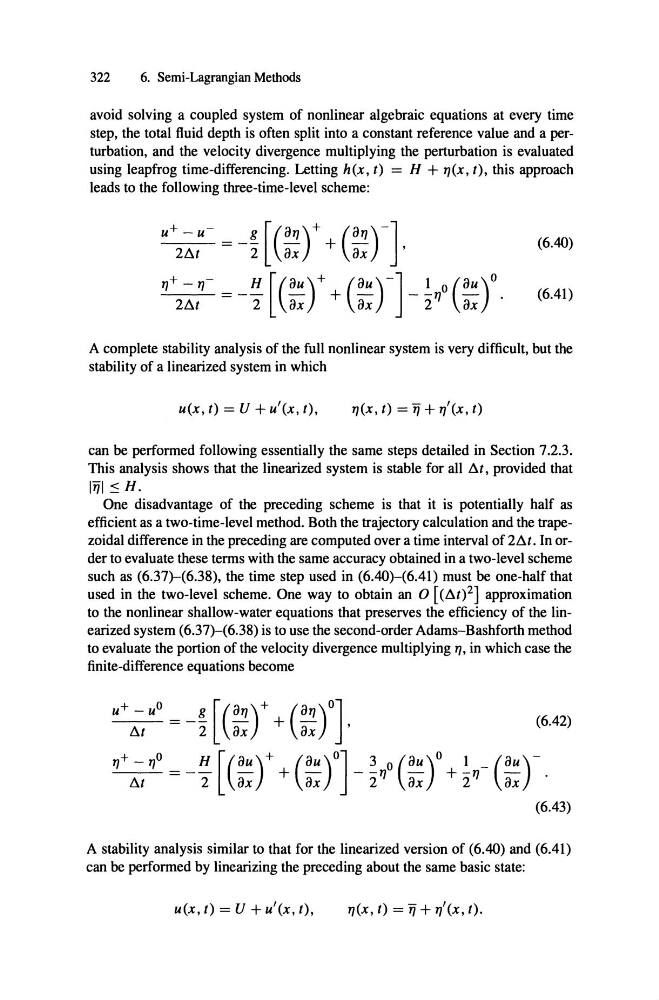
leads to the following three-time -level scheme:
+ (:;)-l
= -
[ (::) + + (::) -] -
(:: Y
(6.40)
(6.41)
A complete stability analysis of the full nonlinear system is very difficult, but the
stability of a linearized system in which
u(x , t) = U + u'(», t),
nt x, t) = 7)+ 17'(x, t)
can be performed following essentially the same steps detailed in Section 7.2.3.
This analysis shows that the linearized system is stable for all M, provided that
17)1 s H.
One disadvantage of the preceding scheme is that it is potentially half as
efficient as a two-time-level method . Both the trajectory calculation and the trapezoidal difference in the preceding are computed over a time interval of261. In order to evaluate these terms with the same accuracy obtained in a two-level scheme
such as (6.37)-(6.38), the time step used in (6.40)-(6.41) must be one-half that
used in the two-level scheme. One way to obtain an 0 [(6t)2] approximation
to the nonlinear shallow-water equations that preserves the efficiency of the linearized system (6.37)-(6.38) is to use the second-order Adams-Bashforth method
to evaluate the portion of the velocity divergence multiplying 17, in which case the
finite-difference equations become
=
[(:;) + + (:;Yl
0
17+ 17 = -
[(::) + + (::Y] - (::Y+
O
u
u+
(6.42)
(::)(6.43)
A stability analysis similar to that for the linearized version of (6.40) and (6.41)
can be performed by linearizing the preceding about the same basic state:
u(x, t) = U + u'(», t),
l7(x , t) = 7)+ 17'(x, t).
6. Semi-LagrangianMethods
avoid solving a coupled system of nonlinear algebraic equations at every time
step, the total fluid depth is often split into a constant reference value and a perturbation, and the velocity divergence multiplying the perturbation is evaluated
using leapfrog time-differencing. Letting h(x, t) = H + l7(x, t), this approach
leads to the following three-time -level scheme:
+ (:;)-l
= -
[ (::) + + (::) -] -
(:: Y
(6.40)
(6.41)
A complete stability analysis of the full nonlinear system is very difficult, but the
stability of a linearized system in which
u(x , t) = U + u'(», t),
nt x, t) = 7)+ 17'(x, t)
can be performed following essentially the same steps detailed in Section 7.2.3.
This analysis shows that the linearized system is stable for all M, provided that
17)1 s H.
One disadvantage of the preceding scheme is that it is potentially half as
efficient as a two-time-level method . Both the trajectory calculation and the trapezoidal difference in the preceding are computed over a time interval of261. In order to evaluate these terms with the same accuracy obtained in a two-level scheme
such as (6.37)-(6.38), the time step used in (6.40)-(6.41) must be one-half that
used in the two-level scheme. One way to obtain an 0 [(6t)2] approximation
to the nonlinear shallow-water equations that preserves the efficiency of the linearized system (6.37)-(6.38) is to use the second-order Adams-Bashforth method
to evaluate the portion of the velocity divergence multiplying 17, in which case the
finite-difference equations become
=
[(:;) + + (:;Yl
0
17+ 17 = -
[(::) + + (::Y] - (::Y+
O
u
u+
(6.42)
(::)(6.43)
A stability analysis similar to that for the linearized version of (6.40) and (6.41)
can be performed by linearizing the preceding about the same basic state:
u(x, t) = U + u'(», t),
l7(x , t) = 7)+ 17'(x, t).