

316
6. Semi-Lagrangian Methods
Courant number, and the stability criteria can become far more restrictive. In the
case of Adams-Bashforth-type approximations this consideration has not always
been recognized. Alternatives to (6.26) of the form
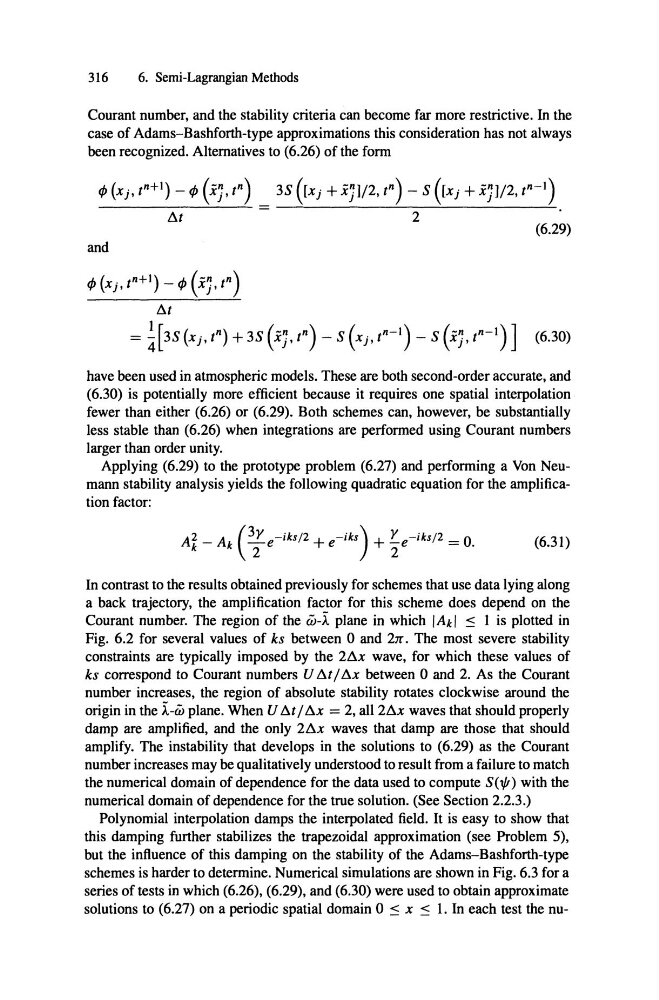
c/J (Xj, t n +
l ) - r/J (ij, t n )
M
and
3S ([x j + ijl/2, t n) - S ([X j + ijl/2, t n- I )
2
(6.29)
c/J (Xj, t
n
+
l ) - c/J (ij, t
n )
M
= H3S (Xj, t n) + 3S (ij, t n) - S (Xj ,tn-I) - S (ij, t n- I)] (6.30)
have been used in atmospheric models. These are both second-order accurate, and
(6.30) is potentially more efficient because it requires one spatial interpolation
fewer than either (6.26) or (6.29). Both schemes can, however, be substantially
less stable than (6.26) when integrations are performed using Courant numbers
larger than order unity.
Applying (6.29) to the prototype problem (6.27) and performing a Von Neumann stability analysis yields the following quadratic equation for the amplification factor:
(6.31)
In contrast to the results obtained previously for schemes that use data lying along
a back trajectory, the amplification factor for this scheme does depend on the
Courant number. The region of the iiJ-I plane in which IAkl 1 is plotted in
Fig. 6.2 for several values of ks between 0 and 2rr. The most severe stability
constraints are typically imposed by the 2Dox wave, for which these values of
ks correspond to Courant numbers UDot/ Dox between 0 and 2. As the Courant
number increases, the region of absolute stability rotates clockwise around the
origin in the I-iiJ plane. When UM / Sx = 2, all 2Dox waves that should properly
damp are amplified, and the only 2Dox waves that damp are those that should
amplify. The instability that develops in the solutions to (6.29) as the Courant
number increases may be qualitatively understood to result from a failure to match
the numerical domain of dependence for the data used to compute Set/!) with the
numerical domain of dependence for the true solution. (See Section 2.2.3.)
Polynomial interpolation damps the interpolated field. It is easy to show that
this damping further stabilizes the trapezoidal approximation (see Problem 5),
but the influence of this damping on the stability of the Adams-Bashforth-type
schemes is harder to determine . Numerical simulations are shown in Fig. 6.3 for a
solutions to (6.27) on a periodic spatial domain 0
x
1. In each test the nu-
6. Semi-Lagrangian Methods
Courant number, and the stability criteria can become far more restrictive. In the
case of Adams-Bashforth-type approximations this consideration has not always
been recognized. Alternatives to (6.26) of the form
c/J (Xj, t n +
l ) - r/J (ij, t n )
M
and
3S ([x j + ijl/2, t n) - S ([X j + ijl/2, t n- I )
2
(6.29)
c/J (Xj, t
n
+
l ) - c/J (ij, t
n )
M
= H3S (Xj, t n) + 3S (ij, t n) - S (Xj ,tn-I) - S (ij, t n- I)] (6.30)
have been used in atmospheric models. These are both second-order accurate, and
(6.30) is potentially more efficient because it requires one spatial interpolation
fewer than either (6.26) or (6.29). Both schemes can, however, be substantially
less stable than (6.26) when integrations are performed using Courant numbers
larger than order unity.
Applying (6.29) to the prototype problem (6.27) and performing a Von Neumann stability analysis yields the following quadratic equation for the amplification factor:
(6.31)
In contrast to the results obtained previously for schemes that use data lying along
a back trajectory, the amplification factor for this scheme does depend on the
Courant number. The region of the iiJ-I plane in which IAkl 1 is plotted in
Fig. 6.2 for several values of ks between 0 and 2rr. The most severe stability
constraints are typically imposed by the 2Dox wave, for which these values of
ks correspond to Courant numbers UDot/ Dox between 0 and 2. As the Courant
number increases, the region of absolute stability rotates clockwise around the
origin in the I-iiJ plane. When UM / Sx = 2, all 2Dox waves that should properly
damp are amplified, and the only 2Dox waves that damp are those that should
amplify. The instability that develops in the solutions to (6.29) as the Courant
number increases may be qualitatively understood to result from a failure to match
the numerical domain of dependence for the data used to compute Set/!) with the
numerical domain of dependence for the true solution. (See Section 2.2.3.)
Polynomial interpolation damps the interpolated field. It is easy to show that
this damping further stabilizes the trapezoidal approximation (see Problem 5),
but the influence of this damping on the stability of the Adams-Bashforth-type
schemes is harder to determine . Numerical simulations are shown in Fig. 6.3 for a
solutions to (6.27) on a periodic spatial domain 0
x
1. In each test the nu-