

314
6. Serni-LagrangianMethods
or the second-order Adams-Bashforth method
rP (x ' t n + l) - rP (x n t n)
J'
j'
= [3S (Xl! t n) _ S (x,!-I tn-I)]
l:i.t
2
J'
J '
.
(6.26)
The most stable and accurate of these schemes is the trapezoidal method, but it
mayaiso require more work per time step because it is implicit.
The fundamental stability properties of each scheme can be analyzed by applying them to the prototype problem
d1{l
dt
-
.
= IW1{l + >"1{1,
(6.27)
where w and >.. are real, 1{1 is complex, and the advecting velocity is constant, so
that
d
s
a
- = - + U - .
dt
Bt
ax
If 1{I(x, 0) = f(x), the solution to (6.27) is
1{I(x, t) = f(x - Ut)e(iW+A)I,
which is nonamplifying for >.. ::: O. This prototype problem is similar to that
considered in Section 3.4.2 except that (3.75) is a partial differential equation,
whereas (6.27) is an ordinary differential equation. In order to simplify the stability analysis, the errors generated during the interpolation of rP to xi and 2xi - x j
will be neglected, in which case our results describe the limiting behavior of a
family of serni-Lagrangian schemes that use increasingly accurate spatial interpolation.
First consider the case where the forcing is approximated with the trapezoidal
scheme. Following the standard Von Neumann stability analysis, the Fourier mode
A'keikjllx is substituted for rP(Xj, r") in the trapezoidal approximation to (6.27),
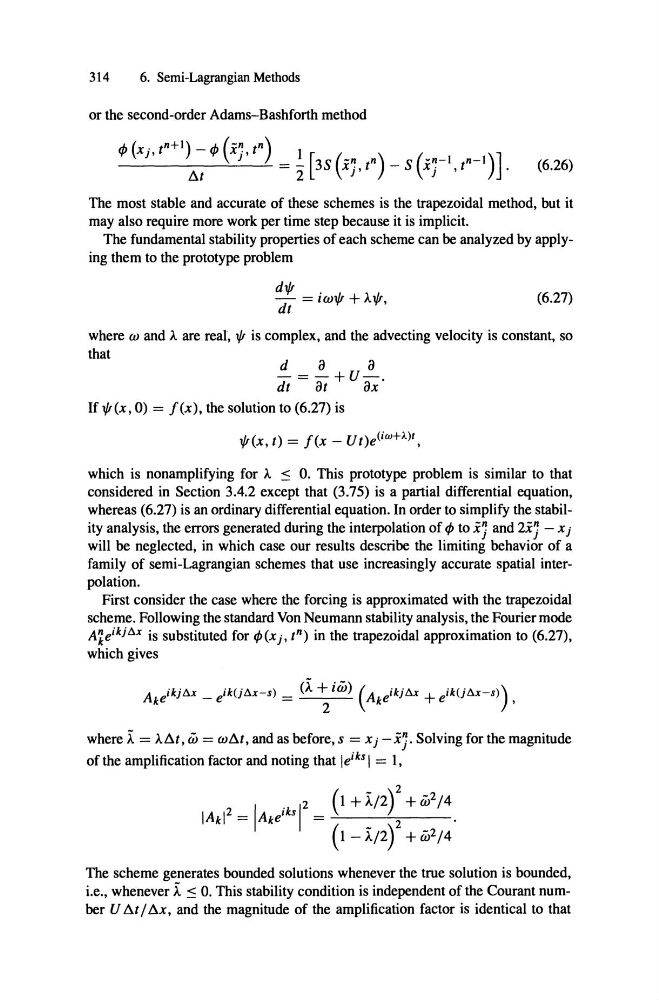
which gives
where X= >"l:i.t, iiJ = wl:i.t, and as before, s = xj - xi.Solving for the magnitude
of the amplification factor and noting that leiksI = I,
The scheme generates bounded solutions whenever the true solution is bounded,
i.e., whenever X::: O. This stability condition is independent of the Courant number U l:i.t / S», and the magnitude of the amplification factor is identical to that
6. Serni-LagrangianMethods
or the second-order Adams-Bashforth method
rP (x ' t n + l) - rP (x n t n)
J'
j'
= [3S (Xl! t n) _ S (x,!-I tn-I)]
l:i.t
2
J'
J '
.
(6.26)
The most stable and accurate of these schemes is the trapezoidal method, but it
mayaiso require more work per time step because it is implicit.
The fundamental stability properties of each scheme can be analyzed by applying them to the prototype problem
d1{l
dt
-
.
= IW1{l + >"1{1,
(6.27)
where w and >.. are real, 1{1 is complex, and the advecting velocity is constant, so
that
d
s
a
- = - + U - .
dt
Bt
ax
If 1{I(x, 0) = f(x), the solution to (6.27) is
1{I(x, t) = f(x - Ut)e(iW+A)I,
which is nonamplifying for >.. ::: O. This prototype problem is similar to that
considered in Section 3.4.2 except that (3.75) is a partial differential equation,
whereas (6.27) is an ordinary differential equation. In order to simplify the stability analysis, the errors generated during the interpolation of rP to xi and 2xi - x j
will be neglected, in which case our results describe the limiting behavior of a
family of serni-Lagrangian schemes that use increasingly accurate spatial interpolation.
First consider the case where the forcing is approximated with the trapezoidal
scheme. Following the standard Von Neumann stability analysis, the Fourier mode
A'keikjllx is substituted for rP(Xj, r") in the trapezoidal approximation to (6.27),
which gives
where X= >"l:i.t, iiJ = wl:i.t, and as before, s = xj - xi.Solving for the magnitude
of the amplification factor and noting that leiksI = I,
The scheme generates bounded solutions whenever the true solution is bounded,
i.e., whenever X::: O. This stability condition is independent of the Courant number U l:i.t / S», and the magnitude of the amplification factor is identical to that