

6. I The Scalar Advection Equation
305
t
,I
•
I,
UM
-+-+
++-_+ X
6.1
Xj_p_1
Xj_p
Xj
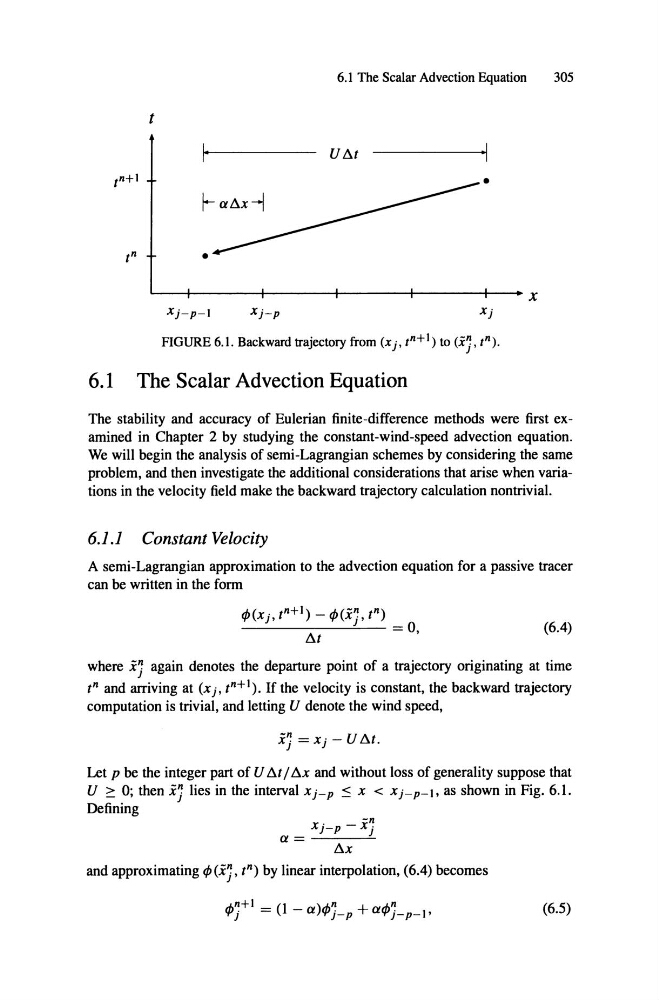
FIGURE 6.1. Backward trajectory from (x i - t n + I ) to (xi. tn).
The Scalar Advection Equation
The stability and accuracy of Eulerian finite-difference methods were first examined in Chapter 2 by studying the constant-wind-speed advection equation .
We will begin the analysis of semi-Lagrangian schemes by considering the same
problem, and then investigate the additional considerations that arise when variations in the velocity field make the backward trajectory caIculation nontrivial.
6.1.1 Constant Velocity
A serni-Lagrangian approximation to the advection equation for a passive tracer
can be written in the form
(6.4)
where xi again denotes the departure point of a trajectory originating at time
t" and arriving at (xl: t n +I). If the velocity is constant, the backward trajectory
computation is trivial, and letting U denote the wind speed,
xi = Xj - U l!..t.
Let p be the integer part of UM / l!..x and without lass of generality suppose that
U 2: 0; then xi lies in the interval Xj_p S x < Xj_p_l. as shown in Fig. 6.1.
Defining
- n
Xj_p - x j
l!..x
and approximating t/Jt
l = (l - a)t/Ji-p + at/Ji-p-I'
(6.5)
305
t
,I
•
I,
UM
-+-+
++-_+ X
6.1
Xj_p_1
Xj_p
Xj
FIGURE 6.1. Backward trajectory from (x i - t n + I ) to (xi. tn).
The Scalar Advection Equation
The stability and accuracy of Eulerian finite-difference methods were first examined in Chapter 2 by studying the constant-wind-speed advection equation .
We will begin the analysis of semi-Lagrangian schemes by considering the same
problem, and then investigate the additional considerations that arise when variations in the velocity field make the backward trajectory caIculation nontrivial.
6.1.1 Constant Velocity
A serni-Lagrangian approximation to the advection equation for a passive tracer
can be written in the form
(6.4)
where xi again denotes the departure point of a trajectory originating at time
t" and arriving at (xl: t n +I). If the velocity is constant, the backward trajectory
computation is trivial, and letting U denote the wind speed,
xi = Xj - U l!..t.
Let p be the integer part of UM / l!..x and without lass of generality suppose that
U 2: 0; then xi lies in the interval Xj_p S x < Xj_p_l. as shown in Fig. 6.1.
Defining
- n
Xj_p - x j
l!..x
and approximating t/Jt
l = (l - a)t/Ji-p + at/Ji-p-I'
(6.5)