

306
6. Semi-Lagrangian Methods
where tP' } = tP (x j, t
n ) . Note that if li.t is small enough that
li.t
0< U - < I
-
S» - ,
- - - = - - - - - - - - = - = O.
li.t
(6.6)
_ [(I - a)A.,! + aA.,! ]
(6.5) reduces to the formula for Eulerian upstream differencing.
Stability
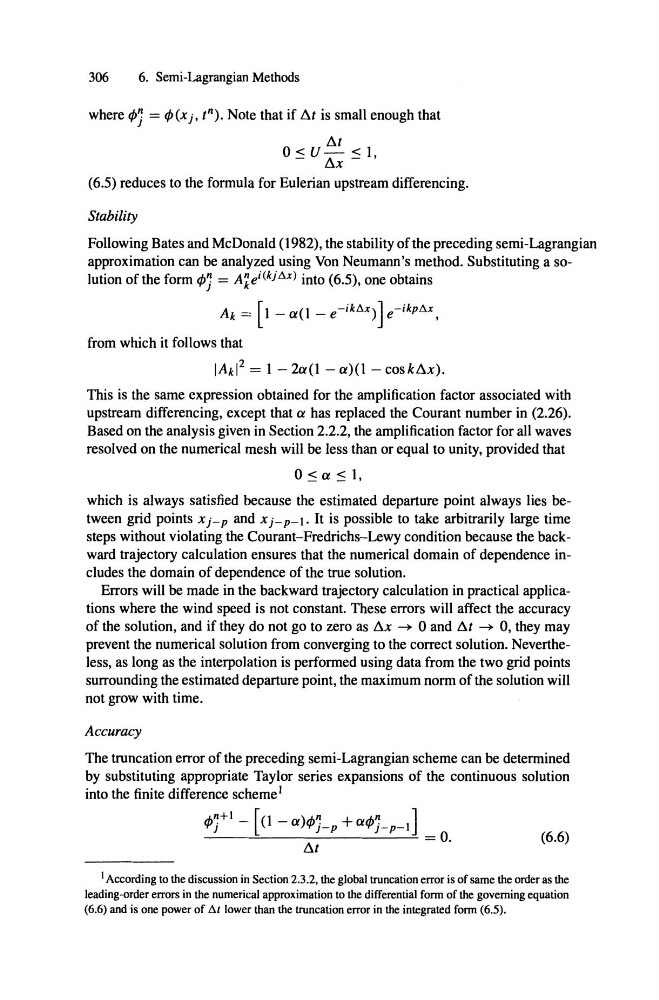
Following Bates and McDonald (1982) , the stability of the preceding semi-Lagrangian
approximation can be analyzed using Von Neumann's method. Substituting a solution ofthe form tP' } = A'kei(kjt.x) into (6.5), one obtains
Ak = [I - a(1 - e-ikt. X)] e- i kp/u ,
from which it follows that
lAd = I - 2a(1 - a)(1 - coskli.x).
This is the same expression obtained for the amplification factor associated with
upstream differencing, except that a has replaced the Courant number in (2.26).
Based on the analysis given in Section 2.2.2, the amplification factor for all waves
resolved on the numerical mesh will be less than or equal to unity, provided that
o s a s I,
which is always satisfied because the estimated departure point always lies between grid points x l : p and x l : p_l. It is possible to take arbitrarily large time
steps without violating the Courant-Fredrichs-Lewy condition because the backward trajectory calculation ensures that the numerical domain of dependence includes the domain of dependence of the true solution.
Errors will be made in the backward trajectory calculation in practical applications where the wind speed is not constant. These errors will affect the accuracy
of the solution, and if they do not go to zero as Sx
0 and li.t
0, they may
prevent the numerical solution from converging to the correct solution. Nevertheless, as long as the interpolation is performed using data from the two grid points
surrounding the estimated departure point, the maximum norm of the solution will
not grow with time .
Accuracy
The truncation error of the preceding semi-Lagrangian scheme can be determined
by substituting appropriate Taylor series expansions of the continuous solution
into the finite difference scherne!
IAccordingto the discussionin Section 2.3.2, the global truncationerror is of same the orderas the
leading-ordererrors in the numericalapproximationto the differential form of the govemingequation
(6.6) and is one power of Öl lower than the truncation error in the integratedform (6.5).
6. Semi-Lagrangian Methods
where tP' } = tP (x j, t
n ) . Note that if li.t is small enough that
li.t
0< U - < I
-
S» - ,
- - - = - - - - - - - - = - = O.
li.t
(6.6)
_ [(I - a)A.,! + aA.,! ]
(6.5) reduces to the formula for Eulerian upstream differencing.
Stability
Following Bates and McDonald (1982) , the stability of the preceding semi-Lagrangian
approximation can be analyzed using Von Neumann's method. Substituting a solution ofthe form tP' } = A'kei(kjt.x) into (6.5), one obtains
Ak = [I - a(1 - e-ikt. X)] e- i kp/u ,
from which it follows that
lAd = I - 2a(1 - a)(1 - coskli.x).
This is the same expression obtained for the amplification factor associated with
upstream differencing, except that a has replaced the Courant number in (2.26).
Based on the analysis given in Section 2.2.2, the amplification factor for all waves
resolved on the numerical mesh will be less than or equal to unity, provided that
o s a s I,
which is always satisfied because the estimated departure point always lies between grid points x l : p and x l : p_l. It is possible to take arbitrarily large time
steps without violating the Courant-Fredrichs-Lewy condition because the backward trajectory calculation ensures that the numerical domain of dependence includes the domain of dependence of the true solution.
Errors will be made in the backward trajectory calculation in practical applications where the wind speed is not constant. These errors will affect the accuracy
of the solution, and if they do not go to zero as Sx
0 and li.t
0, they may
prevent the numerical solution from converging to the correct solution. Nevertheless, as long as the interpolation is performed using data from the two grid points
surrounding the estimated departure point, the maximum norm of the solution will
not grow with time .
Accuracy
The truncation error of the preceding semi-Lagrangian scheme can be determined
by substituting appropriate Taylor series expansions of the continuous solution
into the finite difference scherne!
IAccordingto the discussionin Section 2.3.2, the global truncationerror is of same the orderas the
leading-ordererrors in the numericalapproximationto the differential form of the govemingequation
(6.6) and is one power of Öl lower than the truncation error in the integratedform (6.5).