

5.5 F1ux-Limiter Methods
265
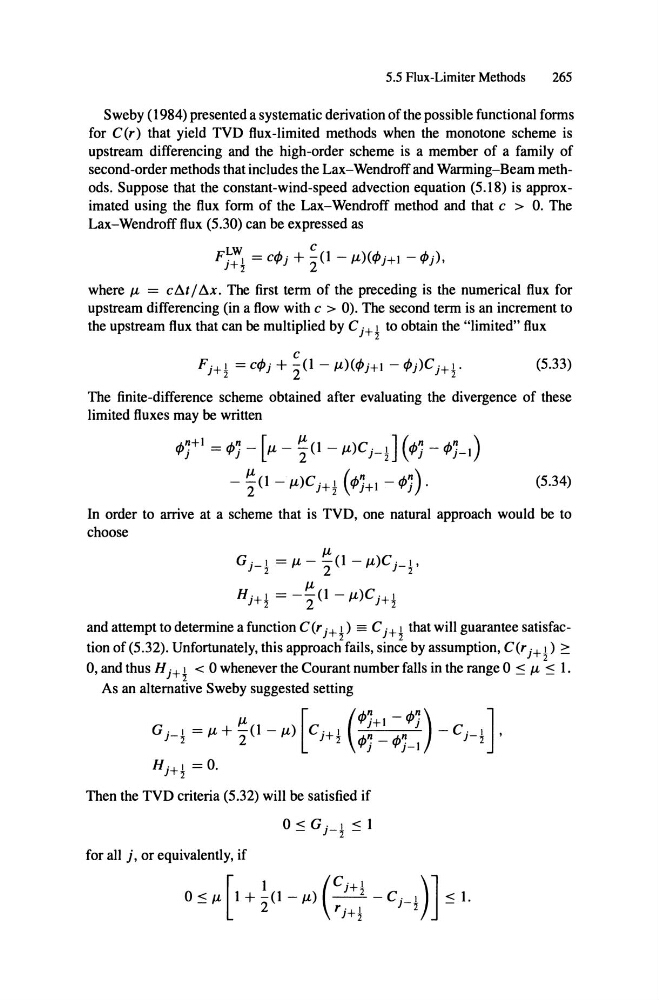
Sweby (1984) presented a systematic derivation ofthe possible functional forms
for C(r) that yield TVD flux-limited methods when the monotone scheme is
upstream differencing and the high-order scheme is a member of a family of
second-order methods that includes the Lax-Wendroff and Warming-Beam methods. Suppose that the constant-wind-speed advection equation (5.18) is approximated using the flux form of the Lax-Wendroff method and that c > O. The
Lax-Wendroff flux (5.30) can be expressed as
LW
c
Fj+! =ct/Jj+2(1-JL)(t/Jj+l-tPj),
where JL = cl:i.t/ S» . The first term of the preceding is the numerical flux for
upstream differencing (in a flow with c > 0). The second term is an increment to
the upstream flux that can be multiplied by Cj+! to obtain the "li mited" flux
(5.33)
The finite-difference scheme obtained after evaluating the divergence of these
limited fluxes may be written
tPj+l = tP' J - [JL -
- JL)Cj_!] (tP'J - tP'J-l)
(tP'J+l- tP'J) .
(5.34)
In order to arrive at a scheme that is TVD , one natural approach would be to
choose
G · I =
j - !
11
t'"
-
!!:.. 2 (1 - II)C · I
rj - ! '
Hj+!
JL
= -'2(1 - JL)Cj+!
and attempt to determine a function C (r j+!) == Cj+! that will guarantee satisfaction of (5.32). Unfortunately, this approach fails, since by assumption, C (r j+!)
0, and thus Hj+! < 0 whenever the Courant number falls in the range 0 S JL S I .
As an alternative Sweby suggested setting
G j_! = JL +
Hj+! = O.
- JL) [C j+!
- C j_!] ,
Then the TVD criteria (5.32) will be satisfied if
O
j - ! -
for all j, or equivalently, if
Os JL 1 + 2(1 -
1
JL) (Cj+1 rj+: - Cj_!
265
Sweby (1984) presented a systematic derivation ofthe possible functional forms
for C(r) that yield TVD flux-limited methods when the monotone scheme is
upstream differencing and the high-order scheme is a member of a family of
second-order methods that includes the Lax-Wendroff and Warming-Beam methods. Suppose that the constant-wind-speed advection equation (5.18) is approximated using the flux form of the Lax-Wendroff method and that c > O. The
Lax-Wendroff flux (5.30) can be expressed as
LW
c
Fj+! =ct/Jj+2(1-JL)(t/Jj+l-tPj),
where JL = cl:i.t/ S» . The first term of the preceding is the numerical flux for
upstream differencing (in a flow with c > 0). The second term is an increment to
the upstream flux that can be multiplied by Cj+! to obtain the "li mited" flux
(5.33)
The finite-difference scheme obtained after evaluating the divergence of these
limited fluxes may be written
tPj+l = tP' J - [JL -
- JL)Cj_!] (tP'J - tP'J-l)
(tP'J+l- tP'J) .
(5.34)
In order to arrive at a scheme that is TVD , one natural approach would be to
choose
G · I =
j - !
11
t'"
-
!!:.. 2 (1 - II)C · I
rj - ! '
Hj+!
JL
= -'2(1 - JL)Cj+!
and attempt to determine a function C (r j+!) == Cj+! that will guarantee satisfaction of (5.32). Unfortunately, this approach fails, since by assumption, C (r j+!)
0, and thus Hj+! < 0 whenever the Courant number falls in the range 0 S JL S I .
As an alternative Sweby suggested setting
G j_! = JL +
Hj+! = O.
- JL) [C j+!
- C j_!] ,
Then the TVD criteria (5.32) will be satisfied if
O
j - ! -
for all j, or equivalently, if
Os JL 1 + 2(1 -
1
JL) (Cj+1 rj+: - Cj_!