

264
5. Finite-Volume Methods
where F 1 and Fh denote the fluxes obtained using monotone and high-order
schemes, and C j+! is a multiplicative limiter. As in the FCT algorithm discussed
previously, the high-order flux is recovered when Cj+! = I, and the performance
of the scheme is highly dependent on the algorithm for specifying Cj+! .We again
demand thut Cj+!
0, but as will become evident, it is advantageous to allow
Cj+! to exceed unity. In scalar problems in which the phase speed of the disturbance is greater than zero,5 C j+! is calculated as a nonlinear function of the local
solution C (r j+!)' where
r'+1 =
rPj - rPj-1
J 2
rPj+1 - rPj
is the ratio of the slope of the solution across the cell interface upstream of j+!
to the slope of the solution across the interface at j +!. The parameter r j+! is
approximately unity where the numerical solution is smooth and is negative when
there is a local maximum or minimum immediately upstream of the cell interface
at j+!.
5.5.1 Ensuring That the Scheme Is 1VD
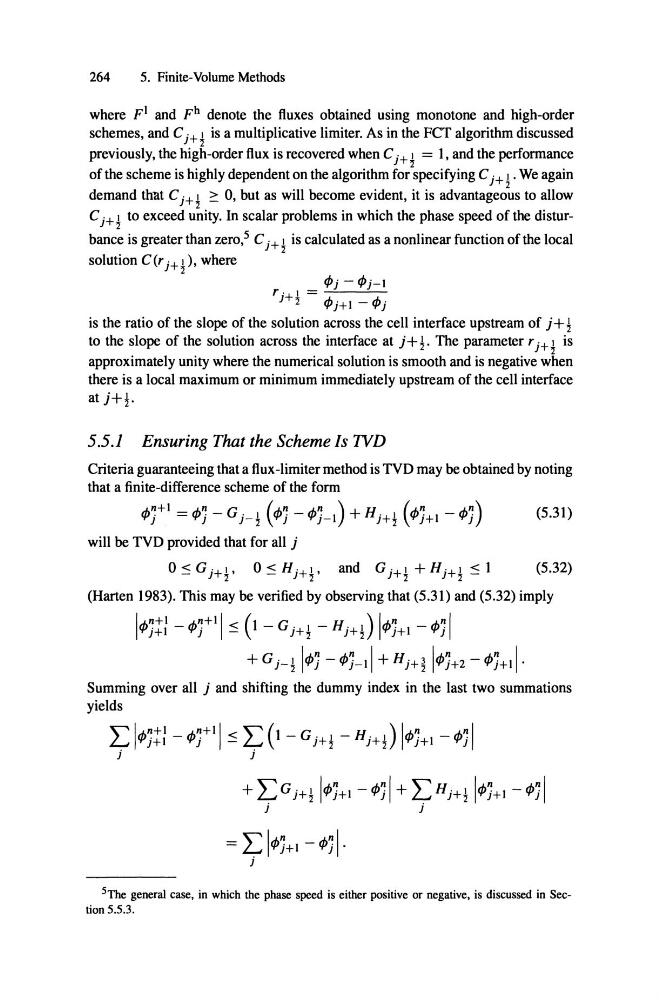
Criteria guaranteeing that a flux-limiter method is TVD may be obtained by noting
that a finite-difference scheme of the form
rP".+1 = rP". - G ·
J
J
J- 2
I (rP". - rP". I) + R'+1(rP".+1 - rP".)
J
JJ 2
J
J
(5.31)
j
will be TVD provided that for all j
0::: Gj+!' 0::: Rj+!' and Gj+! + Rj+! s 1
(5.32)
(Harten 1983). This may be verified by observing that (5.31) and (5.32) imply
ItlJjt: -rPrll::: (I-Gj+! -Rj+!) IrPj+1 -rPjl
+ G j_! IrPj - rPj_11 +
IrPj+2 - rPj+ll ·
Summing over all j and shifting the dummy index in the last two summations
yields
IrPjt: - rPj+ll s (1 - Gj+! - Rj+!) ItlJj+1 - rPj I
J
J
+ L G j+! IrPj+1 - rPj I+ L Rj+! ItlJj+1 - rPj I
j
j
= L IrP J+ 1- rPjl·
5The general case, in which the phase speed is either positive or negative, is discussed in Section 5.5.3.
5. Finite-Volume Methods
where F 1 and Fh denote the fluxes obtained using monotone and high-order
schemes, and C j+! is a multiplicative limiter. As in the FCT algorithm discussed
previously, the high-order flux is recovered when Cj+! = I, and the performance
of the scheme is highly dependent on the algorithm for specifying Cj+! .We again
demand thut Cj+!
0, but as will become evident, it is advantageous to allow
Cj+! to exceed unity. In scalar problems in which the phase speed of the disturbance is greater than zero,5 C j+! is calculated as a nonlinear function of the local
solution C (r j+!)' where
r'+1 =
rPj - rPj-1
J 2
rPj+1 - rPj
is the ratio of the slope of the solution across the cell interface upstream of j+!
to the slope of the solution across the interface at j +!. The parameter r j+! is
approximately unity where the numerical solution is smooth and is negative when
there is a local maximum or minimum immediately upstream of the cell interface
at j+!.
5.5.1 Ensuring That the Scheme Is 1VD
Criteria guaranteeing that a flux-limiter method is TVD may be obtained by noting
that a finite-difference scheme of the form
rP".+1 = rP". - G ·
J
J
J- 2
I (rP". - rP". I) + R'+1(rP".+1 - rP".)
J
JJ 2
J
J
(5.31)
j
will be TVD provided that for all j
0::: Gj+!' 0::: Rj+!' and Gj+! + Rj+! s 1
(5.32)
(Harten 1983). This may be verified by observing that (5.31) and (5.32) imply
ItlJjt: -rPrll::: (I-Gj+! -Rj+!) IrPj+1 -rPjl
+ G j_! IrPj - rPj_11 +
IrPj+2 - rPj+ll ·
Summing over all j and shifting the dummy index in the last two summations
yields
IrPjt: - rPj+ll s (1 - Gj+! - Rj+!) ItlJj+1 - rPj I
J
J
+ L G j+! IrPj+1 - rPj I+ L Rj+! ItlJj+1 - rPj I
j
j
= L IrP J+ 1- rPjl·
5The general case, in which the phase speed is either positive or negative, is discussed in Section 5.5.3.