

266
5. Finite-Volume Methods
(a)
C(r)
(b)
*"- ------.
I
I
I
" .' :.:
r
r
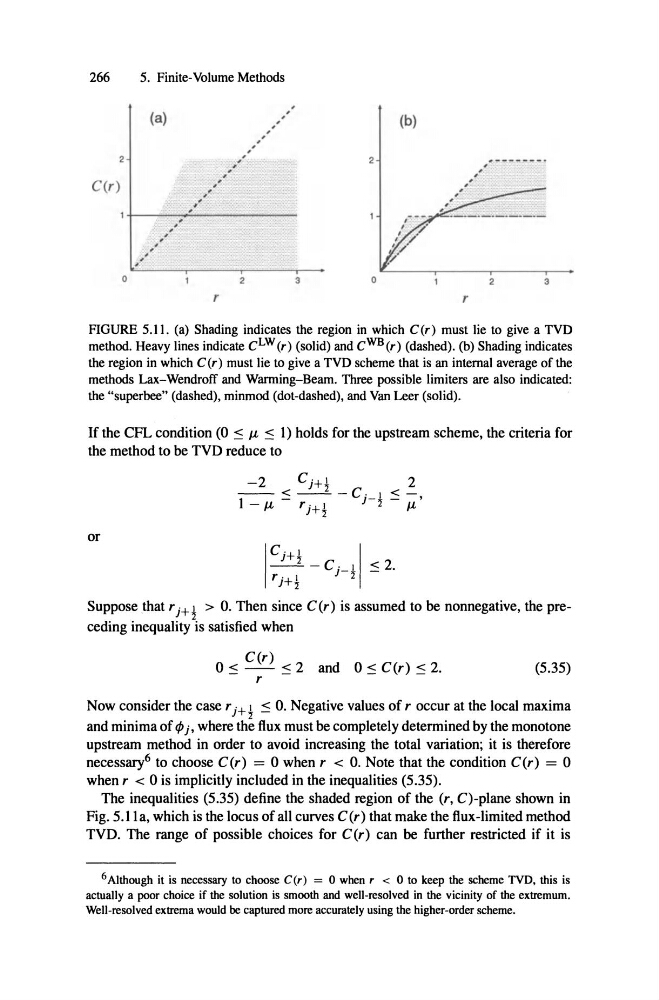
FIGURE 5.1 I. (a) Shading indicates the region in which C(r) must lie to give a TVD
method. Heavy lines indicate C LW (r) (solid) and CWB(r) (dashed) . (b) Shading indicates
the region in which C (r) must lie to give a TVD scheme that is an internal average of the
methods Lax-Wendroff and Warming-Beam. Three possible limiters are also indicated:
the "superbee" (dashed), minmod (dot-dashed), and Van Leer (solid).
If the CFL condition (0 ::; JL ::; 1) ho1ds for the upstream scheme , the criteria for
the method to be TVD reduce to
_ _ < _ _ 2 -C o 1 < -
-2
Cj+1
2
1-JL - rj+!
J-2 - JL'
or
Cj+! -Cj_11 ::;2.
I J
r 0+ 1
2
2
Suppose that r j+! > O. Then since C(r) is assumed to be nonnegative, the preceding inequality is satisfied when
0< C(r) < 2
-
r -
and 0::; C(r) ::; 2.
(5.35)
Now consider the case rj+! ::; O. Negative values of r occur at the 10ca1 maxima
and minima of rjJi - where the flux must be complete1ydetermined by the monotone
upstream method in order to avoid increasing the total variation; it is therefore
necessary'' to choose C(r) = 0 when r < O. Note that the condition C(r) = 0
when r < 0 is implicitly included in the inequalities (5.35).
The inequalities (5.35) define the shaded region of the (r, Cl-plane shown in
Fig. 5.11a, which is the locus of all curves C (r) that make the flux-limited method
TVD. The range of possible choices for C (r) can be further restricted if it is
6Although it is necessary to choose C(r) = 0 when r < 0 to keep the scheme TVD, this is
actually a poor choice if the solution is smooth and well-resolved in the vicinity of the extremum.
Well-resolved extrema would be captured more accurately using the higher-order scheme.
5. Finite-Volume Methods
(a)
C(r)
(b)
*"- ------.
I
I
I
" .' :.:
r
r
FIGURE 5.1 I. (a) Shading indicates the region in which C(r) must lie to give a TVD
method. Heavy lines indicate C LW (r) (solid) and CWB(r) (dashed) . (b) Shading indicates
the region in which C (r) must lie to give a TVD scheme that is an internal average of the
methods Lax-Wendroff and Warming-Beam. Three possible limiters are also indicated:
the "superbee" (dashed), minmod (dot-dashed), and Van Leer (solid).
If the CFL condition (0 ::; JL ::; 1) ho1ds for the upstream scheme , the criteria for
the method to be TVD reduce to
_ _ < _ _ 2 -C o 1 < -
-2
Cj+1
2
1-JL - rj+!
J-2 - JL'
or
Cj+! -Cj_11 ::;2.
I J
r 0+ 1
2
2
Suppose that r j+! > O. Then since C(r) is assumed to be nonnegative, the preceding inequality is satisfied when
0< C(r) < 2
-
r -
and 0::; C(r) ::; 2.
(5.35)
Now consider the case rj+! ::; O. Negative values of r occur at the 10ca1 maxima
and minima of rjJi - where the flux must be complete1ydetermined by the monotone
upstream method in order to avoid increasing the total variation; it is therefore
necessary'' to choose C(r) = 0 when r < O. Note that the condition C(r) = 0
when r < 0 is implicitly included in the inequalities (5.35).
The inequalities (5.35) define the shaded region of the (r, Cl-plane shown in
Fig. 5.11a, which is the locus of all curves C (r) that make the flux-limited method
TVD. The range of possible choices for C (r) can be further restricted if it is
6Although it is necessary to choose C(r) = 0 when r < 0 to keep the scheme TVD, this is
actually a poor choice if the solution is smooth and well-resolved in the vicinity of the extremum.
Well-resolved extrema would be captured more accurately using the higher-order scheme.