

12
1. Introduction
1.2.1 Hyperbolic Equations
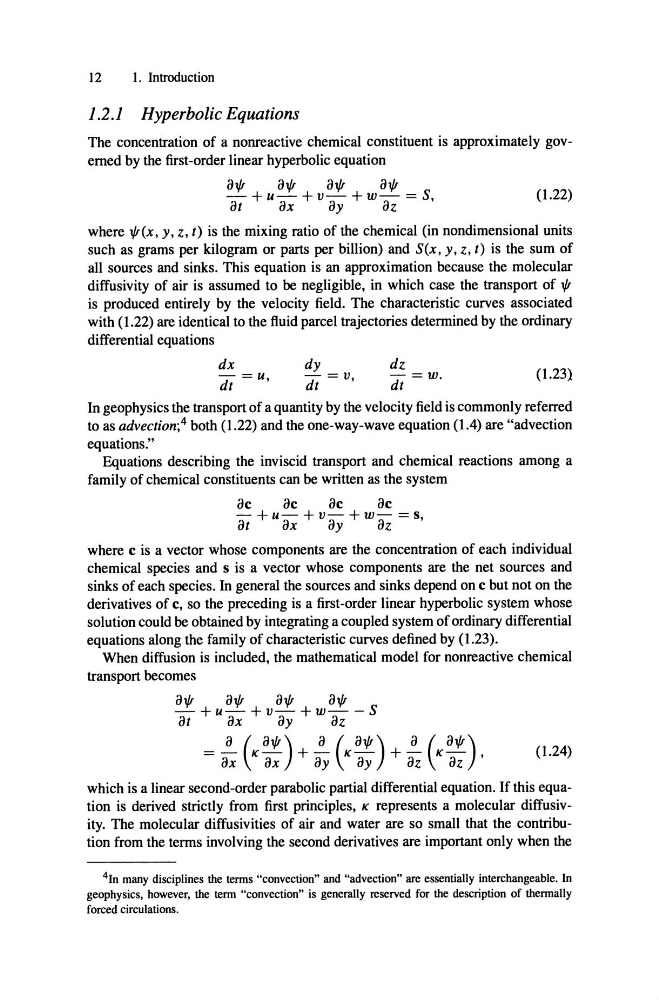
The concentration of a nonreactive chemical constituent is approximately governed by the first-order linear hyperbolic equation
-+U- +V-+W- = S,
a1/l
a1/l
a1/l
CJ1/I
at
CJx
ay
CJz
(1.22)
where 1/1 (x , y , z. t) is the mixing ratio of the chemical (in nondimensional units
such as grams per kilogram or parts per billion) and S(x , y , Z, t) is the sum of
all sources and sinks. This equation is an approximation because the molecular
diffusivity of air is assumed to be negligible, in which case the transport of 1/1
is produced entirely by the velocity field. The characteristic curves associated
with (1.22) are identical to the fluid parcel trajectories determined by the ordinary
differential equations
dx
- = u ,
dt
dy
- = v ,
dt
dz
-=W.
dt
(1.23)
In geophysics the transport of a quantity by the velocity field is commonly referred
to as advectionit both (1.22) and the one-way-wave equation (1.4) are "advection
equations."
Equations describing the inviscid transport and chemical reactions among a
family of chemical constituents can be written as the system
ae
ae
ae
ae
-
at
+u- +v- + Wax
ay
az
=s,
where e is a vector whose components are the concentration of each individual
chemical species and s is a vector whose components are the net sources and
sinks of each species. In general the sources and sinks depend on e but not on the
derivatives of c, so the preceding is a first-order linear hyperbolic system whose
solution could be obtained by integrating a coupled system of ordinary differential
equations along the family of characterist ic curves defined by (1.23).
When diffusion is included, the mathematical model for nonreactive chemical
transport becomes
a1/l + u a1/l + v a1/l + W a1/l _ S
at
ax
ay
az
= ax a (a1/l) Kfh + ay a (a1/l) Kay + az a ( K--a; a1/l) ,
(1.24)
which is a linear second-order parabolic partial differential equation. If this equation is derived strictly from first principles, K represents a molecular diffusivity. The molecular diffusivities of air and water are so small that the contribution from the terms involving the second derivatives are important only when the
4In many disciplines the tenns "convection" and "advection" are essentially interchangeable. In
geophysics, however, the tenn "convection" is generally reserved for the description of thennally
forced circulations.
1. Introduction
1.2.1 Hyperbolic Equations
The concentration of a nonreactive chemical constituent is approximately governed by the first-order linear hyperbolic equation
-+U- +V-+W- = S,
a1/l
a1/l
a1/l
CJ1/I
at
CJx
ay
CJz
(1.22)
where 1/1 (x , y , z. t) is the mixing ratio of the chemical (in nondimensional units
such as grams per kilogram or parts per billion) and S(x , y , Z, t) is the sum of
all sources and sinks. This equation is an approximation because the molecular
diffusivity of air is assumed to be negligible, in which case the transport of 1/1
is produced entirely by the velocity field. The characteristic curves associated
with (1.22) are identical to the fluid parcel trajectories determined by the ordinary
differential equations
dx
- = u ,
dt
dy
- = v ,
dt
dz
-=W.
dt
(1.23)
In geophysics the transport of a quantity by the velocity field is commonly referred
to as advectionit both (1.22) and the one-way-wave equation (1.4) are "advection
equations."
Equations describing the inviscid transport and chemical reactions among a
family of chemical constituents can be written as the system
ae
ae
ae
ae
-
at
+u- +v- + Wax
ay
az
=s,
where e is a vector whose components are the concentration of each individual
chemical species and s is a vector whose components are the net sources and
sinks of each species. In general the sources and sinks depend on e but not on the
derivatives of c, so the preceding is a first-order linear hyperbolic system whose
solution could be obtained by integrating a coupled system of ordinary differential
equations along the family of characterist ic curves defined by (1.23).
When diffusion is included, the mathematical model for nonreactive chemical
transport becomes
a1/l + u a1/l + v a1/l + W a1/l _ S
at
ax
ay
az
= ax a (a1/l) Kfh + ay a (a1/l) Kay + az a ( K--a; a1/l) ,
(1.24)
which is a linear second-order parabolic partial differential equation. If this equation is derived strictly from first principles, K represents a molecular diffusivity. The molecular diffusivities of air and water are so small that the contribution from the terms involving the second derivatives are important only when the
4In many disciplines the tenns "convection" and "advection" are essentially interchangeable. In
geophysics, however, the tenn "convection" is generally reserved for the description of thennally
forced circulations.